Showing posts with label stars. Show all posts

Thursday, January 28, 2016

Winter Hexagon Star Color Comparison

The Winter Hexagon or Winter Circle is an asterism (not an official constellation) that takes up a huge portion of the southern sky in winter with some of the brightest stars (including the brightest Sirius). You really can't miss it! As the hexagon moves across the sky through the season, it becomes the Spring Arch setting in the west at dusk.

Did you know the human eye can detect the temperature of stars? Amazing! We know that cool stars radiate and emit energy in the red and infrared regions of the electromagnetic spectrum and so they appear red or orange. Likewise, hot stars appear white or blue because they radiate their energy in the blue and ultra-violet wavelengths.

Using the same technique from a previous color comparison, I wanated to look at the entire Winter Hexagon. I also used the same exposure settings to keep everything constant, so the difference in brightness is also relative to the star's perceived brightness to us (Sirius is clearly the brightest). This makes it a little harder to determine color, because some of the stars are dimmer, but it's clear at least that there is a variety of color out there in this popular region of the sky.

I arranged them in this composite photo to show their position in the hexagon. It looks like a jewel box of beautiful colored orbs or marbles. This was fun and easy to put together. I feel like trying it again with different exposures to hold the brightness constant and then trying to organize them from coolest to hottest. Do you think you could? Which one looks the most blue?

winter hexagon star colors
Composite out of focus stars from the Winter Hexagon in their relative positions, all taken at 300mm, f/5.6, 1 sec, ISO 200
winter circle star colors
Winter Circle star colors with labels

It looks like last time I used ISO 800 and 1.3 sec exposures, which would have blown out Sirius for comparison but made Rigel brighter blue so it's easier to see. I bet if I looked at the histogram instead and just focused on getting that centered for each star I could get a good color comparison while holding brightness constant (or at least not washing anything out to pure white).

Tuesday, May 13, 2014

How to Locate HD 162826 "Sun Sibling" in Hercules

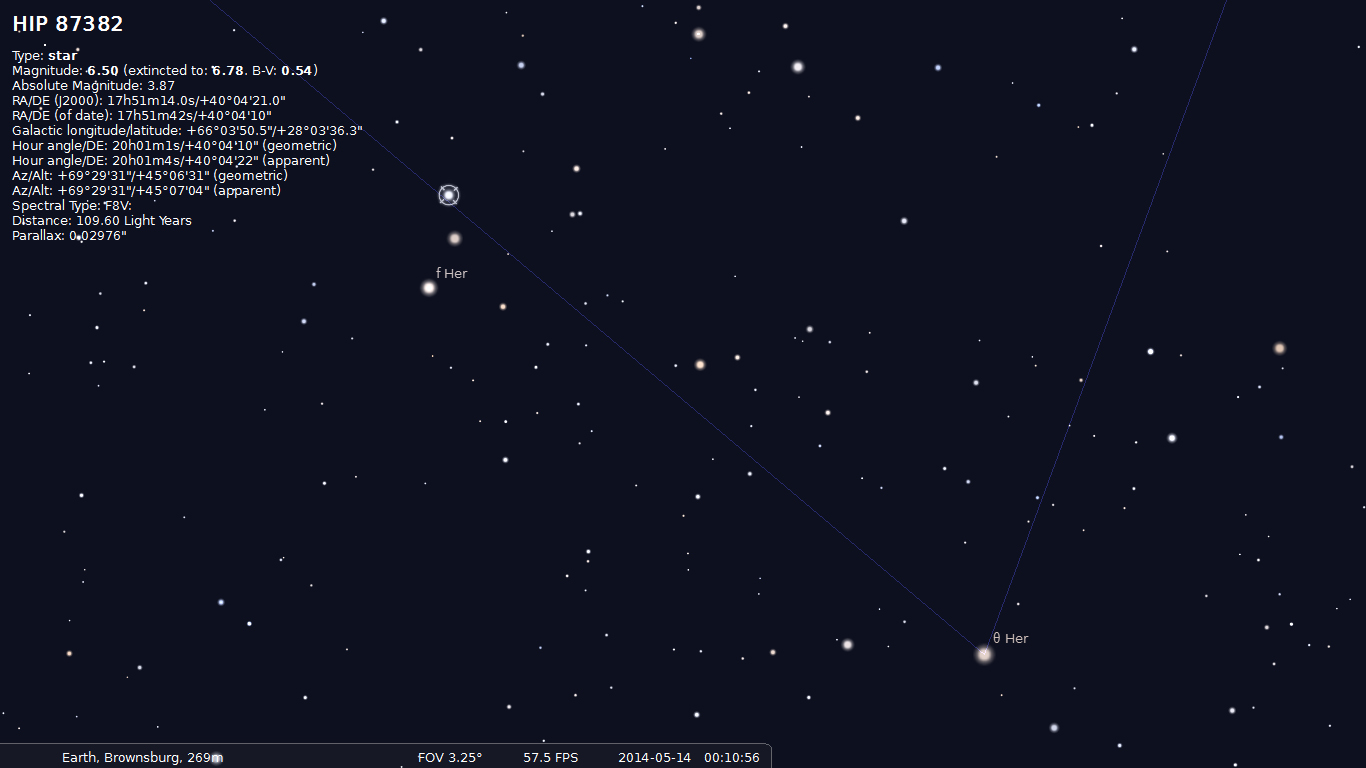
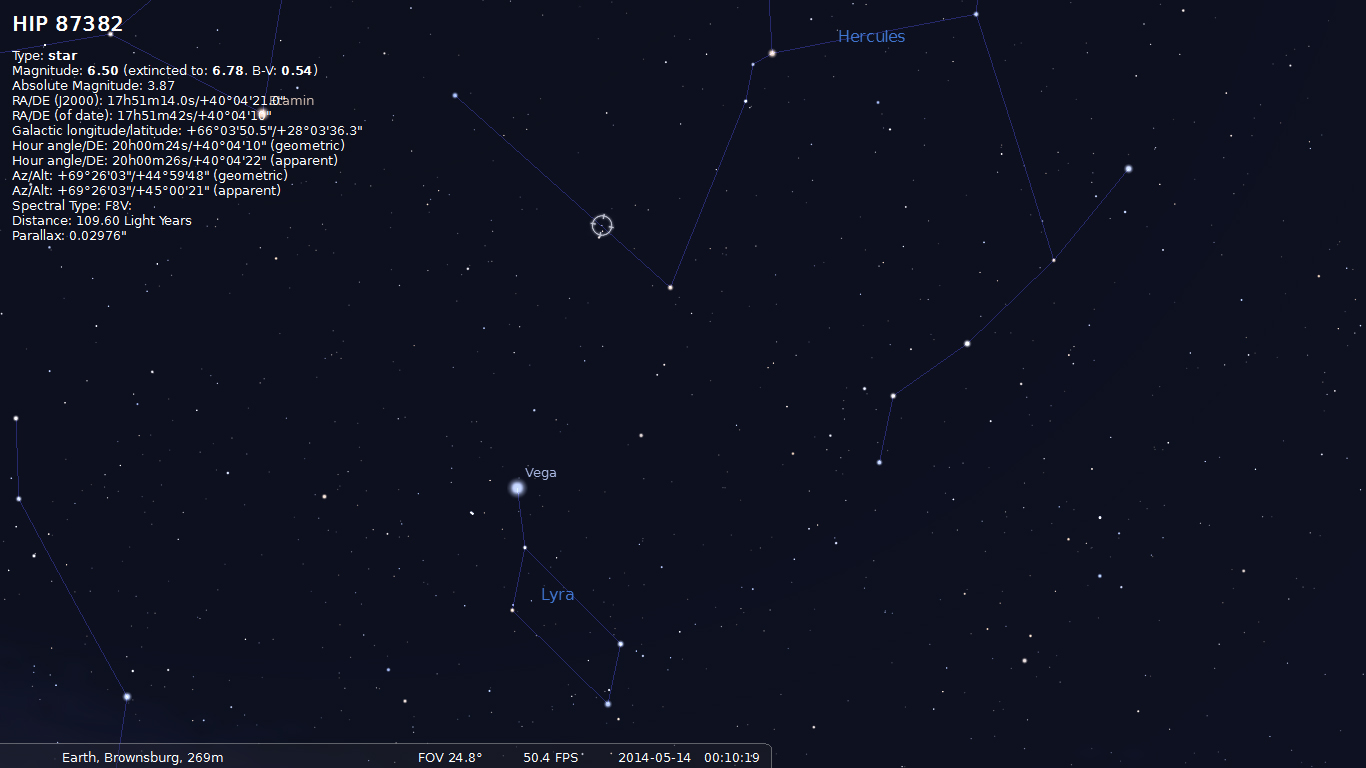
You might have seen recent news items about the Sun's sibling star or "sister star" identified as HD 162826 in the constellation Hercules. If you try to locate this star in Stellarium or other star charts, it might not immediately appear because this star goes by many other names.

According to Wikipedia, other designations include 2MASS J17511402+4004208 , GSC 03093-01946 , TYC 3093-1946-1, BD+40 3225 , HD 162826 , HIP 87382 , HR 6669 , SAO 47009.

In Stellarium, the star is labeled HIP 87382 from the Hipparcos Catalogue.

Locate HD 162826 sub sibling
Location of HD 162826, aka HIP 87382, relative to Vega (Screenshot: Stellarium)
find HD 162826 sub sibling
Location of HD 162826 in Hercules (Screenshot: Stellarium)

Wednesday, April 23, 2014

Bottle of Wine and Wine Glass with Night Sky and Stars in Background

What a relaxing night over the weekend! I took these photos of a bottle of wine with a wine glass and the night sky full of stars (and the planet Jupiter) in the background. I'm so glad Spring is here, and warm summer nights are not far away!

Ok, you got me, I used a super descriptive headline for the blog post in case people are looking for a photo of a wine bottle with stars in the background.

Bottle of Wine and Wine Glass with Night Sky and Stars
f/8, 8 sec, ISO 1600, 18mm

wine bottle and wine glass in front of stars background
f/4, 4 sec, ISO 1600, 18mm

night wine glass and bottle with stars
f/4, 4 sec, ISO 800, 18mm

How about I top off this pseudo-product-astrophotography photo set with a CamelBak star trail portrait! I got tired of the same old balcony railing so at least these objects in the foreground make it a little more interesting.

camelbak bottle with star trails
Stack of 673 images each at 15 sec, f/11, ISO 1600, 22mm

Sunday, April 6, 2014

Double Star Iota Cancri with 300mm DSLR Lens

You don't always need a telescope to split double stars. Zooming in with a 300mm telephoto lens is enough for me to resolve separations of about 28" (arcseconds), so with a separation of about 30" Iota Cancri was within range.

The double star is in the upper left arm of Cancer, and although Cancer is itself a fairly dim constellation, this makes it an easy target to spot. The two stars are supposed to appear yellow and blue/white in a scope, but in my camera they came out more red and blue.

iota cancri double star with 300mm lens
Composite image: Background stack of 29 subs, 85 dark, 78 bias at ISO 3200, 300mm, 1.3 sec, f/5.6
Insert single frame at ISO 3200, 300mm, 1.3 sec, f/5.6

I used the same stacked-background single frame insert technique that I used on 8 Lacertae and I'm pleased with the results again!

Thursday, November 7, 2013

Color Comparison: Betelgeuse, Aldebaran, and Rigel

I took blurry photos of some popular stars to spread their light over more pixels to give a better representation of their color. Hotter stars are white and blue, while cooler stars are red, orange, and yellow. I looked up the surface temperatures of each on Wikipedia. Obviously the image is a composite since these stars aren't right next to each other in the sky. I used the same camera settings for each, so Aldebaran is slightly dimmer.

Color Comparison: Betelgeuse, Aldebaran, and Rigel
300mm, intentionally out of focus, enlarged in Photoshop
Rigel is my favorite star by the way! Comparing the color of Betelgeuse and Rigel was the subject of one of my very first blog posts: Orion constellation with star labels with my point and shoot camera back in 2012.

November Morning Sky ft. Orion and the Seven Sisters

I woke up to take the dog out at 5:00am this morning, and saw that the sky was clear. Sirius and Jupiter were blazing in the crisp, alarmingly cool air. It's been raining for the past few days, so I was super excited to get outside and get some photos.

I started on the balcony with a wide angle shot of the Orion neighborhood (from Sirius to the Pleiades). I tried a bunch of different settings to see if I could stumble upon something cool, or find a way to increase the number of stars without adding to the light pollution. Here's the final result...

orion night sky 18mm
Final result with adjustments in Adobe Camera RAW
Below is the same photo pre-adjustments in Adobe Camera RAW. Notice the prevalence of sky glow and washed out stars. At least the stars were sharp, unlike the shot I took with the aperture wide open.Check out the results from a variety of settings...

orion and night sky f/4.5
Same photo as above, f/4.5, 15 sec, ISO 800, 18mm unprocessed


adobe camera raw remove sky glow
Screen shot of Adobe Camera RAW (check the settings on the right if you want to do something similar)

night sky f/3.5
Trying the same scene with different settings, f/3.5, 15 sec, ISO 800, 18mm (wide open aperture isn't as sharp)

stars f-stop f/11
Trying the same scene with different settings, f/11, 15 sec, ISO 1600, 18mm (very sharp but not much light coming in)

Sunday, September 15, 2013

Omicron-1 Cygni and More Double Stars from the September Observing List

This month's Indiana Astronomical Society Novice/Urban Observing List is more difficult than last month. It includes a lot of double and multiple stars that I just can't resolve with my camera lens alone. I'm going to have to get better with my scope to find some separation in these stars.

I was able to pick a few off the list, however! I should also be able to get the Messier objects (maybe a second attempt at M15 since I already have that one from earlier). I photographed Gamma Delphini and Beta Cephei but couldn't find separation - they just looked like regular stars. I don't think that counts, so I'm going to wait and try to get photos through my scope.

Omicron-1 Cygni, Triple Star in Cygnus
Omicron-1 Cygni, Triple Star in Cygnus (a triple in a double)

61 Cygni, Double Star in Cygnus

Alpha-1/2 Capricorni, “Algiedi”, Multiple Star in Capricornis

Thursday, August 29, 2013

Homemade Star Charts for Abstract Summer Constellations

Summer brings an interesting combination of constellations to the prime evening sky. There are a number of gigantic constellations (Pegasus, Aquarius, Virgo), and a bunch of super tiny abstract constellations. Pictured below, I was able to capture 5 constellations in the same field of view using my 18mm lens. The photo was taken from a set of star trail images earlier this month.

Summer Constellations
Tiny and obscure summer constellations

This photo shows Equuleus (little horse), Delphinus (the dolphin), Sagitta (arrow), Vulpecula (little fox), Aquila (the eagle), and Lyra (the lyre, or small harp). How does two dots make a little fox? And how cool is the word Vulpecula? And how much does Aquila look like a pterodactyl?

If you want to see what constellations are visible this month, check out What's Out Tonight? (www.whatsouttonight.com) for a free star chart.

Saturday, August 24, 2013

Nova Delphini 2013 (N Del 2013) August 21, 2013

In spite of the nearly full moon, I was able to spot Nova Delphini 2013 with my Canon Rebel XT and 300mm lens. The new nova (redundant?) isn't blowing apart like a supernova, but stealing enough gas from its neighbor to temporarily flare up much brighter than normal (10,000x brighter in a matter of days). The star itself is a white dwarf normally too faint to see with even some pretty hefty equipment (approximately +17 magnitude). I took a series of images and stacked them for a total exposure time of about 1 minute.

nova delphini 2013
Stack of 79 light frames 1.3 sec each, 300mm, f/5.6, ISO 1600 (30 dark, 20 bias)
Judging by the known magnitude of nearby stars, I'd estimate it at about +5.6 (but then again I've never estimated the magnitude of a nova before).

I used a chart from the American Association of Variable Star Observers (AAVSO) to identify the magnitudes of several other stars in my image, then tried to place N Del 2013 on a spectrum between them. This process is described in more detail here.

As it so happens, my guess of 5.6 plots perfectly on the AAVSO light curve for N Del 2013. Indiana time is 4 hours behind UTC, and I took my photos at 10:30pm on August 21 - so that puts me smack dab in the middle of the green dots just after midnight UTC on August 22.

nova delphini 2013 light curve graph
Light curve for N Del 2013, data from www.aavso.org
My observation (red circle) added in Photoshop
n del 2013 with delphinus
A wider shot of Nova Delphini 2013 showing location relative to Delphinus
21 subs, 19 darks each at 75mm, f/4.5, 4 sec, ISO 1600
Check out the light pollution from the moon in this last image! On my camera's LCD screen I could barely make out Delphinus, but I'm glad it showed up in my image.

Tuesday, August 13, 2013

Epsilon Lyrae, “The Double Double” Quadruple Star in Lyra

You can clearly see separation between the double stars, but unfortunately you can't see the quadruple star under this magnification. I did, however, catch another double star (Zeta Lyrae) in the same frame. Lyra is jam-packed with double stars!

Epsilon Lyrae
Single frame at ISO 1600, 1 sec, 300mm, f/5.6

Thursday, August 8, 2013

Double Star Bonanza!

Checking more off my list for the Indiana Astronomical Society Novice/Urban Observing List for August 2013. I'm tagging all my posts with those objects: #novice8/13 and I need to get a total of 6 in order to get a certificate!

The only double stars I've seen before these were Mizar and Alcor in the Big Dipper. I was surprised that I could see any division between the stars at all! The stars are a little out of focus, and obviously wouldn't be that close together or that spherical-looking under higher magnification.

albireo double star 300mm
Canon Rebel XT: ISO 1600, f/5.6, 300mm, 1.3 sec

beta lyrae double star 300mm
Canon Rebel XT: ISO 1600, f/5.6, 300mm, 1.3 sec

Saturday, August 3, 2013

M11 Wild Duck Cluster

I had never heard of the Wild Duck Cluster until the Indiana Astronomical Society posted a novice/urban observing list for August 2013.*  I figured I could give it a try, it was listed as a Mag 5.8 and I've seen other clusters around that magnitude with my DSLR.

It was pretty easy to find, following the tail of Aquila down to Scutum. It's also larger than other recent Messier objects (like the tiny blob M53), so the final result is a little more impressive.

m11 wild duck cluster
84 subs, 35 darks, 35 bias (1/4000s), each at ISO 1600, 300mm, f/5.6, 1.3 sec
"The Wild Duck Cluster is one of the richest and most compact of the known open clusters, containing about 2900 stars. Its age has been estimated to about 220 million years. Its name derives from the brighter stars forming a triangle which could represent a flying flock of ducks." (Wikipedia)

Friday, August 2, 2013

Mistaken identity: ν Cyg

I was attempting to star hop to Sadr in the heart of Cygnus the swan when I accidentally captured 58 light frames of the very boring ν Cyg. Sadr would have been a great anchor point to try to image open cluster M29 (my original goal). As it turns out, I was in the right neighborhood but on the wrong block. Maybe next time! In any case, I have a pretty stellar image of ν Cyg if anyone is looking for it!

58 subs, 35 darks, 35 bias (1/4000s), each at ISO 1600, 300mm, f/5.6, 1.3 sec

ν Cyg
That's not the star I wanted! Somebody should label them!

ν Cyg
View of Î½ Cyg in Stellarium with my intended target (Sadr) to the top right.

Sunday, July 28, 2013

Neptune in Aquarius

My first ever shot of Neptune! Neptune was the first planet found by mathematical prediction rather than by empirical observation, and wasn't directly observed until 1846! Took these photos last night at around 5:30am ET over the western horizon.

aquarius constellation with star labels
35 subs, 12 darks, 12 bias frames each at ISO 1600, 35mm, 8 sec, f/4.5

neptune canon rebel xt
Cropped from 35mm image above

The "Coathanger" and Northern Cross Asterisms

I saw a post from Astro Bob about The "Coathanger" asterism, and I immediately went back to check my Northern Cross photos to see if they included this fun little group of stars. Indeed they did! Here is a Northern Cross photo I made last night at about 5:30am ET.

Update: Take a closer look at the Coathanger Asterism

northern cross with star labels
34 subs, 12 darks, 25 bias frames each at 28mm, ISO 1600, f/4.5, 13 sec

Friday, July 26, 2013

Star Trails with a Dead Tree in a Corn Field

I've been wanting to shoot this dead tree since I moved in. It's about 100 feet off the side of a 5 lane highway. Now that the corn is tall enough, the tree sits in sort of a horseshoe-shaped clearing that blocks most of the headlights from traffic, and also lets me hide from passing cars.

The tree sits far enough back that I felt comfortable leaving both my cameras out there for about an hour and a half. Unfortunately clouds rolled in after about an hour. This scene is definitely the next step in my star trail development because it has actual subject matter! I'll definitely be back for more.

dead tree star trails

dead tree star trails

dead tree and night sky

dead tree and night sky


Sunday, July 14, 2013

Coma Berenices with Star Labels over Indiana

This is my first attempt at stacking star fields using Deep Sky Stacker since moving to the Indianapolis suburbs. It's been a while since I tried stacking faint objects like this, and I have a host of new targets in the summer sky. Facing west off my balcony, I tried to locate a clump of objects below Coma Berenices because it looked like a fairly busy piece of sky (and there is light pollution to the south blocking my views of the Milky Way and all its jewels).

I stacked 67 light frames and 18 dark frames, and uploaded the results to nova.astrometry.net to help me label and identify interesting objects (green), then I identified the objects that were too faint for the system to pick up (white).

Coma Berenices
Each sub (light frame) was taken at 75mm, f/4.5, 4 sec, ISO 1600
Since this was only zoomed in to 75mm, I'll have to try again to take designated shots of M64 and M100. I don't think I can check them off my Messier object checklist until I get a little more detail. It looks promising that I can even make out a faint blob at 75mm with only 67 subs!

Saturday, May 18, 2013

Milky Way Over Slippery Elm Trail, Don't Take Mediocre Dark Skies for Granted

I got a job at Indiana University-Purdue University Indianapolis (IUPUI) so I'll be moving to the Indianapolis area in just a few weeks. Because of this, I decided to try my hand at some Milky Way shots to take advantage of my rather rural location here in Bowling Green. I'd hate to get to Indy only to realize I was sitting under halfway decent skies all these years and wasted them. 

I've been waiting for the bright part of the Milky Way to return to the late evening sky later this summer, but I decided not to wait any longer and had to go out at 3:30am to catch the Milky Way high enough above the horizon. By the time the Milky Way is high around 11pm, I'll already be in Indy!

I took the dog out at 3:00am on May 16 and saw a fairly clear sky with some storms about 10-20 miles to the South. I figured there's no time like the present, grabbed my camera, and headed to the Slippery Elm Trail. I know the trail is closed at dark, but I figured I'd risk it since I've never seen anyone patrolling the path.

milky way over ohio
Stack of 10 subs, 5 darks, each at 15 sec, f/4.5, ISO 1600, 18mm

milky way over ohio
Single frame at 15 sec, f/4.5, ISO 1600, 18mm, processed in Photoshop CS5

milky way image processing
The above image, before and after image processing

scorpius constellation label
A fun piece of summer sky! Single frame color corrected in Photoshop

milky way in summer triangle
Stack of 7 subs, 5 darks, each at 15 sec, f/4.5, ISO 1600, 18mm

I got some pretty good results even with just a few subs stacked in Deep Sky Stacker (DSS). I only took 29 shots (15 seconds each) during my entire session because it was so late, I forgot a head lamp, and because I heard a creepy noise in the bushes next to me. Here is the story I told to my friends on our e-mail chain about my experience:

Last night, at 3:30am, I woke up to take the dog out. The night sky was clear overhead, with some very low clouds to the south producing flashes of lightning but no audible thunder. I looked at several weather apps and decided to seize the moment to take some night sky photos. Since I'll be moving to Indy, I don't want to take for granted the fact that I currently live about 5 minutes drive from some decently dark skies.

I slowly drove through the trailer park behind Walmart and parked as far down as I could along the Slippery Elm Trail. I quietly removed my camera bag and tripod from the back seat and shuffled down the trail beyond the reach of trailer park street lights. Under the highway overpass, I heard my footsteps echo as my pace quickened. I reached a suitable area and looked up to see what looked like a pale swath of clouds arching from the south horizon through the Summer Triangle - it was the Milky Way!

After shooting a few dozen photos, and struggling to find focus with no moon as a point of reference, I heard an unexpected noise about 100 yards in the brush to the southeast of my location. It was a short loud "WOO!" almost identical to the high pitched "woo!" sample in the 1988 smash hit "It Takes Two" by Rob Base and DJ E-Z Rock (http://youtu.be/vsxsyZqmmlQ)

It was loud enough to echo off the mound of the elevated highway overpass, but I didn't think much of it. It could have been a whistle or a wild turkey or a meth-head yelling "woo!" - so I continued shooting. 5 minutes later I heard it again much closer... "WOO!" At 4:00am in the middle of a field surrounded by young pine trees and honeysuckle, what could be making that noise? I froze to listen, and heard interval twigs snapping through tall grass under what could have been footsteps. I pictured an elk charging out of the brush, or a meth zombie eating my face and stealing my camera. Then I realized, it could also be the Ohio grassman sneaking up to see what I was doing out there in the darkness all alone. My eyes watered. I grabbed my camera bag without closing it and didn't wait to fold up my tripod before making an awkward speedwalk getaway toward my car. It was the kind of speedwalk you make after a 3 hour breakfast at Harris, except carrying an open camera bag and looking over your shoulder.

Did I have an encounter with the Ohio grassman? Ooooh probably not. But even though I had a camera on a tripod ready to go, I wasn't going to wait around to find out.

The end.

Monday, April 22, 2013

Lyrid Meteor Recap: 2 Sightings but Nothing in the Can

Last night I woke up at 2:30am to take the dog out. I planned ahead for the Lyrid Meteor Shower by setting my tripod and camera out before going to bed, and making sure my batteries were charged up. 

I read that the Lyrid shower isn't typically as dramatic as other meteor showers, however I figured it was worth a peek since I was up and it was clear. 

When I took my dog out, I did a quick scan of the darkest part of the sky and immediately saw a meteor streak from East to West (facing South). The 83% moon was still peeking over the top of the apartment building and producing a lot of sky glow. After picking up Katie's poops I went back in side, optimistic that the meteor shower would be as prolific as the Geminids this past winter. 

Rebel XT: 18mm, 20 sec, ISO 1600, f/4.5

Rebel XT: 18mm, 20 sec, ISO 1600, f/4.5

PowerShot A3100 IS: 6.2mm, 15 sec, ISO 1600, f/2.7

Rebel XT: 18mm, 20 sec, ISO 1600, f/4.5
While my cameras were running, I spotted one more meteor in the general area where I thought it would make it into frame - alas, either it was just out of frame or it was too brief to show up on the sensor. Visually, I was able to observe 2 pretty good Lyrid meteors, but I was left with nothing on "film" a.k.a. nothing in the can. 

While I was out, I did become more familiar with the late spring sky, which will soon become the early summer sky. I spotted Hercules, and of course the Summer Triangle. I also took a picture of Arcturus, Spica, and Saturn in a triangle next to the glow of the moon just behind the apartments. 

Wednesday, April 3, 2013

Shooting star in the Big Dipper April 2, 2013

What is THIS? While I was shooting at Slippery Elm Trail last night, I set up my point and shoot to take some photos to stack into star trails later. I had 83 frames total, and I didn't see this object until I got home to upload my photos.

At first I thought it was an iridium flare, but it's not listed in the heavens-above.com predictions for my area. Plus, it looks like there are a total of 3 streaks of light simultaneously. My guess would be it's a meteor split into one big chunk and two little ones!

Update 4/8/2013: After further analysis, and some expert eyes over at Reddit, it has been determined that the 3 lights in the sky were, in fact, a trio of Naval Ocean Surveillance System (NOSS) satellites. I had no idea satellites flew in formation, and flew this close together! It still looks odd though - still more like an iridium flare than the slow crawl of the NOSS formation.

shooting star meteor in big dipper april 2
9:10pm facing NE, ISO 800, 15 sec, taken with Canon Powershot A3100IS
star trail with meteor
83 frames stacked in StarStaX, the odd angle of the shooting star stands out
Help from Redditors to identify the NOSS formation