Showing posts with label meteor. Show all posts

Sunday, August 16, 2015

Back in Action with 8 Perseids Caught on Camera

My star gazing sabbatical is over, and I'm once again borrowing my mother-in-law's DSLR lenses. I actually had a co-worker ask me the other day why I stopped posting night sky photos! Chris' brother dropped the lenses off last week, just in time for the tail end of the Perseid meteor shower. I put my camera out in my (now fenced-in) back yard with a shutter lock taking 15 sec exposures until the battery died.

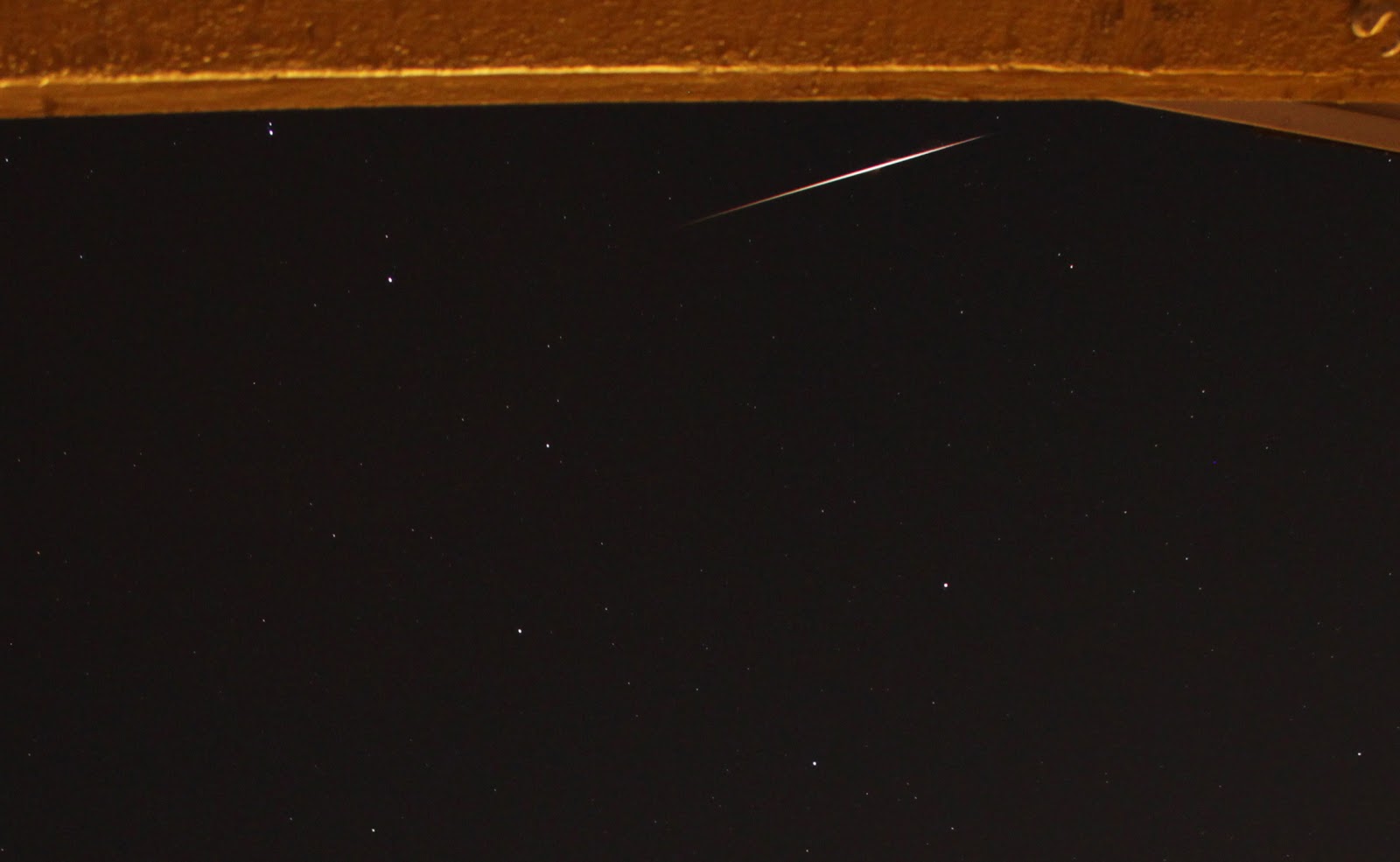
I got 550 shots and started sifting through them on Friday morning before work. I found a total of 8 confirmed Perseid meteors originating from the radiant, all with javelin shape, and no light trails in the frames before or after (eliminating other satellites and planes). I also saw 2 other anomalies that are either non-Perseid meteors, or some other kind of flare.

2015 perseid meteors
Canon T5i, Composite, 8 Perseid meteors and 2 others, 15 sec, ISO 800, f/4.0, 18mm


I made a rushed composite before work, planning to come home and fix it later. When I tried, I ran into a lot of problems. The light changed over the course of the night with a very thin haze, so layering the brightest pixels from my other images into one composite wasn't very straight forward. Trying to match the background color led to some very faint fuzzy halos around the meteor streaks where you can tell I cut them out. I'm not sure how to get rid of them without dimming the already faint meteors.

perseid meteors


At least I got one meteor that stands on its own, this bright one that starts out greenish. A nice catch!

2015 perseid meteor

2015 perseid meteor


As always, the bonus prize after a night of meteor watching is a nice batch for star trails (in addition to 5 bug bites). I took the time to remove airplanes in this one by simply painting over them with black. Since the black isn't counted when each light pixel is added, it doesn't need to be blended or clean at all. Removing the planes really turned this decent star trail into probably my best, longest north-facing trails. It makes me think of a time warp! I still need to add more foreground objects to compose my photos better, but it's good to be back!

star trails with perseid meteor
Canon T5i, 522 images stacked in StarStaX, planes removed in Photoshop before stacking with brush tool, each at ISO 800, f/4.0, 18mm, 15 sec, do dark frames, bright Perseid visible in bottom right

Tuesday, December 2, 2014

Capture Meteor Photos with iPhone: What You'll Need

For the upcoming Geminid meteor shower, I'm planning to put out as many cameras as I can to increase my chances of catching a handful of big bright meteors! This includes my iPhone with the updated version of NightCap Pro, which has been shown to be capable of catching meteors with nothing but your phone!

Using NightCap for meteors photos with your iPhone, select Night Mode , and Long Exposure (aka Star Trail) to create a long exposure photo waiting to capture meteors that fly by. 

iphone meteor photo
Shooting star captured on iPhone using NightCap - Photo from NightCapCamera.com

Here's my plan:

I'm going to attach my iPhone to a tripod using the Glif tripod mount. I'm still using the iPhone 5 until I upgrade in January, so I have the iPhone 5 version, but I see they have a new universal adapter for just about any phone.

iphone tripod for meteor photos
iPhone 5 with Glif tripod adapter

If you want to go super cheap, you can also make a tripod adapter out of a binder clip - but this will wobble in the wind so it's not really the best solution. 

A big concern is battery life while taking a long exposure photo in the cold. You're going to want to plug your phone in to keep it charged. The combination of camera apps and freezing air really drains it fast. If you absolutely don't have access to a power source, you can try something I learned a while ago which is to give your iPhone a little winter coat made out of a plastic bag - it helps keep your phone protected from the freezing wind for a little while but it's not the ideal solution.

extend iphone battery cold
iPhone wearing a plastic bag winter jacket with a hole cut for the camera to peek through
Get everything set up and then leave it alone. As long as you have it plugged in, the phone shouldn't die in the cold and you should end up with a nice star trail photo dotted with meteors.

Monday, December 1, 2014

Watch 2014 Geminids Meteor Shower Peak December 13-14

The Geminids meteor shower is my favorite of the year, and the one I've had the most consistent luck observing and even photographing! I really can't say enough about this great meteor shower, it was my first one since taking up skywatching as a more intentional hobby.

It's a fun memory because on both nights I photographed the meteor shower I went to midnight showings of The Hobbit. In 2012 we saw meteors through the car windshield while driving to the theater, there were so many of them! In 2013 I got back from the theater in the middle of the night and set up my camera on the balcony to shoot away - I was exhausted from seeing a double feature and let the camera do the observing for me. 

how to watch 2014 geminids
Canon Powershot - My best Geminid meteor photo from 2012
how to watch 2014 geminids
Canon Rebel XT - My best Geminid meteor photo from 2013

Here are a few lessons I learned in the past 2 years trying to observe and photograph the Geminids meteor shower:

1. Keep looking in the same spot with a view of the most sky possible in the general direction of the apparent radiant. I used to think you had to look at the exact radiant point - the spot the meteors appear to be coming from. But you actually see much longer trails a little further away from that point. Just look where you have a comfortable view of the most sky possible.

2. Use a high enough ISO to capture the quick faint meteors. I started using ISO 400 and saw a bunch visually but didn't catch anything on the camera. Now I use ISO 800 in 15 second exposures. Find a high ISO that isn't too noisy.

3. Stop moving the camera! This is just random chance, and a natural tendency to want to point the camera to where you saw meteors in the past. Well lightning doesn't strike the same place twice, does it? (Actually, it does, but that's not the point). So keep your camera in one spot and let the meteors come to you - just keep your fingers crossed.

4. You might still see meteors even if the moon is out, and even if you have light pollution. A lot of astrophotography sites will complain about the horrid moonlight ruining the show - but don't let that discourage you. You're not looking for professional photos, so go out and give it a try, or just go take a look. You never know what you'll see!

5. You can still see meteors even on the non-peak nights. In fact, you can see Geminids from around December 4 to December 17. So, if your forecast looks miserable on the actual peak night, have a go a little early or late. I actually got my best photo the day before the peak last year.

6. What camera settings? From suburban skies, I like 18mm (as wide as possible), f/4.0 (as open as possible), ISO 800-1600, then adjust the time to avoid washing out the sky, for me that's about 15 seconds each.

7. Without meteors, star trails are a consolation prize! If you've snapped hundreds of frames with no meteors, you have a nice batch for star trails - a beautiful consolation prize after a long cold night!

Saturday, August 16, 2014

Nice Perseid Meteor Capture and Perseid Candidate Analysis

I knew the Perseid meteor shower was coming up, but frankly because of the recent Supermoon I wasn't giving it much thought. On August 12 I was taking Katie out in the middle of the night and inspecting my recently planted linden tree to see if it was improving. While I was looking up I noticed a quick meteor flash high in the sky to the north.

The next night, the night of August 13, I looked at my Scope Nights app to see if it would be clear - but the icon was red so I mentally planned on not going out that night. It wasn't until I took Katie out again that night that I noticed the sky was perfectly clear with a bright moon high to the south. I looked at the app again and noticed that the forecast was for clear skies but that the icon was red because of the moonlight.

In any case, I decided that a clear sky to the north (which happened to be the best direction for observing the Perseids) was worth a shot setting my camera out to try to capture something. I set my camera up on the back patio so it hopefully wouldn't get stolen (we're building a fence soon).

I woke up in a hurry for work, but eagerly put my memory card into my computer and began sifting through the 555 photos. I found a handful of meteor candidates, and two very clear very bright meteor streaks!

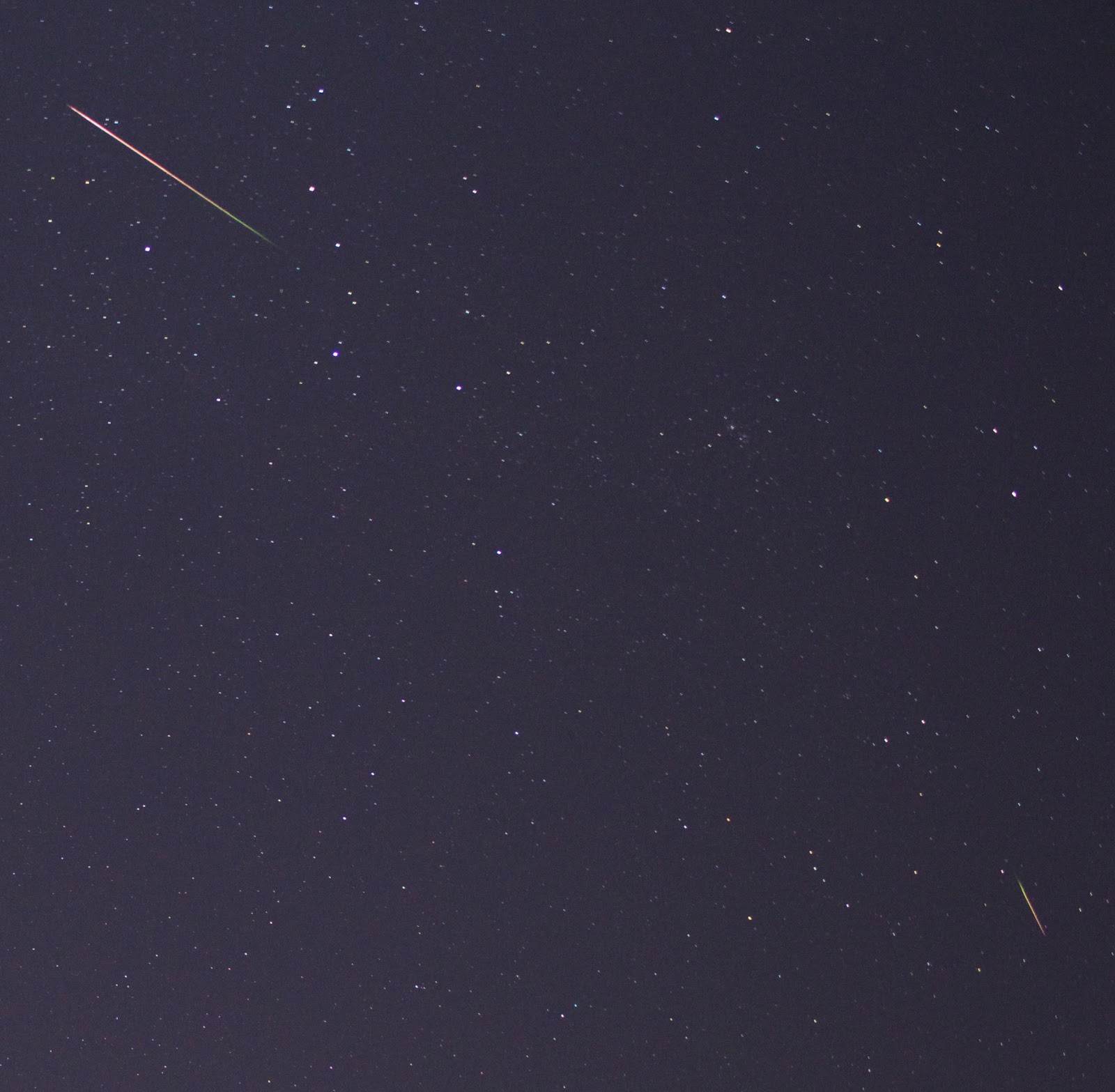
bright perseid meteor
Close crop from larger image, T5i, ISO 800, 18mm, f/4, 15 sec, contrast in Photoshop

bright perseid meteors
2 frames aligned, T5i, ISO 800, 18mm, f/4, 15 sec, contrast in Photoshop

These two bright meteors have a javelin shape and irregular colors, they did not have trails on the frames before or after (ruling out many satellites), and the best evidence is that they are pointing to the anticipated radiant point. These are the real thing! Because they happened in two consecutive frames, we know they lit up within 30 seconds of each other - this makes them great tools for backtracking to the radiant point.

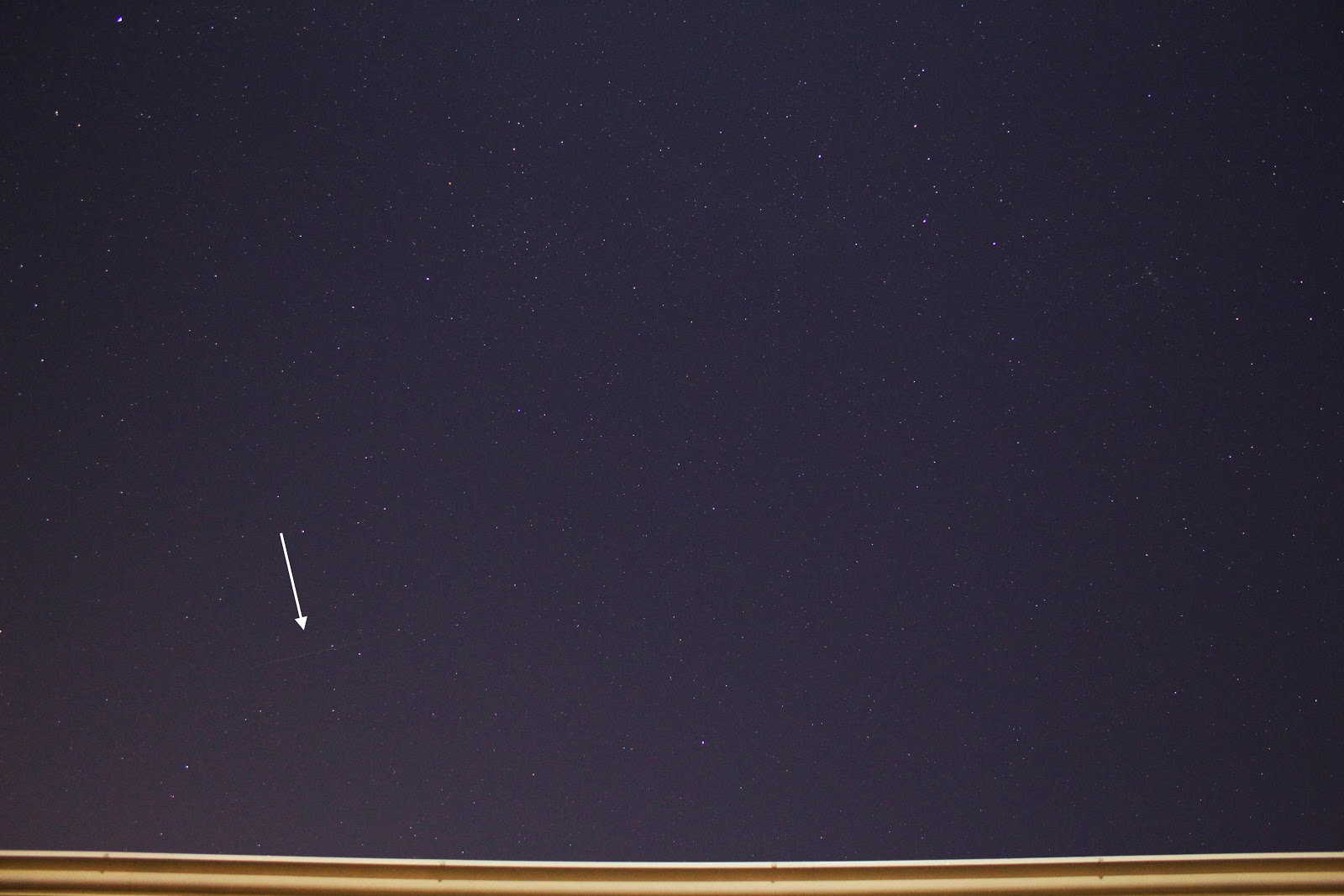
identify perseid meteor candidate
Single frame with T5i, ISO 800, 18mm, f/4, 15 sec, contrast in Photoshop

Now let's look at a candidate Perseid meteor - a faint streak of light that we're not so sure about. It could be a satellite, or another meteor unrelated to the Perseids. How can we find out? First, I look to see if there are any lines in the frames before or after. If this 15 second exposure is of a satellite, there should be a continuation of the path in the adjacent frames - but there isn't. Ok, it might be a meteor, but is it a Perseid? Let's look at the paths.

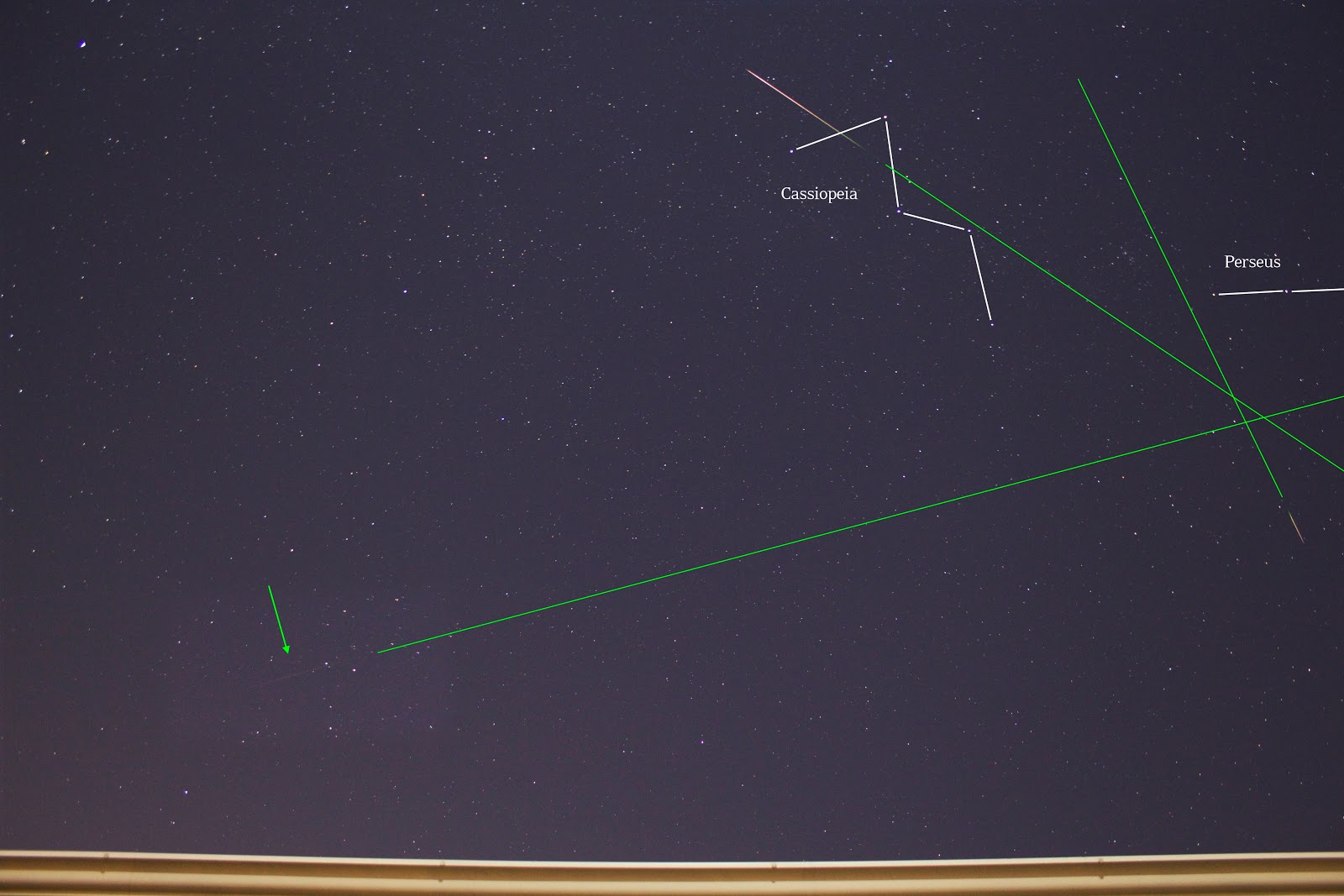
identify perseid meteor candidate
3 frames aligned, T5i, ISO 800, 18mm, f/4, 15 sec, contrast in Photoshop

Here's the candidate overlayed onto the confirmed meteor photo. Notice how the paths of the two bright meteors meet right where we expected the radiant to be. This candidate appears to be originating from the same point - so it's very possible that this is also a faint Perseid.

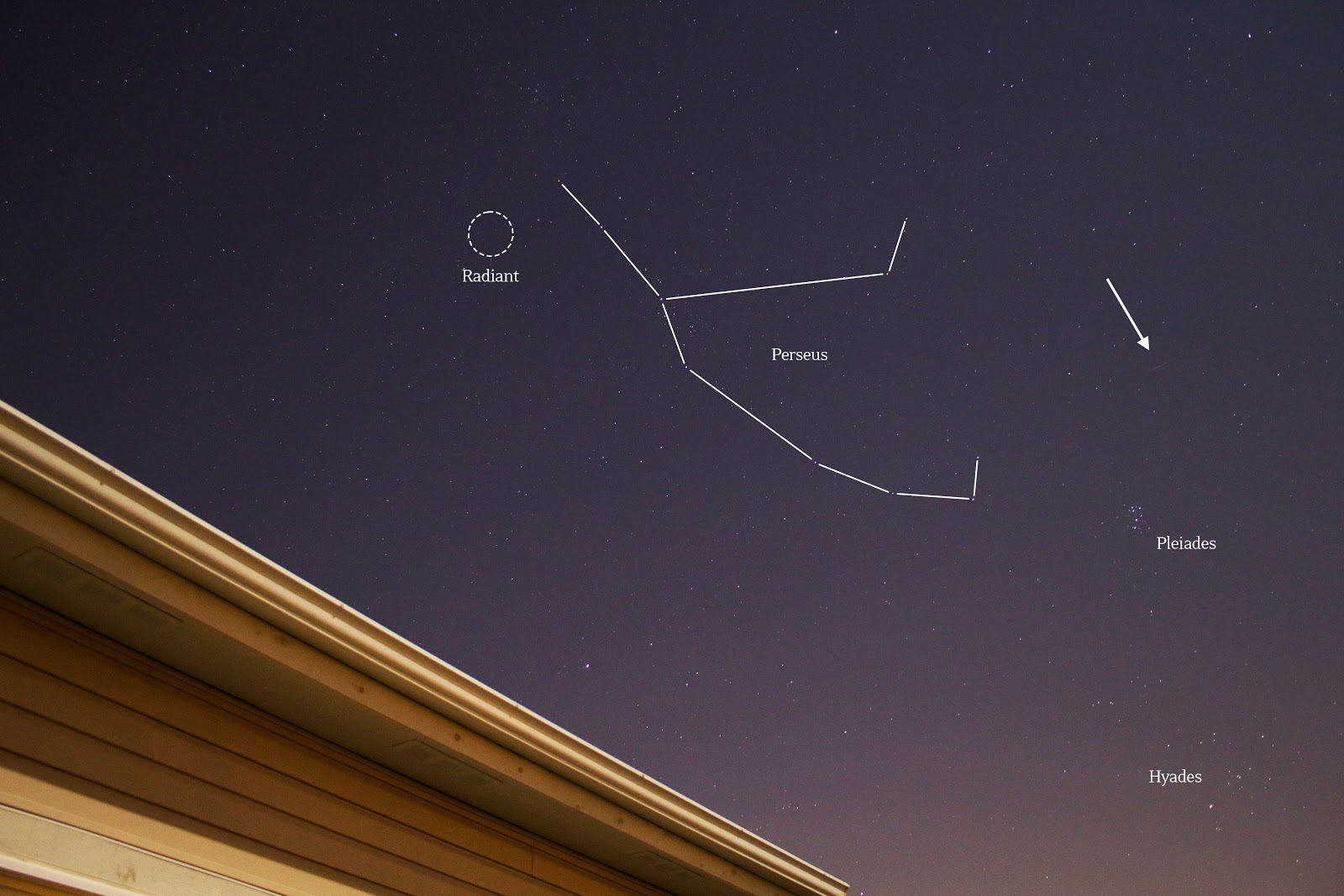
identify perseid meteor candidate
Single frame with T5i, ISO 800, 18mm, f/4, 15 sec, contrast in Photoshop

Now what about this little guy? A faint streak in the sky with no trails in the frames before or after. Sounds like a meteor - but is it a Perseid? It is certainly in Perseus, but the angle of the origin is a little off. It should look like it's flying out of the radiant point, but instead it looks more like it's cutting across Perseus. I'm not sure sure about this one - It's in the right general orientation but not quite.

Saturday, May 24, 2014

Camelopardalids Meteor Fireball with Smoke Trail Animated GIF

Camelopardalids meteor with smoke trail
Camelopardalids meteor with smoke trail - Click to enlarge!
10 frames each at ISO 800, 18mm, f/5.6, 15 sec
Canon T5i
Camelopardalids meteor
Camelopardalids meteor - single frame same as above

Camelopardalids
Same thing with the brightness turned up a bit... Click to enlarge!

Camelopardalids smoke trail
Camelopardalids smoke trail - Click to enlarge!
8 frames each at ISO 800, 6.2mm, f/2.7, 15 sec
Canon PowerShot A3100 IS (Point and Shoot)

I took the shots above from my balcony in Brownsburg, Indiana on May 24, 2014 at 12:04am. Each frame is a 15 second exposure (there were only 8 frames from the point and shoot because it has longer processing time). The smoke trail was visible for roughly 2 minutes based on the camera timestamps. I had no idea they stuck around that long!

Images are cropped from their original size. Here is a single frame straight out of the camera (below).

Camelopardalids Meteor canon t5i
Single frame (uncropped) straight from camera
Canon T5i at ISO 800, 18mm, f/5.6, 15 sec

Friday, January 3, 2014

Hunting Quadrantid Meteors with a Frosty Lens

I woke up and looked at the weather on my phone. To my surprise it looked "mostly clear" at about 2:00am ET here in Indiana. I took Katie out to pee and noticed that indeed the sky looked very clear (especially compared to the weeks of clouds this December). I had already planned on photographing the Quadrantid meteor shower tomorrow night, but then learned that this shower has a notoriously short peak window. Turns out the shower peaked several hours ago, and that I probably wouldn't see any tomorrow night, so I better give it a go right now!

DSLR hunting quadrantid meteors
Leaving my T5i out on the balcony until the cold air kills the battery, or the memory card fills up, whichever comes first. At 6°F my money is on the cold.

I went out onto my West-facing snow-covered balcony and aimed my camera to the NW above the light pollution as much as I could. The radiant point is behind the roof line to the East, but I should be in good shape since I'm within 30 degrees of the radiant point - and maybe I'll even get some longer trails this way! Here's hoping, you can't bag any meteors if you don't try.

I used the same camera settings that produced two Geminid meteors last month, ISO 800 because the light pollution is too great any higher (kind of a waste now that my ISO max is 12800 on the T5i). I'm shooting at 18MP now instead of 8MP so anything I do catch should cover more pixels, and I should have even cleaner images at ISO 800. Because my files are larger, I am shooting in JPEG instead of RAW, which raises my max images from 150 to 495 on my memory card. A 64GB memory card is on its way in the mail, but I'm doing what I can with 4GB for now.

I left my camera out overnight in the cold, and when I got it at 7am in the morning it looked like this...

canon camera covered in frost

camera lens covered in frost

Yep the camera and lens got a little frosty! I let them air dry on the mantle and tested everything out afterward and seems to be working fine. Could have been a lot worse!

As for the meteors, well I didn't see any in the hundreds of pictures that I took. I'm surprised the battery held up as well as it did! I think I had around 600 images to sift through. They did make for one nice star trail though - with an interesting twist thanks to the frost on the lens. Looks so bizarre!

long exposure with frosty lens
Single frame at ISO 800, 15 sec, f/4.0, 18mm

star trails with lens flare
Stack of 651 frames
bokeh and rainbow from frost on lens
With some slight contrast and white balance adjustment, this picture looks quite ethereal.

Saturday, December 14, 2013

Geminid Meteors with Canon Rebel XT over Indiana, December 13, 2013

This was my second time photographing the Geminid meteor shower. After coming up short after 3 nights of shooting last year (1 good meteor candidate), I was ready for another try. The forecast called for a huge snow storm to roll through the night of December 13-14 (the peak night). However, the night of December 12-13 was clear for the most part.

I went to see The Hobbit double feature in IMAX 3D with my brother, and after being in the theater from 7pm - 3am I wasn't in any mood to do some serious star photography, especially with work in the morning. I knew I would regret it if I didn't at least TRY to catch some Geminids the day before the peak, and am I ever glad I did! The bright moon was setting, and I had the benefit of a remote shutter lock this year (compared to taping the shutter down last year). 

I watched the photos download onto the computer, and didn't see any meteors in the thumbnail images. I took 381 photos total, each at ISO 800 (couldn't go to 1600 because of light pollution), 18mm, f/4.0, 15 sec each. My camera clicked away on the balcony from 3:21 AM to 5:06 AM when the battery finally died in the cold. 

When I finally looked through all the photos "by hand" on the computer one at a time, I was thrilled! Not only did I have a good "candidate" for a meteor, I had TWO very obvious meteors originating out of the constellation Gemini. Jackpot!

Geminid Meteors december 13
A Geminid meteor between Gemini and Canis Minor, it appears to be originating out of Jupiter near the center of the contellation

Geminid Meteors december 13
A Geminid meteor to the right of Gemini, this one's trail appears to originate out of top of the constellation between Castor and Pollux. I can't believe I nabbed this one just 2 min before my battery died!

geminid meteor composite
Composite of the two images above, color and contrast messed with in Photoshop

Sunday, October 27, 2013

Meteorite Identification Kits and a Russian Celebrity

Last night the Indiana Astronomical Society hosted a presentation on meteorites by Dr. Fritz Kleinhans, associate professor of physics at Indiana University-Purdue University Indianapolis (IUPUI).

I arrived late because I had trouble finding the Holcomb Observatory and Planetarium on campus at Butler University. I also had to drive slow because there were a lot of college Halloween parties going on and pedestrians were darting out of the shadows all around me!

Fritz brought these kits of samples, and we got to identify 4 meteorites from a lineup of 6 objects. He had 30 kits for us to use, that's a lot of meteorites!

meteorite identification kit
Identifying meteorites with magnets and physical characteristics
chelyabinsk meteorite
From Russia with love!
A piece of the Chelyabinsk meteor that lit up the Russian sky in February of this year. This meteorite, from Fritz' personal collection, must have cost a pretty penny! The Chelyabinsk meteor was a once in a century event, and is the most-photographed meteor air burst in history.

I also won a door prize, a copy of The Universe and Beyond 4th Edition. Woo!

Monday, August 12, 2013

My best Perseid meteor candidate out of 704 photos

I left two cameras out last night. Tonight it's overcast so it looks like my chances of catching a fireball on camera are slim. Here is my best candidate for a meteor from last night's batch. I've had bad luck with mis-identifying satellites and other faint streaky objects, so I'm just calling my finds "meteor candidates" from now on. 

This one has no streak in the frames before or after, and has a characteristic "head" (bottom left) that makes it look convincing to me, but what do I know!

perseid meteor ohio
Single frame, ISO 800, 20 sec, f/4.5, 18mm

Friday, August 2, 2013

Last night's meteor candidates probably aren't Perseids

possible meteor
10 sec single exposure, ISO 1600, f/5.6, 300mm

This first one is especially frustrating! I was taking 10 sec exposures in the constellation Scutum while trying to locate M11, the Wild Duck Cluster. During an exposure, I visually saw a shooting star near the stars that I knew were in frame. When I dumped my files onto the computer, I was pretty pumped because I figured this had to be the meteor I saw last night. With some review, however, it appears this is most likely a satellite. The line is too narrow and uniform, and fades out without getting fatter first.

possible meteor
Single exposure 15 sec, f/2.7, ISO 1600, 6.2mm, Canon Powershot A3100 IS

possible meteor

This next one has some potential to be a real meteor. The trail is short and it shows up on this much wider shot. The down side is I can't figure an origin in any active meteor showers. Positioned between Bootes and Draco, I figure if it is a meteor it must just be a random one.  

The good thing about leaving the camera out at night to take back to back meteor hunting pictures is that you get to stack the photos to create your own "constellation prize" (yuk yuk yuk) even if you don't find anything.

273 images stacked, each 15 sec, ISO 1600


Monday, April 22, 2013

Lyrid Meteor Recap: 2 Sightings but Nothing in the Can

Last night I woke up at 2:30am to take the dog out. I planned ahead for the Lyrid Meteor Shower by setting my tripod and camera out before going to bed, and making sure my batteries were charged up. 

I read that the Lyrid shower isn't typically as dramatic as other meteor showers, however I figured it was worth a peek since I was up and it was clear. 

When I took my dog out, I did a quick scan of the darkest part of the sky and immediately saw a meteor streak from East to West (facing South). The 83% moon was still peeking over the top of the apartment building and producing a lot of sky glow. After picking up Katie's poops I went back in side, optimistic that the meteor shower would be as prolific as the Geminids this past winter. 

Rebel XT: 18mm, 20 sec, ISO 1600, f/4.5

Rebel XT: 18mm, 20 sec, ISO 1600, f/4.5

PowerShot A3100 IS: 6.2mm, 15 sec, ISO 1600, f/2.7

Rebel XT: 18mm, 20 sec, ISO 1600, f/4.5
While my cameras were running, I spotted one more meteor in the general area where I thought it would make it into frame - alas, either it was just out of frame or it was too brief to show up on the sensor. Visually, I was able to observe 2 pretty good Lyrid meteors, but I was left with nothing on "film" a.k.a. nothing in the can. 

While I was out, I did become more familiar with the late spring sky, which will soon become the early summer sky. I spotted Hercules, and of course the Summer Triangle. I also took a picture of Arcturus, Spica, and Saturn in a triangle next to the glow of the moon just behind the apartments. 

Wednesday, April 3, 2013

Shooting star in the Big Dipper April 2, 2013

What is THIS? While I was shooting at Slippery Elm Trail last night, I set up my point and shoot to take some photos to stack into star trails later. I had 83 frames total, and I didn't see this object until I got home to upload my photos.

At first I thought it was an iridium flare, but it's not listed in the heavens-above.com predictions for my area. Plus, it looks like there are a total of 3 streaks of light simultaneously. My guess would be it's a meteor split into one big chunk and two little ones!

Update 4/8/2013: After further analysis, and some expert eyes over at Reddit, it has been determined that the 3 lights in the sky were, in fact, a trio of Naval Ocean Surveillance System (NOSS) satellites. I had no idea satellites flew in formation, and flew this close together! It still looks odd though - still more like an iridium flare than the slow crawl of the NOSS formation.

shooting star meteor in big dipper april 2
9:10pm facing NE, ISO 800, 15 sec, taken with Canon Powershot A3100IS
star trail with meteor
83 frames stacked in StarStaX, the odd angle of the shooting star stands out
Help from Redditors to identify the NOSS formation

Friday, February 15, 2013

Holy Toledo! Amazing videos of Russian meteor explosion

Russian fireball
Screenshot from the video below by fed potapow

I woke up at 3:00am ET to take my dog out to pee and I decided to hop online real quick. To my amazement I saw news of a fireball (meteor) over Chelyabinsk, Russia at 9:26am local time. Thanks to an abundance of dashboard cams, there are some great videos of the moment the meteor enters the atmosphere!

[Video removed by user]

Apparently the large flash is an explosion that occurred around 32,000 feet - which resulted in a large BOOM heard moments later that shook windows and set off car alarms. (Turn your volume down for this video!!). If this video is real, it's super creepy and impressive! It sounds like Hollywood special effects!


I'm sure this story is going to be all over the Internet, especially with the hype over Asteroid 2012 DA14. Google even released a doodle animation about the asteroid, which now seems even more relevant with this huge meteor story!

Screenshot of Google Doodle animation for Asteroid 2012 DA14

Hopefully these dramatic videos, along with the close asteroid approach, will bring enough media attention to increase funding for asteroid detection and defense programs. It's a good reminder that these things are out there, and there isn't much we can do (at this point).

Update: Discovery News has a great synopsis of the story so far. Apparently there are 400-500 injuries reported, mostly from broken glass and concussions. Yikes!

Friday, December 14, 2012

Lessons learned from the Geminid meteor shower

The 2012 Geminid shower was the first meteor shower I attempted to photograph. It was an eye-opening experience, simultaneously frustrating and fun.

Over a 3 night period, I shot 672 images of the night sky using both my Canon Powershot and Canon Rebel XT. After hours of recording, all I have to show for it is some star trail images, and one measly photo of a real Geminid meteor:

geminid meteor iso 800 with point and shoot
Geminid meteor faint even at ISO 800

The first two nights I was shooting with ISO 400, which in hindsight looks like it was just too low to pick up the fast and faint meteors. Although I saw dozens with the naked eye, they just weren't registering on the cameras. 

Looking back, I also moved my cameras around too much. I originally thought to get the best shots I would have to aim toward the origin of meteors in the Gemini constellation, but now I know that meteors appear anywhere in the sky and actually have longer trails further from the radiant point. I should have framed a good shot with the roof line of the apartment complex and just let the meteors come to me.

Hopefully next time I'll be better prepared to capture the meteors - and hopefully by then I'll have a shutter remote lock for the Canon Rebel XT so I don't have to tape the button down!

star trails with aircraft iso 800
No shortage of stars and aircraft, just no meteors...

Thursday, December 13, 2012

Second Geminids attempt, what am I doing wrong?

Last night I left the point and shoot out to try to capture a Geminid two days before the peak. Well I didn't catch anything. Last night, I saw plenty of meteor streaks in the sky, so I again put the point and shoot out on the ground - but this time I set up the Canon Rebel XT with a wide angle lens to try to catch some meteors with a cleaner sensor.

I saw several streak through the field of view, but when I downloaded the photos I didn't see anything! What gives? I'm guessing I didn't have the ISO high enough to catch the very quick and faint meteors. Tonight, the peak Geminid night, I'm going to give it another go with a higher ISO. I guess I'll have to accept a little noise in order to capture the little buggers on film ("film").

night sky over ohio
Full disclosure: I adjusted the color a bit in Photoshop
star trails
No meteors here...
star trails
None here either...
extra long star trails
No meteors, but my largest stack to date: 260 images, 15 sec ea., ISO 400