Showing posts with label Aldebaran. Show all posts

Saturday, January 25, 2014

Hyades Cluster in Taurus with Major Star Labels

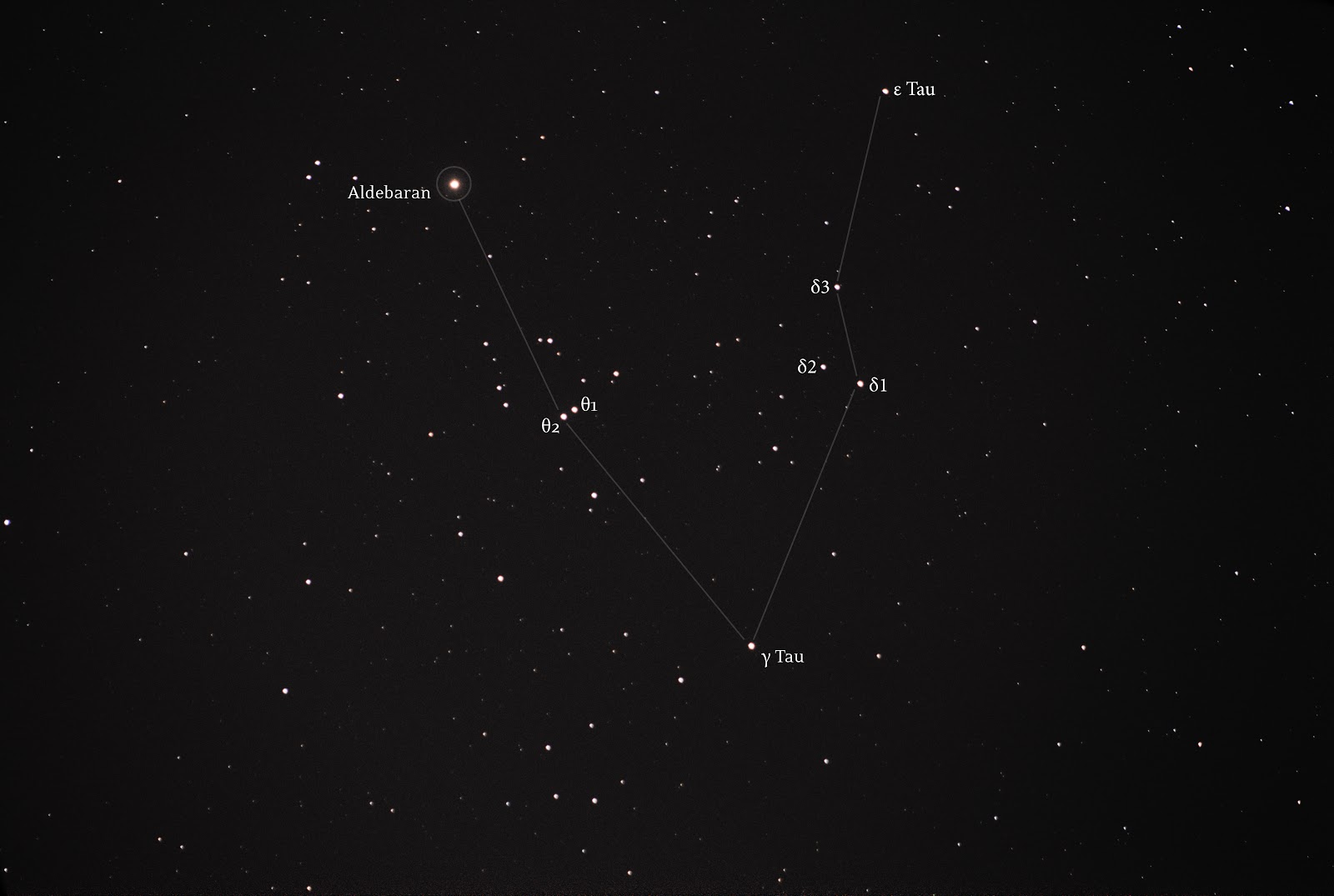
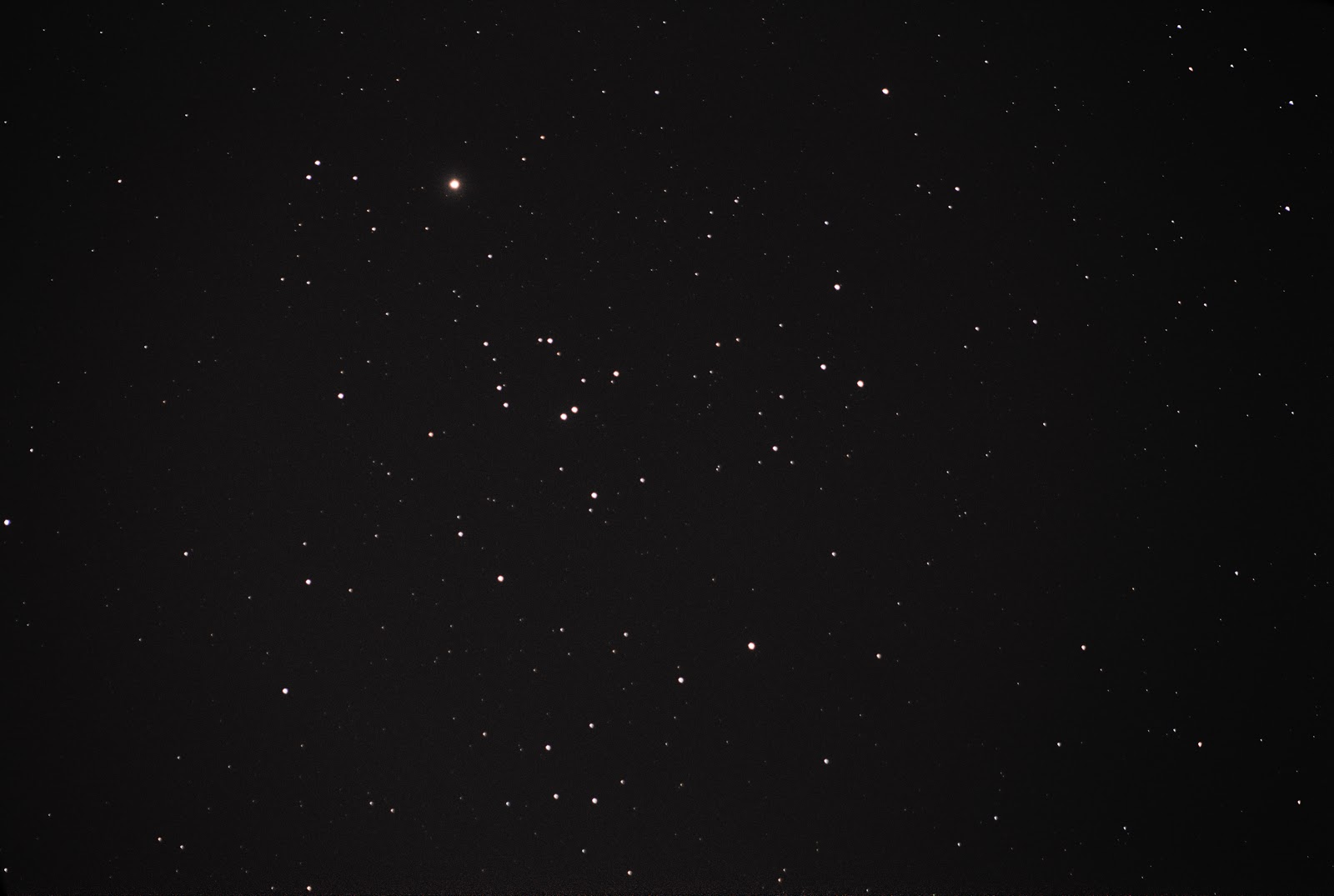
Another recognizable object that I've photographed before is on the IAS observing list for January. I'm happy to revisit the Hyades star cluster with my new camera! I took a series of short exposures and stacked the images in Deep Sky Stacker. Typically this brings out more stars which is great, but makes the original asterism less apparent - so I've included some labels and made a little star chart out of my final image.

hyades star cluster asterism with labels
Stack of 69 subs, 22 darks, 28 bias each at ISO 3200, 135mm, f/4.5, 2 sec

hyades star cluster in taurus
Stack of 69 subs, 22 darks, 28 bias each at ISO 3200, 135mm, f/4.5, 2 sec

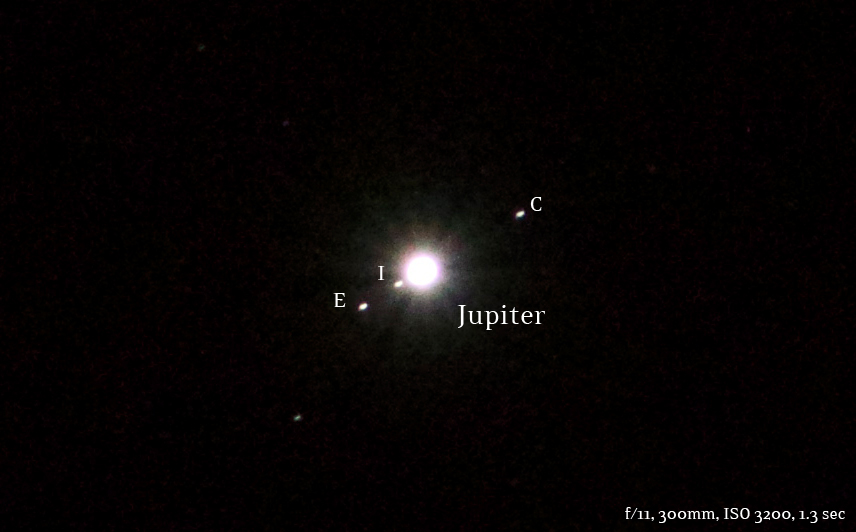
jupiter and moons on january 21
Crop of Jupiter at f/11, 300mm, ISO 3200, 1/3 sec

That same night I also snagged a quick photo of Jupiter with my T5i on a fixed tripod. Still waiting for some warmer weather to take my mount out to play with it. It's going to be a low of -17°F on Monday. This winter is the worst!

Thursday, November 7, 2013

Color Comparison: Betelgeuse, Aldebaran, and Rigel

I took blurry photos of some popular stars to spread their light over more pixels to give a better representation of their color. Hotter stars are white and blue, while cooler stars are red, orange, and yellow. I looked up the surface temperatures of each on Wikipedia. Obviously the image is a composite since these stars aren't right next to each other in the sky. I used the same camera settings for each, so Aldebaran is slightly dimmer.

Color Comparison: Betelgeuse, Aldebaran, and Rigel
300mm, intentionally out of focus, enlarged in Photoshop
Rigel is my favorite star by the way! Comparing the color of Betelgeuse and Rigel was the subject of one of my very first blog posts: Orion constellation with star labels with my point and shoot camera back in 2012.

Monday, March 4, 2013

Asteroid hunting: Ceres and Vesta

If someone had told me a year ago that I'd be able to see asteroids from my apartment building with an 8 megapixel camera, I would have said "you're crazy!" Currently at magnitude 7.54 and 7.25 respectively, Ceres and Vesta were my best chances for bagging some big rocks near the limit of my camera's (and sky conditions') capacity.

The dwarf planet Ceres is the largest asteroid in the asteroid belt. At nearly 600 miles in diameter, it is the would-be planet that never came to exist thanks to a disruptive gravity tug from Jupiter. Ceres alone comprises nearly 1/3 of the mass of the asteroid belt. 

Vesta, the second largest asteroid, is typically the brightest asteroid. Vesta is over 300 miles in diamater and makes up about 9% of the mass of the asteroid belt. Vesta was recently visited by NASA's Dawn spacecraft

Stack of 46 subs, each at 75mm, ISO 1600, f/4.5, 4 sec (cropped)
Stack of 43 subs, each at 75mm, ISO 1600, f/4.5, 4 sec (cropped)
The asteroids are barely visible, but after some tedious work lining up charts in Stellarium and Star Walk, I'm confient that these dots are asteroids and not dim stars. This is also my first sighting of open cluster M35, so I can check that one off my list!

Sunday, January 6, 2013

The Hyades Cluster, Jupiter, and the Pleiades

I took these photos on January 3, 2013 at 12:20am (just now getting around to posting). If the beautiful conjunction of Jupiter with two prominent asterisms (Hyades and the Pleiades) weren't enough, I wanted to look up some more information on the Hyades star cluster for my own benefit.

I'm also working on improving my manual noise-reduction technique by stacking. The image below was made with a simple stack of 2 exposures to reduce some of the random noise at high ISO. I also did some color adjustments in Photoshop - for some reason my high ISO exposures come out with a hazy red tint to them. I'm not sure if there is something up with the camera (it's pretty old) or the lights in the parking lot (they naturally have an orange tint to them).

Hyades Jupiter and Pleiades
Two stacked images at f/4.5, ISO 1600, 10 sec, 75mm focal length
According to Wikipedia, the Hyades Cluster includes the 4 brightest stars in the "V" shaped head of Taurus. These stars, designated Gamma, Delta, Theta, and Epsilon Tauri, are all very close together (only a few light years apart). Aldebaran, however, is much closer to Earth - although it appears to line up with the other stars in the "V" shaped asterism.
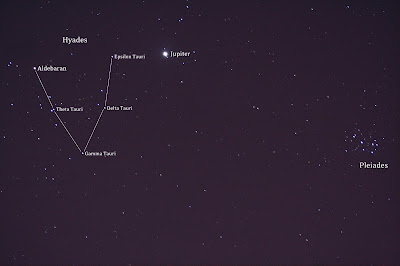
The Hyades Cluster
Same image as above, but with labels!

Jupiter has been passing over the Hyades since the summer (although not always visible in the Northern Hemisphere) and will hover in the area before leaving again this early Spring. Looking at the Star Walk app, it looks like Jupiter is in the middle of one of it's backwards loops in the sky (an illusion based on our perspective as we overtake Jupiter in our orbit around the Sun). Jupiter will dip between the Hyades and the Pleiades, and begin turning around by the first part of February - leaving the Hyades in its dust by April.