Showing posts with label novice8/13. Show all posts

Thursday, August 15, 2013

Complete! IAS Novice/Urban Observing List for August 2013

Now that I'm a card-carrying member of the Indiana Astronomical Society, it brings me great pleasure to complete my first monthly challenge! Here is the Novice/Urban Observing List for August 2013 with links to the objects I successfully observed/imaged. My goal was 6 out of 10 plus the challenge object. Acquisition details are located on the individual blog posts (linked at the bottom).


Mini Messier Marathon: M13, M92, M22, M57

I had an exceptionally clear night here in Indiana, and I was able to shoot 4 deep sky objects, plus dark and bias frames all in one 4GB memory card. Here are the results of my Mini Messier Marathon! I've got M13 the Great Globular Cluster in Hercules, M92 another globular cluster in Hercules, M22 a globular cluster in Sagittarius, and a very tiny very faint M57 Ring Nebula at the edge of my imaging abilities!

M13 globular cluster
M13, Great Globular Cluster in Hercules
Total exposure time 1min34s; 94 subs, 62 darks, 45 bias
1.3 sec, ISO 1600, 300mm, f/5.6

M22 globular cluster
M22, Globular cluster in Sagittarius
Total exposure time 1min36s; 96 subs, 62 darks, 45 bias
1.3 sec, ISO 1600, 300mm, f/5.6

M57 ring nebula with canon rebel xt
M57, The Ring Nebula
Total exposure time 3min; 180 subs, 62 darks, 45 bias
1.3 sec, ISO 1600, 300mm, f/5.6

M92 globular cluster
M92, Globular cluster in Hercules
Total exposure time 3min; 180 subs, 62 darks, 45 bias
1.3 sec, ISO 1600, 300mm, f/5.6

Moon with iPhone Default Camera Through Meade 285 (Handheld)

I took this photo of the moon through my Meade 285 telescope using a handheld iPhone 5. I took about 20 photos and this is the best one! I either need to get an eyepiece clip for my phone, or invest in a t-ring/t-adapter set for my DSLR. This handheld stuff is for the birds!

moon with iphone through telescope
Single exposure with default iPhone camera app, contrast adjusted in Filterstorm app

Tuesday, August 13, 2013

Epsilon Lyrae, “The Double Double” Quadruple Star in Lyra

You can clearly see separation between the double stars, but unfortunately you can't see the quadruple star under this magnification. I did, however, catch another double star (Zeta Lyrae) in the same frame. Lyra is jam-packed with double stars!

Epsilon Lyrae
Single frame at ISO 1600, 1 sec, 300mm, f/5.6

Thursday, August 8, 2013

Double Star Bonanza!

Checking more off my list for the Indiana Astronomical Society Novice/Urban Observing List for August 2013. I'm tagging all my posts with those objects: #novice8/13 and I need to get a total of 6 in order to get a certificate!

The only double stars I've seen before these were Mizar and Alcor in the Big Dipper. I was surprised that I could see any division between the stars at all! The stars are a little out of focus, and obviously wouldn't be that close together or that spherical-looking under higher magnification.

albireo double star 300mm
Canon Rebel XT: ISO 1600, f/5.6, 300mm, 1.3 sec

beta lyrae double star 300mm
Canon Rebel XT: ISO 1600, f/5.6, 300mm, 1.3 sec

Monday, August 5, 2013

Messier Triplet: M21 (open cluster), M20 (Trifid nebula) and M8 (Lagoon nebula)

Three Messier objects all in one frame, not too shabby! I first saw these little guys in a wider view of the Milky Way, and I've been slowly chipping away at Messier solo numbers for my collection - but these 3 are so close together they all fit in the same frame even with my 300mm lens.

lagoon nebula and trifid nebula
89 subs, 35 darks, 35 bias (1/4000s), each at ISO 1600, 300mm, f/5.6, 1.3 sec

It turned out better than I thought. I figured Orion was the only nebula I'd be able to see with my older camera and slow lens, but I was pleased to see some nebulosity come out right away. I could probably spend some more time on this, but I wanted to get it posted and get on with processing some other photos that I took on my trip to Peoria, IL. 

This was the last stack from my mini-Messier-marathon the other night, when I also got M11 (and thought I got M29 but had the wrong anchor star... ooops). 

Saturday, August 3, 2013

A closer look at Cr 399 “The Coat Hanger” asterism in Vulpecula

Also on the August 2013 novice/urban observing list, I took this better / more intentional look at The Coat Hanger asterism. It was surprisingly difficult to find because it's out at the end of the Northern Cross but doesn't really have a good anchor star in the frame with it.

cr 399 the coat hanger
49 subs, 35 darks, 35 bias (1/4000s), each at ISO 1600, 300mm, f/5.6, 1.3 sec

cr 399 the coat hanger
I especially like the difference in colors of the stars in this asterism. I blew out the saturation in this image to emphasize the contrast between the blue and red stars.

coat hanger asterism
It's a little harder to see close up, does this help?

M11 Wild Duck Cluster

I had never heard of the Wild Duck Cluster until the Indiana Astronomical Society posted a novice/urban observing list for August 2013.*  I figured I could give it a try, it was listed as a Mag 5.8 and I've seen other clusters around that magnitude with my DSLR.

It was pretty easy to find, following the tail of Aquila down to Scutum. It's also larger than other recent Messier objects (like the tiny blob M53), so the final result is a little more impressive.
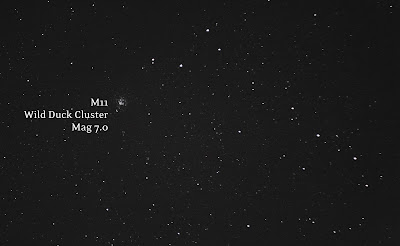
m11 wild duck cluster
84 subs, 35 darks, 35 bias (1/4000s), each at ISO 1600, 300mm, f/5.6, 1.3 sec
"The Wild Duck Cluster is one of the richest and most compact of the known open clusters, containing about 2900 stars. Its age has been estimated to about 220 million years. Its name derives from the brighter stars forming a triangle which could represent a flying flock of ducks." (Wikipedia)