Showing posts with label Andromeda. Show all posts

Wednesday, November 4, 2015

Canon DSLR Astrophotography: Andromeda Galaxy Improvements

The last time I tried to image the Andromeda Galaxy (M31), I was still just testing out my Orion EQ-1 mount and trying to learn how to align and how it all worked. That time I only took 9 light frames and got my (at the time) best image stacked. Just 9 frames! That shows the benefit of the motor-driven mount for sure. But since then my Canon DSLR astrophotography has gotten a little better.

After I learned the mount a little, I imaged the Orion Nebula (every beginner's favorite target I'm pretty sure), but didn't go back to Andromeda.... UNTIL NOW! Last night I did a proper treatment of M31 high in the sky directly overhead and with very favorable conditions. Here's how it went down.
Canon DSLR astrophotography
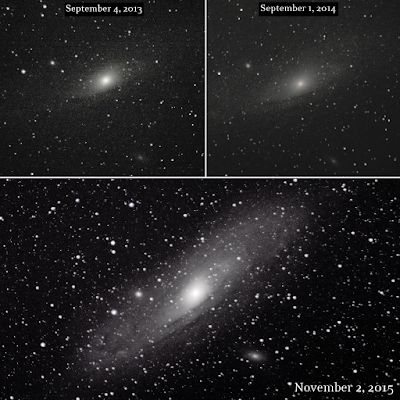
Sometimes you don't realize how far you've come until you look back.

I aligned slightly to the bottom left of Polaris. Without cross hairs or a finder scope, I'm really just aiming at the center focal point through the viewfinder and hoping for an approximate alignment. I think my best is about 20 seconds, but that night I got 13 seconds without star trails. Not great, but not bad for a simple motor. I bumped it a few times and I'm sure I knocked it out of focus a bit, especially with this lens that seems to jump if you touch it.

Next I had to find Andromeda, but since it was directly overhead, I couldn't do my usual technique of star hopping through the viewfinder. In fact, I couldn't even get my head under the viewfinder. I pulled out the folding screen (this thing has saved my butt a few times) and just started firing off test shots in the general direction. It only took me 16 shots to find the fuzzy blob and then I zeroed in on it.
Canon DSLR astrophotography
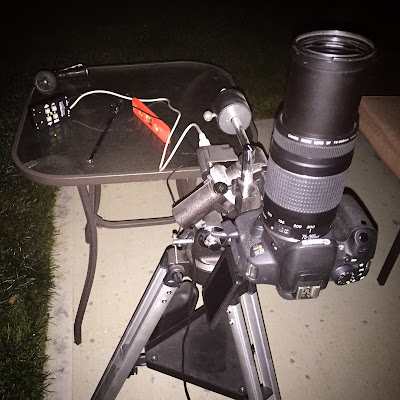
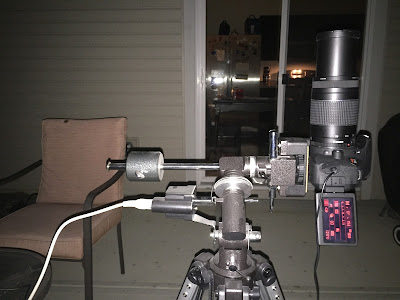
Canon T5i on Orion EQ-1 motorized mount (single speed, no tracking)
canon DSLR on motor tripod mount
If it looks awkward, that's because it was! I couldn't even see through the viewfinder, I had to just guess and click around for a little while to find my target.
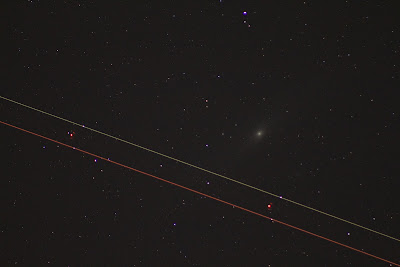
I wanted to at least give M31 equal treatment compared to my Orion shot that I love so much, so I let it click away for about 30 minutes doing 160 or so 13 second exposures. Individual frames look like this one (although not all have an airplane buzzing the fuzzy galaxy blob). Quite a close approach considering the field of view is around 5 degrees.
andromeda airplane
One of the frames I had to throw out, but kind of a unique image that shows what Andromeda looks like in a single 13 second exposure, and a near miss from an airplane. 

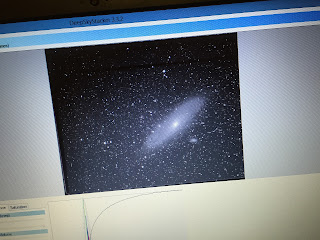
The first thing I did after stacking in DSS (total exposure time 31 min 24 sec) was to crank the curves all the way up just to see what might be hiding in there. I don't use this as a final product, but it is a quick way to see what to shoot for in Photoshop teasing it out bit by bit with curves to avoid the grain of this rough pass. This also proves that I'm not just drawing an oval around the center and turning up the brightness! It really is that bright compared to the surrounding sky. It looks like I just drew a ring around it, but that's really the galaxy itself!
canon dslr andromeda galaxy
Cranked the curves all the way up in DSS just to get an idea of what might be hiding in the pixels. It's too grainy to use, but gives me something to shoot for in Photoshop where I have to tease it out bit by bit to avoid the quick-and-dirty grain from the DSS pass at it.
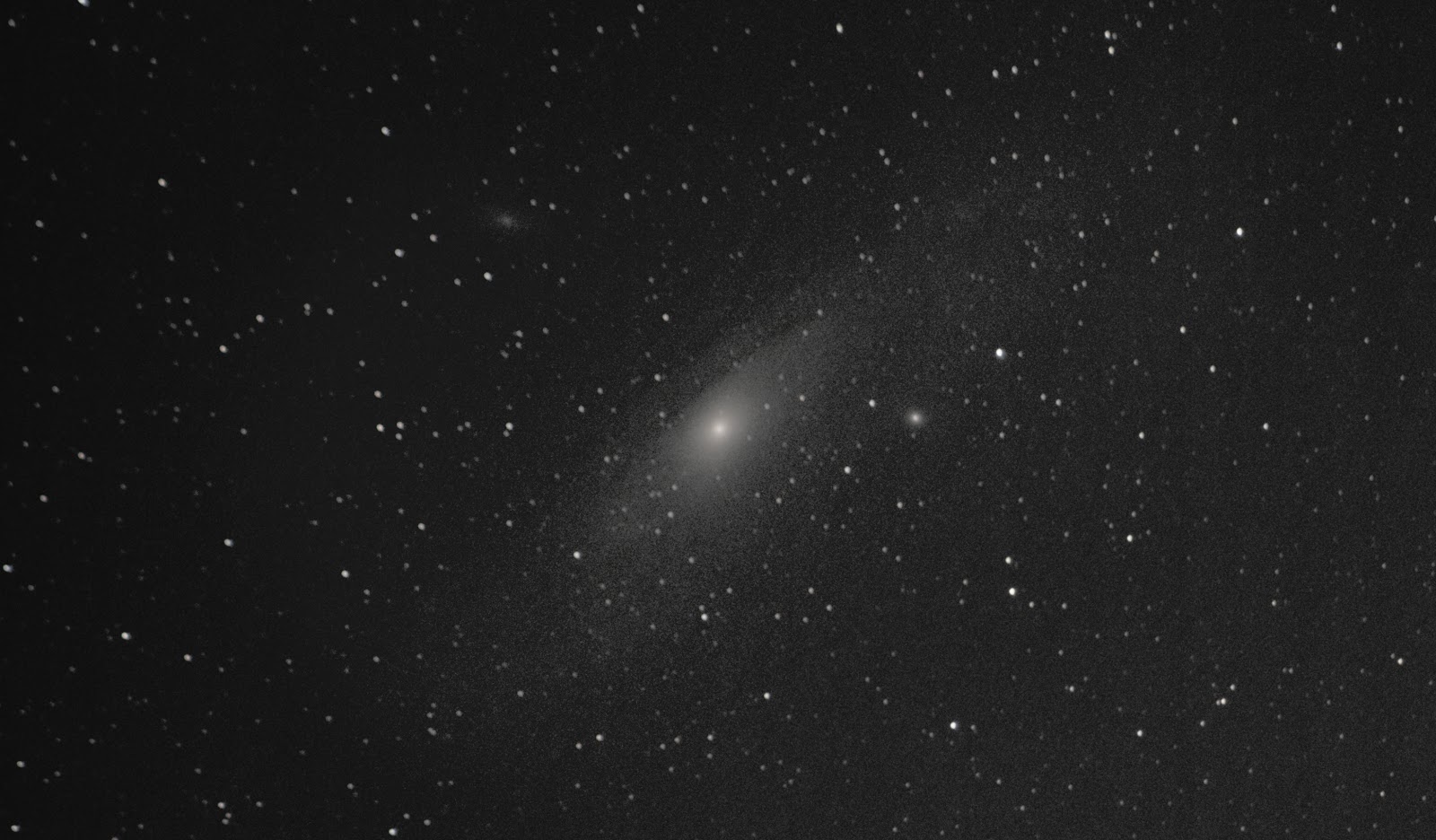
I'm a little rusty at deep sky stuff. I used curves in Photoshop to tease out the contrast between the dust trails and the brighter parts. I spent about 2 hours on it. My best Andromeda Galaxy (M31) by far! I'm a little rusty on the post processing, but the motor driven mount is night and day compared to a fixed tripod. Really pleased! Might even get a print!
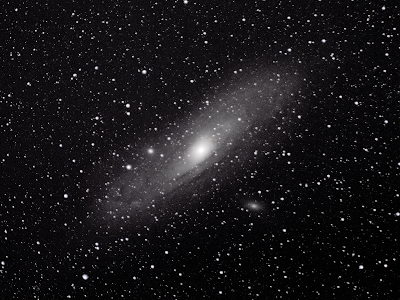
canon dslr andromeda galaxy
Canon T5i on Orion EQ-1 mount, stacked in DSS, 159 subs at 13 sec, f/5.6, ISO 1600, 300mm; 27 dark frames, 24 bias, and 15 flat frames (re-used the ones from last year and they seemed to work just fine).
Take your vitamins and don't skip the flat frames! I'll never go back to not using flat frames on anything that I'm seriously trying to improve on.

Tuesday, September 16, 2014

Bradford Woods Views of the Milky Way with Canon T5i

This weekend I was co-hosting a Peer Educator retreat for our health and wellness peer educators at Bradford Woods in Martinsville, IN. Bradford Woods is close to the Link Observatory, and I knew it would have better skies than my house in Noblesville, so I brought my camera along.

We had a campfire at night and I could see through the trees that the stars were crystal clear and that it was going to be a great night for stargazing.

When I put the fire out and stepped out into a clearing, I could immediately see the faint veil of the Milky Way. You know it's a great sky when you don't even recognize constellations because there are too many stars!

milky way in summer triangle over bradford woods
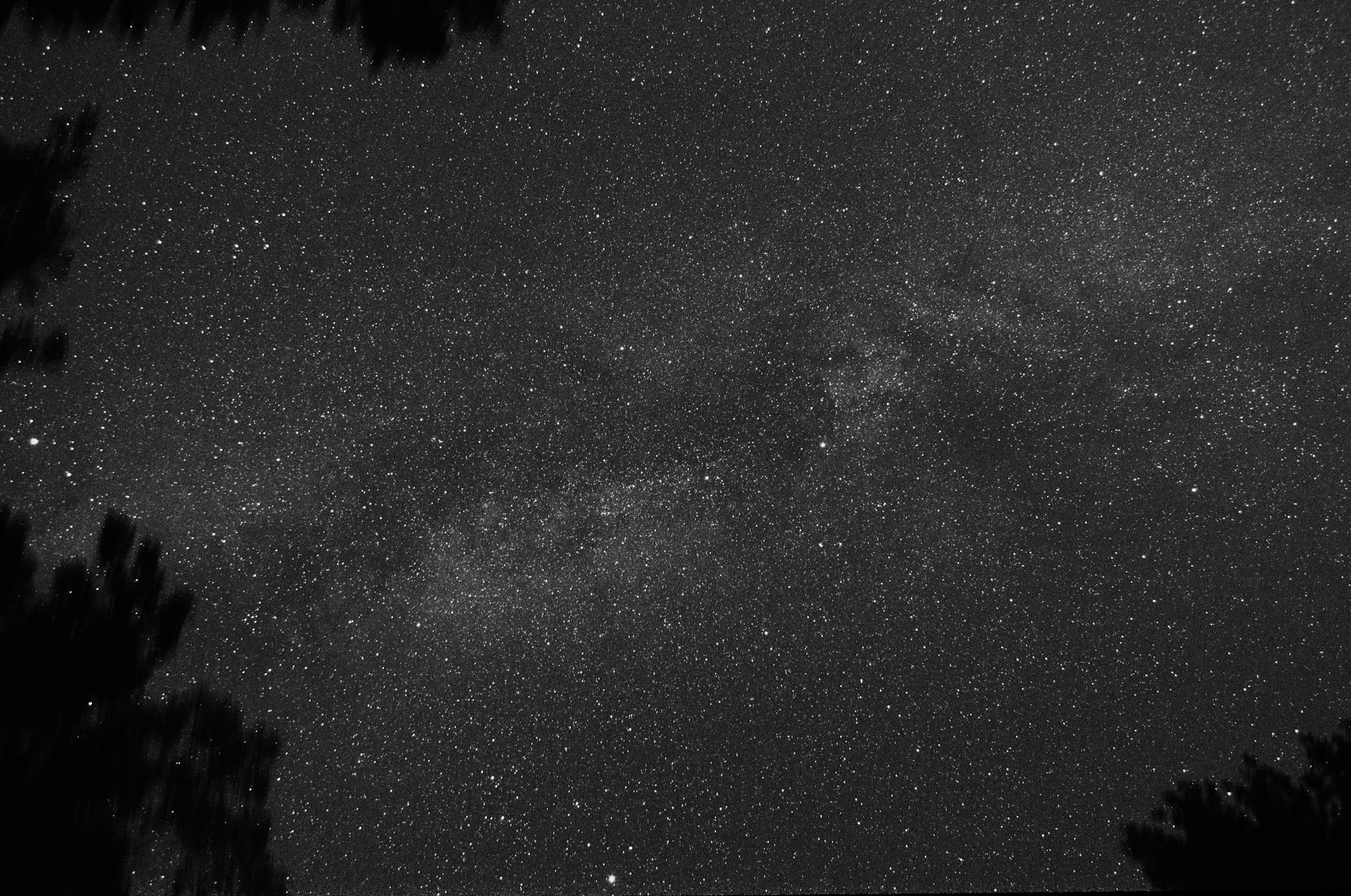
Canon T5i on fixed tripod, stack of 29 light frames at ISO 6400, f/4.5, 18mm, 10 sec
Total exposure time 4 min 8 sec

cygnus milky way label
Same image as above with the Summer Triangle and Cygnus
The clearing I was standing in was amazing, it blocked out all of the parking lot lights, and all of the lights from the cabins in the park were blocked by the tall trees. One drawback to the trees, however, is that I had no view of the horizon - and missed out on the brightest areas of the Milky Way. The region within the Summer Triangle is nice, and recognizable, but not the brightest bit by far.

andromeda 18mm
Canon T5i on fixed tripod, stack of 95 light frames at ISO 3200, f/4.5, 18mm, 10 sec
Total exposure time 14 min 41 sec
Facing the other direction, and at ISO 3200, I didn't get much nebulosity in the Milky Way, but I did catch our neighbor galaxy Andromeda - which at 18mm looks like a large blurry star.

stars and black tree silhouettes
Cassiopeia and Andromeda rising over the treetops
Canon T5i on fixed tripod, single frame ISO 3200, 18mm, f/4.5, 10 sec

I'll end by saying it's a good sign when the trees in the foreground are actually black at night. I'm so used to seeing houses and orange trees in the neighborhood. Even at ISO 3200, these trees make true silhouettes against the night sky. Very cool!

Monday, September 1, 2014

Kicking Off Andromeda Season with First Successful Motorized EQ-1 Run

I haven't done a good Andromeda attempt since 'Andromeda Season' kicked off last year in September. At that point, I made incremental baby steps to finally visualize some dark dust trails in the spiral arms of our galactic neighbor. Last year I was reaching the upper limit of what I could do with a fixed tripod - which limits me to 1.3 sec exposures at 300mm.

I got the Orion EQ-1 mount last Christmas, but I didn't really get to USE it, I did try setting it up once on my balcony but I was nervous about dropping screws through the floorboards.

I was trying to figure out how to slew the camera to the right position in the sky without unhooking and re-attaching the motor. It is delicate and uses a tiny hex screw to attach to the gear wormscrew attachment thinggy. Was I seriously expected to slew to the right spot, and then unhook the manual knob and replace it with the motor out in the field??

I avoided using it until I had my own place to really sit down and figure it out. While I was setting up last night, I noticed the thumb screws on the mount - and I tried loosening them to slew without unhooking the motor. It worked! This might seem obvious, but to a self-taught amateur this was the secret that made the setup a lot more user-friendly... I'm much more likely to use the EQ-1 mount now that I know I can leave the motor attached while I slew to the approximate location.

Canon DSLR camera on motorized EQ mount
Canon T5i on Orion 9011 EQ-1 Equatorial Telescope Mount

EQ motor and wormscrew
Orion 7826 EQ-1M Electronic Telescope Drive attached to the wormscrew
 
camera adapter for Orion EQ 1 mount
Camera attaches with the Orion 10103 1/4-Inch-20 Adapter for EQ1 Telescope Mount

Orion EQ thumb screw
Thumbscrew that loosens the ascension axis

Orion EQ-1M motor
EQ-1 motor driving the declination axis

EQ-1 thumb screw
Thumb screw that loosens the declination axis so you don't have to unhook the motor
I set up on the front walkway with a kitchen chair. I did a rough polar alignment - I still need to figure out a good way to align correctly with a camera since I don't have a finder scope (and really good alignment was never important before with just observing manually).

After aligning to Polaris, I loosened the thumbscrews and slewed toward Andromeda. I found it easy enough because I've been observing it for a couple years now. I did a test shot of 15 seconds at ISO 1600 and found that not only was I getting some small trails but the light pollution was washing out the photo. I pulled back to 13 seconds and the trails were insignificant. This is a pretty crappy polar alignment but WAY more light gathering potential compared to 1.3 second frames!

I took a quick stack and then noticed clouds getting in the way. I waited a little bit and then played with ISO 800 for 13 sec to see what that would look like. I took some dark and bias frames and stacked in Deep Sky Stacker this morning.

andromeda m31 with canon T5i on EQ-1 mount
Canon T5i on EQ-1 mount, 9 subs at ISO 1600, 14 subs at ISO 800, all 13 sec, f/5.6, 300mm, 21 dark frames, 21 bias frames

improvement in andromeda photo
Incremental improvement in the past year, particularly the longer exposure time reduces the grain... e.g. more 'real photo' and less computer manipulation of noise to extract the signal


Monday, December 30, 2013

New Camera (T5i) Test on Fixed Tripod Stacking Method: Andromeda, Orion, Pleiades

I'm easing in to using my new camera, the Canon T5i, so I did a couple test shots on familiar objects using a technique I already know: Stacking short exposure images from a DSLR on a fixed tripod. I wasn't going for a new personal best or anything, but I wanted to take some short stacks to see how the new camera compares to the Rebel XT.

The first thing I noticed was that my memory card fills up A LOT faster with 18 megapixel RAW files. I only got about 150 shots where with the 8 megapixel XT I was getting closer to 250 in a single memory card. I actually filled the memory card, dumped the files, and went back out to shoot more a total of 3 times to take advantage of what seemed to be the one clear night in December.

andromeda galaxy canon t5i
Andromeda (M31) stack of 24 subs, 36 darks, 12 bias at 300mm, f/5.6, ISO 3200, 1.3 sec
orion nebula canon t5i iso 3200
Orion Nebula (M42) crop from stack of 42 subs, 36 darks, 12 bias at 300mm, f/5.6, ISO 3200, 1.3 sec
orion nebula canon t5i iso 6400
Orion Nebula 300mm crop, this time at ISO 6400, 11 subs, 23 darks, 21 bias, f/5.6, 1.3 sec
pleiades canon eos rebel t5i
Pleiades (M45) stack of 34 subs, 23 darks, 21 bias, 300mm, f/5.6, ISO 6400, 1.3 sec
Although I only did short stacks, I may have inadvertently achieved my best effort on the Orion Nebula with very minimal post-processing. Rather than working for an hour to bring out nebulosity, I had a fair amount of gray cloudiness emerge just from the fact that my ISO was higher. I think I like the ISO 3200 Orion better than the ISO 6400 due to the reduced noise. Either way, very promising for just a test shot of less than 50 light frames - and only 11 light frames for the ISO 6400 image!

Saturday, December 28, 2013

Canon EOS Rebel T5i ISO Test on Orion, Andromeda, and the Pleiades

I just got the Canon EOS Rebel T5i for Christmas, and I used it for the first time last night! I was able to photograph a few popular celestial objects, and I wanted to make some test sets to see the level of noise at ISO higher than what I was using previously (Rebel XT only goes up to ISO 1600).  What do these night sky objects look like at ISO 3200, ISO 6400, and ISO 12800? All of these tests are with single frames on a fixed tripod in 25ºF clear weather about 20 miles outside a large city.

Andromeda (M31) shot at ISO 3200, 6400, and 12800

Orion Nebula (M42) shot at ISO 3200, 6400, and 12800
Orion Nebula (M42) shot at ISO 3200, 6400, and 12800

The Pleiades (M45) shot at ISO 3200, 6400, and 12800
The Pleiades (M45) shot at ISO 3200, 6400, and 12800

As you can see the noise goes up a great deal between ISO 3200 and ISO 6400, but I think the jump in noise from ISO 6400 to ISO 12800 is a deal-breaker when it comes to using it for astrophotography. I think I'll try stacking some images to reduce noise in the 3200 and 6400 range.

Hopefully when I get my motorized EQ mount set up I won't have to resort to such high ISO to reveal faint deep sky objects, but this was a fun little experiment using fixed-tripod techniques I'm already familiar with!

Canon EOS Rebel T5i
Canon EOS Rebel T5i

Wednesday, September 4, 2013

Starting the Next Andromeda Season with Baby Steps

We're getting to the point in the year when the Andromeda Galaxy (M31) is above the Indiana haze at around 11:30pm - so it's the earliest in the season to attempt a decent Andromeda stack. My previous attempt was back in January when I was first learning how to use Deep Sky Stacker - and while I haven't had too much practice since then, I figured I could do a little better.

For comparison, my previous attempt was during a gibbous moon with 318 light frames. This time around, I had a new moon and 667 light frames (but I chose to keep the best 80%, so an effective 534 total subs). Total exposure time is around 11 minutes. Images were taken with Canon Rebel XT (350D) on a fixed tripod.

Messier 31 andromeda 300mm
Stack of 534 subs, 94 darks, 104 bias, f/5.6, 300mm, ISO 1600, 1.3 sec each
Layered with my previous image at 30% transparency

It's definitely more recognizable than just a fuzzy blob! Granted, it's got plenty of fuzz and blob to go around. I try to remind myself that this is with a relatively slow lens and 8 megapixel camera (Canon Rebel XT) so it's not going to be Hubble quality. It's a baby step, and my best Andromeda to date! Still, after two nights of shooting, 4 hours of image stacking, and 2 hours of image processing, I had high expectations!

Messier 31 andromeda galaxy label
Dust trails are visible on M31 as darker lines on the top ridge. M110 and M32 are featureless but visible nonetheless.
Andromeda image processing
Baby steps, improvement over my first Andromeda attempt


Update: Planning my shot...

Jason in the comments asked for an unprocessed light frame, but I can do one better. Here is some more info on how I planned out the shot.

andromeda star chart
First I find the right general area by star-hopping from Mirach to the left

andromeda 8 second exposure
Then I scan the area at ISO 1600 with 8 second exposures until I get Andromeda framed correctly. In this case, in the bottom 1/3 of the frame. This is because the sky will appear to move upward, so Andromeda will be centered as long as possible.

andromeda fixed tripod frame
After getting Andromeda in the right spot in my field of view, I switch to 1.3 sec exposures to avoid star trails following the 600 rule (600 ÷ 1.6 (my image sensor crop factor) ÷ 300 (focal length) = 1.25 sec

Monday, September 2, 2013

Homemade Star Charts: Andromeda, Perseus, and Cassiopeia

I really enjoy making star charts from my own photos. It helps me learn the constellations, their position relative to each other, and a little about their features. As I look up each constellation (usually in Wikipedia or Stellarium), I find which stars are the brightest, which have names, and a little about interesting deep sky objects or double stars nearby.

Andromeda constellation
Single frame at 18mm, f/4.5, ISO 1600, 15 sec

First up, the constellation Andromeda, which was directly overhead late last week. I've seen the constellation drawn with as few as 4 stars and as many as 16. The version I chose to draw was the most complex, and is the one depicted in the IAU/Sky&Telescope chart on the Wikipedia page. The constellation contains Messier object 31, also known as the Great Andromeda Nebula or simply the Andromeda Galaxy. I photographed the Andromeda Galaxy last winter, and I hope to improve on my effort in the near future.

Perseus with labels
Single frame at 18mm, f/4.5, ISO 800, 15 sec

When I see Perseus, I see what looks like a dove or some kind of bird flying to the left. I guess it is supposed to be Perseus carrying the head of Medusa. Algol, the second brightest star in Perseus, is also known as The Demon's Head (how wicked is that!) and represents the eye of Medusa. This is becoming one of my favorite constellations, it's relatively easy to spot as a sweeping arch pointing to Pleiades.

Cassiopeia with labels
8 subs, 5 darks, 10 bias, each at ISO 800, f/5.6, 15 sec, 45mm

Cassiopeia is a very interesting piece of sky. Situated along the Milky Way, it's full of star clusters. Because of this, I gave Cassiopeia the special treatment with a stack of images rather than just a single frame. I'm definitely going to be back at a higher power to check out some detail in a few of these objects. I'm also realizing that there are a bunch of NGC objects available to me through my little camera that I've been counting out. I've been focusing on Messier objects, but these NGC's (especially the double cluster) deserve some more attention.

Sunday, April 14, 2013

Comet PanSTARRS buzzes the Andromeda Galaxy

Last month I posted my plan to photograph C/2011 L4 (PanSTARRS) as it approached the Andromeda Galaxy (M31). I was successful, but never got around to blogging about it, so here goes! On April 2, 2013 I went to Slippery Elm Trail at dusk to wait until the comet and galaxy were visible low in the NW sky.

I had all but given up on Andromeda for the season, because the view to the west from my apartment is blocked below 40º or so. This far into Spring, Andromeda is well behind the building by sunset, and so low in the sky by the time it gets dark that taking detailed deep sky images with my camera probably wouldn't yield anything beyond a fuzzy blob. However, paired with a comet, a fuzzy blob would be a welcome target!

andromeda and panstarrs
180 subs, 30 dark, 30 bias; subs at 1.6 sec, ISO 1600, f/5.0, 190mm

I used bright stars in Cassiopeia and Andromeda to star hop to the approximate location. Once I knew I was in the area, I used the same technique from the last time I spotted Andromeda or PanSTARRS - and that is to take 10 second exposures and see what blobs appear. Then, once you have the images framed well, take exposures more appropriate for stacking (in my case, 1.6 sec at 190mm).

andromeda and panstarrs
One of my "finder frames" to help me zero in on my targets, 10 sec, ISO 1600, 190mm

Here is a wide field shot to show just how low M31 ended up at the end of my night. With all the atmospheric distortion and light pollution, it's a wonder I was able to see the darn thing!

interesting night sky objects
Background image is a single exposure at ISO 1600, 13 sec, 18mm

Sunday, March 31, 2013

Comet PanSTARRS within 2° of the Andromeda Galaxy this week

I take most of my photos from my apartment courtyard, and since my view to the west is obstructed by the building, I thought I'd already said goodbye to Andromeda for the season. The same goes for C/2011 L4 PanSTARRS, which is fading while rising higher into the NW sky just after sunset. With an obstructed view, PanSTARRS calls for a special trip. And since I've already photographed it twice, I felt content to let it slip out of sight.

Using Stellarium to plan my views of PanSTARRS below Andromeda


That is, until I learned about a sort-of conjunction of the comet with the Andromeda Galaxy (within 2°) over the next week - especially from April 2-3. This event is definitely worth a special trip, and I'm excited to have another go at Andromeda, especially if I can catch it in the same frame as a comet! (See my previous attempt at Andromeda)


Grid lines in Stellarium show that the two objects will be separated by a few degrees relatively low in the NW sky

It's also nice to know that PanSTARRS should be near Andromeda for a few days in a row, which will increase my chances of getting good weather. Although, as of right now, it looks like the weather should cooperate on both Tuesday and Wednesday nights (knock on wood). 

Double clusters between Cassiopeia and Perseus are my backup targets

My backup plan is to shoot a double cluster a little higher in the sky. I'm a little worried Andromeda will be too low to the horizon to get a good shot, or that it won't be dark enough by 9:00pm. If I'm going to make a 30 minute drive out to darker skies, I want to have plenty of targets.

Friday, January 18, 2013

My first Andromeda in spite of the waxing gibbous

Although the nearly-half moon was in the same general vicinity as the Andromeda Galaxy, I couldn't pass up the first clear night in a week. I wanted to test my deep sky stacking abilities with a new target (I get the feeling my Orion Nebula posts are getting a bit tired).

I want to try re-stacking my batch with some different parameters, and I'll eventually re-shoot Andromeda without the Moon glaring at me.

I created this image with 318 subs, 30 darks, and 30 bias frames in Deep Sky Stacker (DSS). Total exposure time 7 min 45 sec.

andromeda galaxy 300mm lens
318 light frames, ISO 1600, 300mm, 1.6 sec each, stacked in DSS, adjusted in Photoshop
andromeda
Labeled version of the same picture above
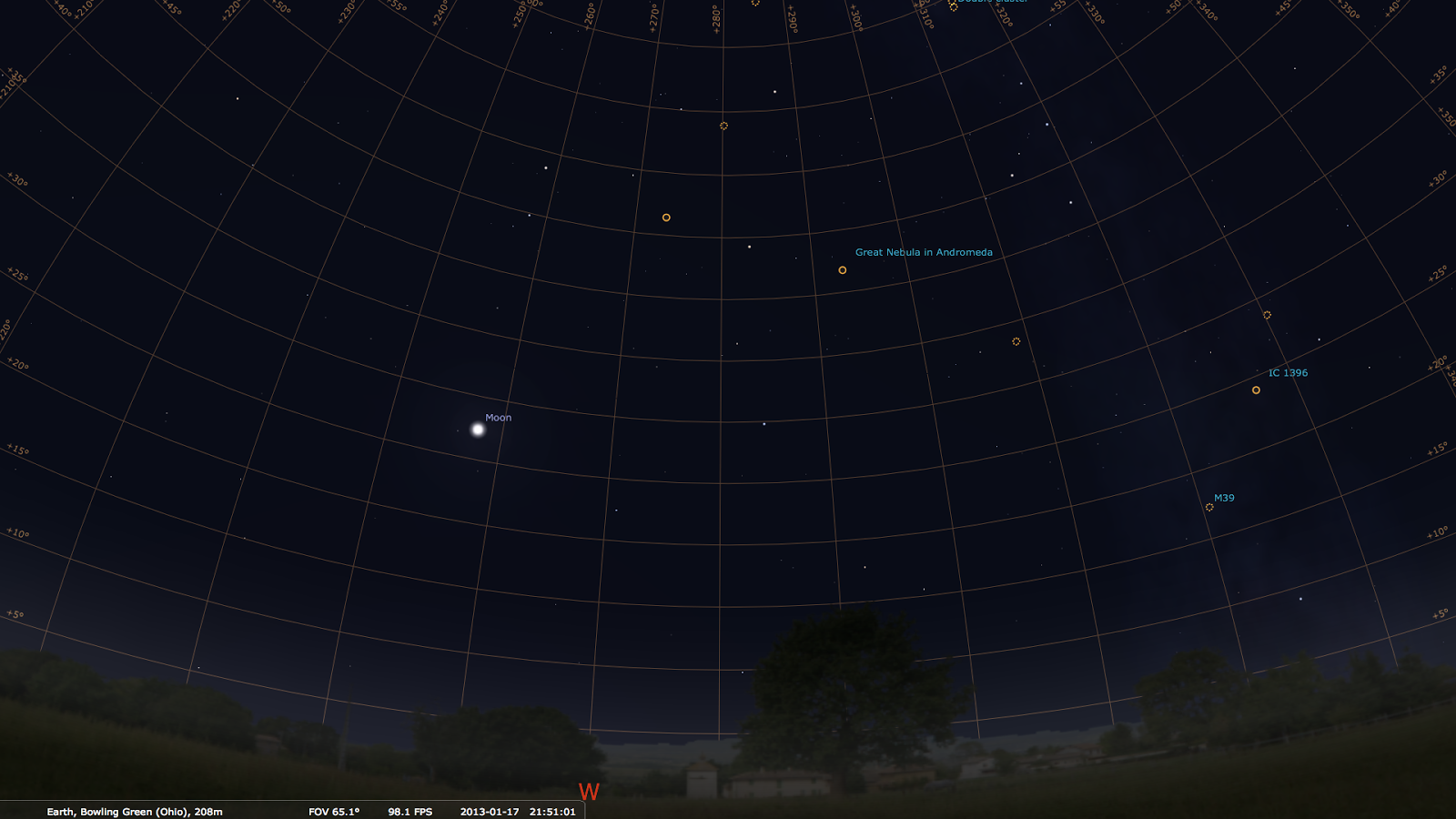
stellarium view of andromeda to the west
Planning my shot earlier last night, view generated in Stellarium

The hardest part was FINDING the faint gray blur in the sky in the first place! I turned my shutter speed down to 8 seconds to try to find a smear in the general area where I thought it would be. Nothing. Next I tried going from landmark to landmark - leapfrogging from the Moon to surrounding stars to the general area where I thought it should be.

300mm, 8 sec at ISO 1600 used to locate Andromeda for the first time

I saw a rusty orange smear on the 8 sec exposure. Having never seen Andromeda "in person" before, I had to assume that this was the real thing. 300+ exposures later, manually tracking using the visible stars as a reference, I stacked my batch and came out with something pretty cool (for a newbie). Next time finding it should be a breeze. It's fun knowing that I know where to look, or that I could show off by pointing it out to someone :)

I get a little blown away thinking about the light coming from ANOTHER GALAXY and landing in the back of my camera in the courtyard of my apartment complex - and the light that must surely be landing on me as well. It's kinda spiritual in an atheist way.

Update 1-21-2013: I did another pass at stacking in DSS and used Median Kappa Sigma (whatever that is!). I wanted to see if there was any more data hiding in there, so I really blasted it out with levels and contrast. I think dust trails are slightly more visible. I think this set is about maxed out, I need to try again from a darker sky and shoot for 400 subs.

andromeda
Re-stacked same image set, blasted out the levels and contrast in Photoshop