Showing posts with label galaxy. Show all posts

Sunday, April 14, 2013

Comet PanSTARRS buzzes the Andromeda Galaxy

Last month I posted my plan to photograph C/2011 L4 (PanSTARRS) as it approached the Andromeda Galaxy (M31). I was successful, but never got around to blogging about it, so here goes! On April 2, 2013 I went to Slippery Elm Trail at dusk to wait until the comet and galaxy were visible low in the NW sky.

I had all but given up on Andromeda for the season, because the view to the west from my apartment is blocked below 40ยบ or so. This far into Spring, Andromeda is well behind the building by sunset, and so low in the sky by the time it gets dark that taking detailed deep sky images with my camera probably wouldn't yield anything beyond a fuzzy blob. However, paired with a comet, a fuzzy blob would be a welcome target!

andromeda and panstarrs
180 subs, 30 dark, 30 bias; subs at 1.6 sec, ISO 1600, f/5.0, 190mm

I used bright stars in Cassiopeia and Andromeda to star hop to the approximate location. Once I knew I was in the area, I used the same technique from the last time I spotted Andromeda or PanSTARRS - and that is to take 10 second exposures and see what blobs appear. Then, once you have the images framed well, take exposures more appropriate for stacking (in my case, 1.6 sec at 190mm).

andromeda and panstarrs
One of my "finder frames" to help me zero in on my targets, 10 sec, ISO 1600, 190mm

Here is a wide field shot to show just how low M31 ended up at the end of my night. With all the atmospheric distortion and light pollution, it's a wonder I was able to see the darn thing!

interesting night sky objects
Background image is a single exposure at ISO 1600, 13 sec, 18mm

Friday, January 18, 2013

My first Andromeda in spite of the waxing gibbous

Although the nearly-half moon was in the same general vicinity as the Andromeda Galaxy, I couldn't pass up the first clear night in a week. I wanted to test my deep sky stacking abilities with a new target (I get the feeling my Orion Nebula posts are getting a bit tired).

I want to try re-stacking my batch with some different parameters, and I'll eventually re-shoot Andromeda without the Moon glaring at me.

I created this image with 318 subs, 30 darks, and 30 bias frames in Deep Sky Stacker (DSS). Total exposure time 7 min 45 sec.

andromeda galaxy 300mm lens
318 light frames, ISO 1600, 300mm, 1.6 sec each, stacked in DSS, adjusted in Photoshop
andromeda
Labeled version of the same picture above
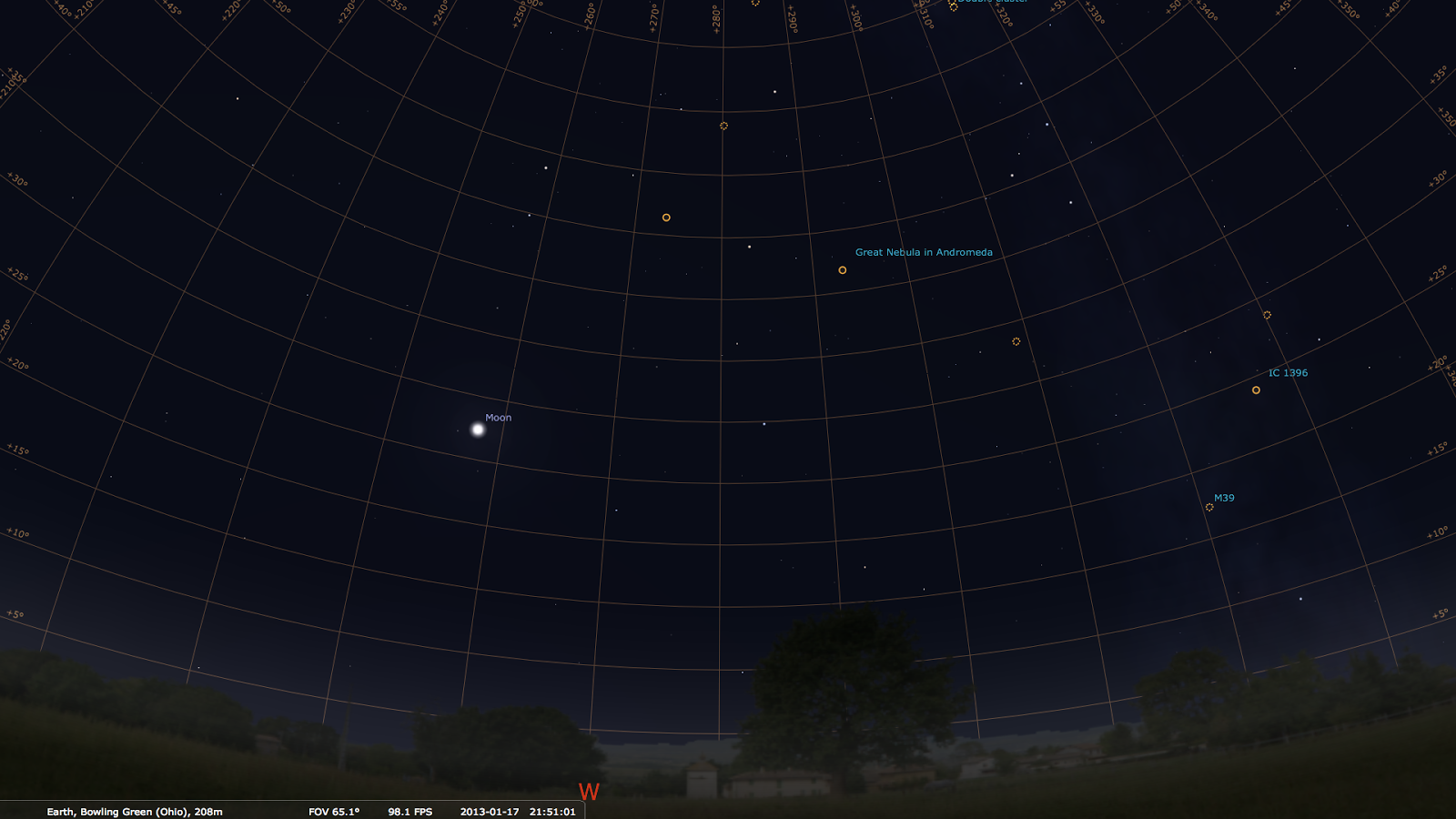
stellarium view of andromeda to the west
Planning my shot earlier last night, view generated in Stellarium

The hardest part was FINDING the faint gray blur in the sky in the first place! I turned my shutter speed down to 8 seconds to try to find a smear in the general area where I thought it would be. Nothing. Next I tried going from landmark to landmark - leapfrogging from the Moon to surrounding stars to the general area where I thought it should be.

300mm, 8 sec at ISO 1600 used to locate Andromeda for the first time

I saw a rusty orange smear on the 8 sec exposure. Having never seen Andromeda "in person" before, I had to assume that this was the real thing. 300+ exposures later, manually tracking using the visible stars as a reference, I stacked my batch and came out with something pretty cool (for a newbie). Next time finding it should be a breeze. It's fun knowing that I know where to look, or that I could show off by pointing it out to someone :)

I get a little blown away thinking about the light coming from ANOTHER GALAXY and landing in the back of my camera in the courtyard of my apartment complex - and the light that must surely be landing on me as well. It's kinda spiritual in an atheist way.

Update 1-21-2013: I did another pass at stacking in DSS and used Median Kappa Sigma (whatever that is!). I wanted to see if there was any more data hiding in there, so I really blasted it out with levels and contrast. I think dust trails are slightly more visible. I think this set is about maxed out, I need to try again from a darker sky and shoot for 400 subs.

andromeda
Re-stacked same image set, blasted out the levels and contrast in Photoshop