Showing posts with label M45. Show all posts

Sunday, November 2, 2014

Deep Sky Imaging with Canon T5i on Orion EQ-1: Pleiades and North America Nebula

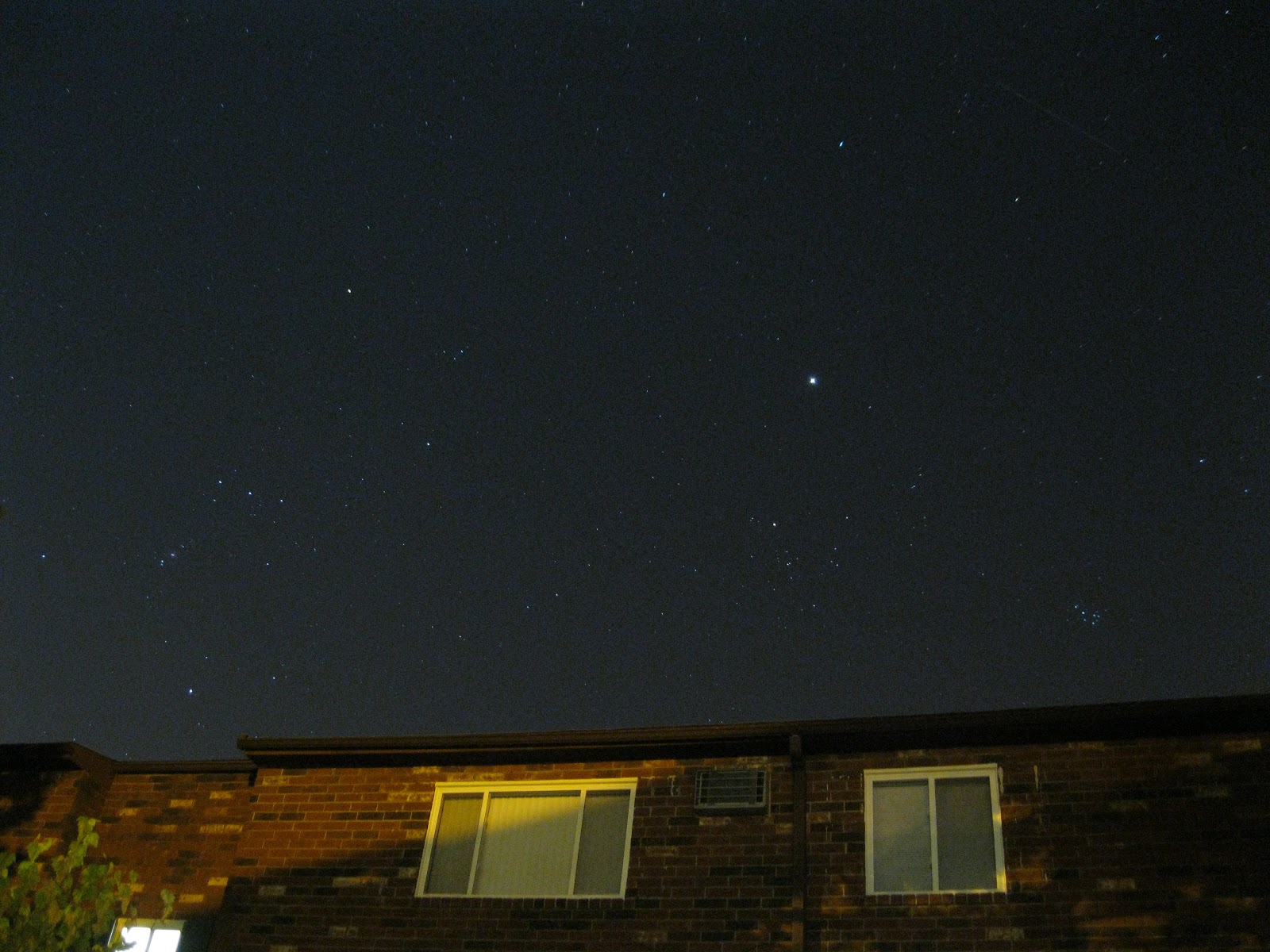
star trails over observation site
50 frames stacked in StarStaX each at ISO 800, 6.2mm, f/2.7, 15 sec

I set up my telescope and Canon T5i on the Orion EQ-1 mount (with motor attachment) on my back patio. It was a super clear night, and nice and dark with the exception of the waxing gibbous moon. I attempted to take a long stack of images for Andromeda, since last time was just a test with 14 light frames.

back patio observing with telescope
Patio setup, complete with candle and coffee. Tripod just barely on the patio to spot Polaris.

With my camera and tripod on the very edge of my patio, Polaris is just barely visible above the roofline. We're talking JUST BARELY - here is a photo to prove it, you can see the blurry gutter in the foreground!

polaris over roof
Polaris just barely visible over the roofline with a blurry gutter in the foreground, but I was able to keep my tripod on firm concrete without going into the yard.

I tried to slew to Andromeda and ran into a little problem. Actually I ran into the motor with this little metal pole on the side of the mount. It's the casing for the declination slow motion control screw rod thing. I messed with it for a little bit, but the cold was getting to me so I moved on to select a new target.

motor EQ-1 stuck in the way
EQ-1 motor getting in the way!

In hindsight, all I had to do is turn the declination axis around 90° to point the screw casing the other direction and let the smaller side pass by the motor. Another solution would be to spin the RA axis around the other way and turn the camera upside down - there are lots of ways to get to where you want to go on the sky but they're not always easy with a camera viewfinder.

I took stacks of both the Pleiades and the North America Nebula. the North America Nebula (NGC 7000) easy to find but tricky because it's not in my Stellarium catalogue. It's very close to Deneb (a bright star in the Summer Triangle) so in that sense it is very easy to find. I ended up using an asterism of 7 stars to help tell if I was in the right place - it's sort of like a sideways Orion right in front of the "Gulf of Mexico" part of the North America Nebula, so that's a good spot to aim for.

I had a real problem with a center hot spot in the middle, a vignette that turned the center of the image lighter gray even in the absence of actual nebula dust clouds. I tried to subtract this vignette to show what dust clouds are really there, but it's difficult to tease them apart. I need to do more of these to really up my processing skills. Really the three things that make a good deep sky photo are dark skies, good equipment, and processing skills -- if any of these is your weak link you can expect mediocre results.


north america nebula canon t5i 300mm
Canon T5i on Orion EQ-1 motorized, 154 subs, 40 darks, 90 bias, ISO 1600, f/5.6, 300mm, 15 sec, total exposure time around 40 minutes

sideways orion asterism in north america
The group of stars that helped me identify the right area near Deneb

north america nebula compare
Comparison between my image and a much nicer image by Ignacio Rico Gualda shows some faint light and dark patches around the "Gulf of Mexico" portion of the nebula, and some general-ish light patch in the middle. Just barely!

Next up, the Pleiades, "Seven Sisters," or M45. I've stacked the Pleiades before, but never really got much nebulosity. I've seen plenty of photos, always with some wispy blue clouds around the stars, but I was never sure if I really captured it or not.

The stack from last night puts that ambiguity to rest, with some clear wisps in the right places when compared to a Hubble image. I had a major problem with vignettes creating a hot spot right in the center of the frame. I tried to remove the gray circle in the middle while leaving the nebulosity, but it's a bit like throwing the baby out with the bath water.

pleiades with canon t5i 300mm
Canon T5i on Orion EQ-1 motorized, 44 subs, 40 darks, 90 bias, ISO 1600, f/5.6, 300mm, 15 sec, total exposure time around 11 minutes

pleiades with wisps
Close up crop comparing my image to a Hubble image of the Pleiades shows a couple wisps around the stars

So there you have it! Light polluted skies in Noblesville, Indiana and some free time on a Saturday night produced some pretty faint fuzzy blobs - but when you compare to the 'actual' appearance of the deep sky objects, some faint similarities do emerge. This comparison technique helped me confirm my first Milky Way capture, so I think these objects definitely count!

Monday, December 30, 2013

New Camera (T5i) Test on Fixed Tripod Stacking Method: Andromeda, Orion, Pleiades

I'm easing in to using my new camera, the Canon T5i, so I did a couple test shots on familiar objects using a technique I already know: Stacking short exposure images from a DSLR on a fixed tripod. I wasn't going for a new personal best or anything, but I wanted to take some short stacks to see how the new camera compares to the Rebel XT.

The first thing I noticed was that my memory card fills up A LOT faster with 18 megapixel RAW files. I only got about 150 shots where with the 8 megapixel XT I was getting closer to 250 in a single memory card. I actually filled the memory card, dumped the files, and went back out to shoot more a total of 3 times to take advantage of what seemed to be the one clear night in December.

andromeda galaxy canon t5i
Andromeda (M31) stack of 24 subs, 36 darks, 12 bias at 300mm, f/5.6, ISO 3200, 1.3 sec
orion nebula canon t5i iso 3200
Orion Nebula (M42) crop from stack of 42 subs, 36 darks, 12 bias at 300mm, f/5.6, ISO 3200, 1.3 sec
orion nebula canon t5i iso 6400
Orion Nebula 300mm crop, this time at ISO 6400, 11 subs, 23 darks, 21 bias, f/5.6, 1.3 sec
pleiades canon eos rebel t5i
Pleiades (M45) stack of 34 subs, 23 darks, 21 bias, 300mm, f/5.6, ISO 6400, 1.3 sec
Although I only did short stacks, I may have inadvertently achieved my best effort on the Orion Nebula with very minimal post-processing. Rather than working for an hour to bring out nebulosity, I had a fair amount of gray cloudiness emerge just from the fact that my ISO was higher. I think I like the ISO 3200 Orion better than the ISO 6400 due to the reduced noise. Either way, very promising for just a test shot of less than 50 light frames - and only 11 light frames for the ISO 6400 image!

Saturday, December 28, 2013

Canon EOS Rebel T5i ISO Test on Orion, Andromeda, and the Pleiades

I just got the Canon EOS Rebel T5i for Christmas, and I used it for the first time last night! I was able to photograph a few popular celestial objects, and I wanted to make some test sets to see the level of noise at ISO higher than what I was using previously (Rebel XT only goes up to ISO 1600).  What do these night sky objects look like at ISO 3200, ISO 6400, and ISO 12800? All of these tests are with single frames on a fixed tripod in 25ºF clear weather about 20 miles outside a large city.

Andromeda (M31) shot at ISO 3200, 6400, and 12800

Orion Nebula (M42) shot at ISO 3200, 6400, and 12800
Orion Nebula (M42) shot at ISO 3200, 6400, and 12800

The Pleiades (M45) shot at ISO 3200, 6400, and 12800
The Pleiades (M45) shot at ISO 3200, 6400, and 12800

As you can see the noise goes up a great deal between ISO 3200 and ISO 6400, but I think the jump in noise from ISO 6400 to ISO 12800 is a deal-breaker when it comes to using it for astrophotography. I think I'll try stacking some images to reduce noise in the 3200 and 6400 range.

Hopefully when I get my motorized EQ mount set up I won't have to resort to such high ISO to reveal faint deep sky objects, but this was a fun little experiment using fixed-tripod techniques I'm already familiar with!

Canon EOS Rebel T5i
Canon EOS Rebel T5i

Thursday, January 10, 2013

Pleiades in Deep Sky Stacker, 205 subs at 1.3 sec each

Ok, so after my moderate success with the Orion Nebula using short exposures stacked in DSS, I decided to try The Pleiades for my next target. I was hoping for something like this, but ended up with this:

Pleiades with 300mm lens
205 subs (f/5.6, ISO 1600, 300mm, 1.3 sec), 30 darks, and 30 flats bias stacked in DSS

So I didn't get much (if any) nebulosity out of the image, but at least my stars are round! I used a shorter-than-necessary exposure time to make sure I didn't get trails, which maybe sabotaged my ability to capture any faint wispy gas couds.

This stack is a total exposure time of 4 minutes and some change. It's possible that with a larger stack I could develop some wispyness in the area, but for now I'm pleased with a neat star cluster.

I tried everything I could to bring out the nebulosity in processing but I think it comes down to longer exposure time.

hdr toning photoshop
'Combing' streaks are visible as the image is pushed to the max

Update: I believe my 'flats' were actually 'bias' frames, I'm not sure how that may have affected my DSS session but I might try re-stacking with my bias frames in the appropriate spot.

Friday, November 9, 2012

Orion Nebula, Jupiter's moons, and the Pleiades on an early Winter morning

At around 5:00am ET on November 6, 2012 I was taking my new puppy out to piddle. When I looked up, I saw a brilliant clear sky with Orion, Taurus, and the Pleiades just over the roof of my apartment complex. It was about 30 degrees out, but I figured since I was up I'd jump on the opportunity. I went back inside to get my Canon with 300mm lens to take my first night sky photos since September.

My biggest problem the last time I tried using the Canon was the inability to focus on the stars. Through trial and error, I know it's possible to get the focus right after shooting a picture, viewing it and zooming to see the result. Luckily, I had a 25% moon that allowed me to auto-focus at a good distance, so these steps were not required.

I snapped a few pictures at a lower ISO and longer exposure time, and noticed since the zoom was so tight, the stars would form trails much sooner than in a wider frame. I cranked the ISO up to 1600 and reduced the shutter time to just 3.2 seconds. This gave me almost round stars (rather than lines) and a clearer view of the nebula clouds.

orion nebula with canon Canon Digital Rebel XT 300mm
Orion Nebula, ISO 1600, 3.2 sec, 300mm

orion nebula taurus and pleiades with Canon PowerShot A3100IS
Orion Nebula, Jupiter, and the Pleiades, ISO 400, 10 sec

Pleiades with Canon Digital Rebel XT 300mm
Pleiades, ISO 1600, 3.2 sec, 300mm

Jupiter with Canon Digital Rebel XT 300mm
Jupiter and 3 moons, ISO 1600, 3.2 sec, 300mm
orion nebula instagram
Crop of the Orion Nebula with HDR and filter on Instagram