Tuesday, January 7, 2014

38% Crescent Moon with Canon T5i: Frustrating First Images

I'm glad to unveil my first fixed tripod moon photos with the Canon T5i, however, these are probably the most frustrating images I've posted. It all started when...

My normal process for stacking moon photos from RAW DSLR files is to crop and convert them to TIF in Adobe Camera RAW then stack them in Registax. Simple! However...

Adobe Camera RAW doesn't recognize the CR2 (RAW) files from my T5i so I spent hours trying to update, reinstall Photoshop, patch the plugin, etc. - No success.

I discovered a work-around where I export the RAW files as TIF from iPhoto and then run a Photoshop script to open files as layers, crop them, then save layers as individual files.

I tried to open these TIF files in Registax and got a funky error, so I tried cropping them smaller (maybe the files are too large at 10MB each?) nothing, then tried saving them a BMP and loading them to Registax - it worked!

Then I stacked my BMP files and was underwhelmed by the results. Was it too hazy? Was there something wrong with my autofocus? Was it too cold? Was I just getting my hopes up too high for this new camera? I will have to try again on different moons to see if I can get better quality stacks.

moon registax canon t5i
Stack of JPEG images in Registax, each at ISO 100, 300mm, f/11, 1/50sec, High pass and desaturated in Photoshop

moon registax canon t5i
Stack of BMP images in Photoshop, each at ISO 100, 300mm, f/11, 1/50sec, High pass and desaturated in Photoshop

moon registax canon t5i
Stack 27 sec AVI in Registax, 30 fps taken with T5i at 300mm, desaturated in Photoshop

I had high hopes for the video but I forgot I would be getting frames at 1080p and not the full 18MP from the still shots. In this case, I think my best bet for videos is still iPhone + telescope and my best bet for still frames is at prime focus with the benefit of the T5i's live view to help me make finer adjustments than I was able to looking through the viewfinder on the Rebel XT.

So much more to learn and experiment with, I wish it would warm up!

tripod in the snow

Monday, January 6, 2014

Clear Skies at 10° Below

Mother Nature is cruel. We've got nice clear skies tonight in Brownsburg, Indiana. We've also got lows of -13°F with current actual temperature of -10°F and wind chill -38°F. My dog won't even walk outside without picking up her paws to give them relief from the frozen ground. I should have invested in doggie boots. We also taped the balcony door shut because snow was blowing onto a nearby electrical outlet through the cracks.

Still waiting for the chance to take my EQ mount out for its first go, but it'll have to wait. Tonight, a few iPhone shots will suffice.

moon snow iphone fish eye
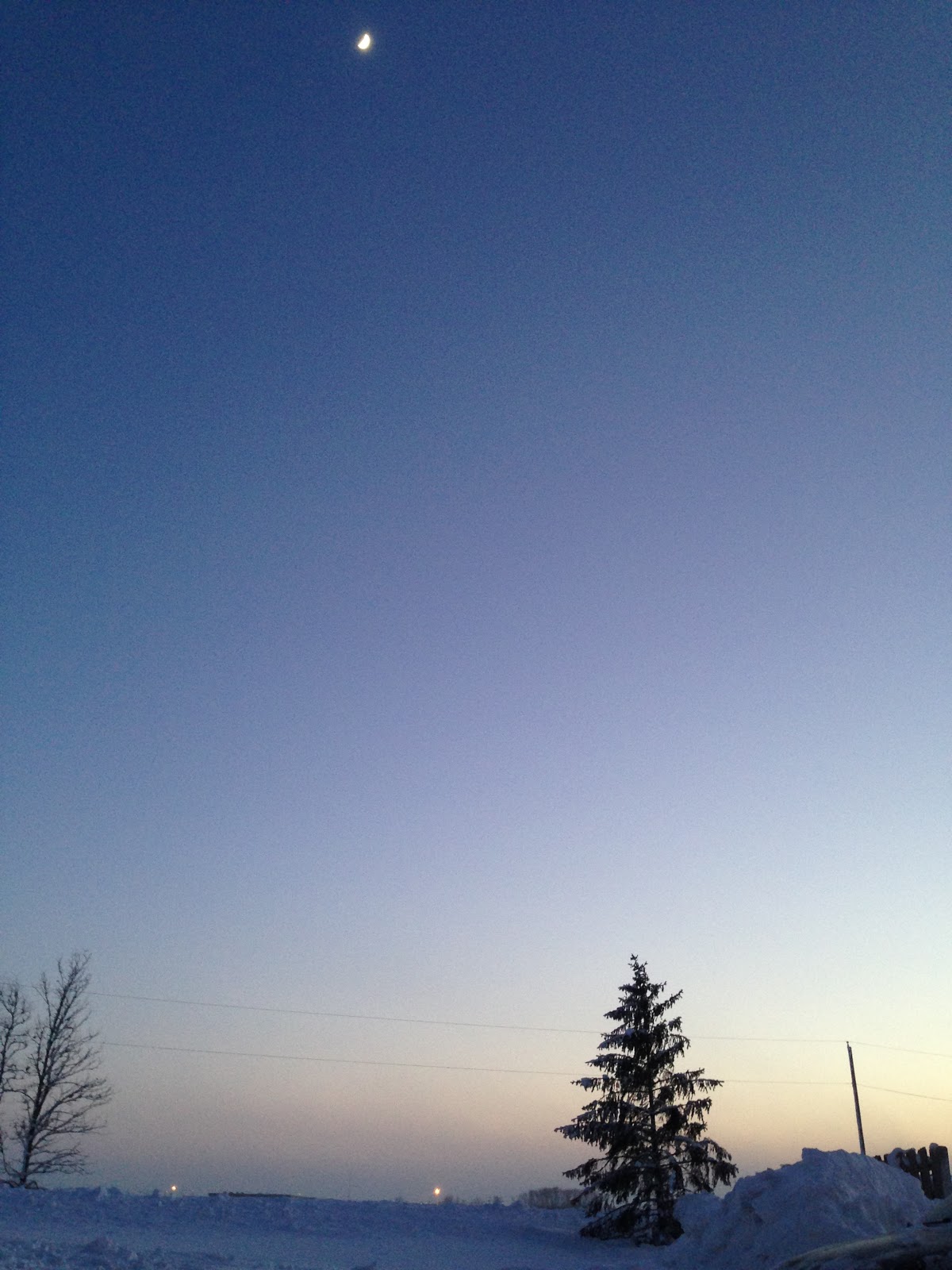
Clip on fish eye lens with iPhone, a beautiful "blue hour" icy scene

moon snow iphone
Sans fish eye, a beautiful icy scene

blizzard 2014 indiana snow on car
Yesterday was the second snowiest day (11.4 inches) in Indianapolis history (since 1884) coming in right behind March 19, 1906

Sunday, January 5, 2014

Crescent Moon and Crescent Venus at Sunset

It's going to be -15°F on Tuesday, and we're supposed to have a snow storm all weekend. My camera attachment for my Orion EQ-1 mount came in the mail so I can finally set it up - but... it's freaking freezing out and I'm half sick.

sunset january 3 in Indiana
ISO 800, 53mm, f/5.6, 1/800 sec

Pink and purple sunset with trees
ISO 800, 300mm, f/11, 1/50 sec

When I saw the crescent moon setting above some pink and purple clouds, I did take my camera and tripod out onto the balcony for a few shots. Can't waste this weather. Clear skies were a rare commodity in December.

I'm eager to try a "real" moon photo with my T5i, stacking in Registax from a fixed tripod. For now, I just have a few frames taken while the sky was still blue.

crescent moon january 3 2014
ISO 200, 300mm, f/11, 1/40 sec

crescent moon january 3 2014
Originally ISO 200, 300mm, f/11, 1/160 sec, brightened in Photoshop

artistic moon with jet contrail
Same image as above with the settings jacked up to look cool!

crescent venus with DSLR and 300mm lens
ISO 800, 300mm, f/11, 1/250 sec
I'm really surprised how clear Venus turned out! I didn't even recognize it at first, I saw a bunch of contrails and jets and then this white dot about to go behind the clouds. I figured it must be Venus because it has been extremely bright recently, but I never thought I'd be able to resolve the crescent shape with just my camera lens. Maybe it's sharper because of the high f-stop, or maybe it's just my first time shooting Venus with my higher resolution camera. Either way, this is pretty cool!

Auriga Bounty: Cheshire Cat Asterism, M36, M37, M38

The constellation Auriga is not one I have spent much time in before last night. With the exception of the bright star Capella, this large pentagon did not catch my attention until several objects were included on this month's observing list. Specifically, Messier objects 36, 37, and 38, and a playful asterism known as the Cheshire Cat since the name was coined by Ben Cacace in 2002. 


M37 open cluster in Auriga
Stack of 36 subs, 36 darks, 12 bias, ISO 3200, 1.3 sec, f/5.6, 300mm

Open cluster M37 was just far enough away from M36 to not fit in the same frame with my lens zoomed in to 300mm. I attempted to make a mosaic of the clusters in relative position to each other, but there wasn't much overlap and it looked like two separate photos placed next to each other. Not quite the effect I was going for, so I just posted them separately. 

I did get the Cheshire Cat asterism, M36 and M38 in the same field of view at 300mm. Two Messier objects in the same shot, and 3 observation list items in a single frame! Now that's efficiency!


M36 and M38 open cluster in Auriga
Stack of 68 subs, 36 darks, 12 bias, ISO 3200, 1.3 sec, f/5.6, 300mm

Do you see the asterism? It's actually a lot easier to see through the camera viewfinder and in single exposures. In these stacked images, the fainter background stars emerge and make it more difficult to recognize the pattern. 


cheshire cat asterism iso 3200
Cheshire Cat single frame from camera ISO 3200, 1.3 sec, f/5.6, 300mm

I'll try to help you out! Below is the same image as the one above at a 90° counter-clockwise rotation. I've taken the Cheshire Cat face and overlayed it onto the asterism in an animated .GIF image. The eyes don't quite line up, but it's recognizable as a face nonetheless - classic example of pareidolia, the human tendency to recognize images and shapes in otherwise random patterns.


Turn up your screen brightness if you can't see the face

Cheshire Cat asterism

I'm well on my way with 4 objects from January's novice/urban observing list. Woohoo! I'm waiting for this severe cold spell to pass before trying to set my EQ mount up outside. M42 is going to be my first target!

Friday, January 3, 2014

Hunting Quadrantid Meteors with a Frosty Lens

I woke up and looked at the weather on my phone. To my surprise it looked "mostly clear" at about 2:00am ET here in Indiana. I took Katie out to pee and noticed that indeed the sky looked very clear (especially compared to the weeks of clouds this December). I had already planned on photographing the Quadrantid meteor shower tomorrow night, but then learned that this shower has a notoriously short peak window. Turns out the shower peaked several hours ago, and that I probably wouldn't see any tomorrow night, so I better give it a go right now!

DSLR hunting quadrantid meteors
Leaving my T5i out on the balcony until the cold air kills the battery, or the memory card fills up, whichever comes first. At 6°F my money is on the cold.

I went out onto my West-facing snow-covered balcony and aimed my camera to the NW above the light pollution as much as I could. The radiant point is behind the roof line to the East, but I should be in good shape since I'm within 30 degrees of the radiant point - and maybe I'll even get some longer trails this way! Here's hoping, you can't bag any meteors if you don't try.

I used the same camera settings that produced two Geminid meteors last month, ISO 800 because the light pollution is too great any higher (kind of a waste now that my ISO max is 12800 on the T5i). I'm shooting at 18MP now instead of 8MP so anything I do catch should cover more pixels, and I should have even cleaner images at ISO 800. Because my files are larger, I am shooting in JPEG instead of RAW, which raises my max images from 150 to 495 on my memory card. A 64GB memory card is on its way in the mail, but I'm doing what I can with 4GB for now.

I left my camera out overnight in the cold, and when I got it at 7am in the morning it looked like this...

canon camera covered in frost

camera lens covered in frost

Yep the camera and lens got a little frosty! I let them air dry on the mantle and tested everything out afterward and seems to be working fine. Could have been a lot worse!

As for the meteors, well I didn't see any in the hundreds of pictures that I took. I'm surprised the battery held up as well as it did! I think I had around 600 images to sift through. They did make for one nice star trail though - with an interesting twist thanks to the frost on the lens. Looks so bizarre!

long exposure with frosty lens
Single frame at ISO 800, 15 sec, f/4.0, 18mm

star trails with lens flare
Stack of 651 frames
bokeh and rainbow from frost on lens
With some slight contrast and white balance adjustment, this picture looks quite ethereal.