Showing posts with label iridium flare. Show all posts

Saturday, August 2, 2014

Iridium 39 Over Indiana, Snapseed Quick Edits and Star Trails

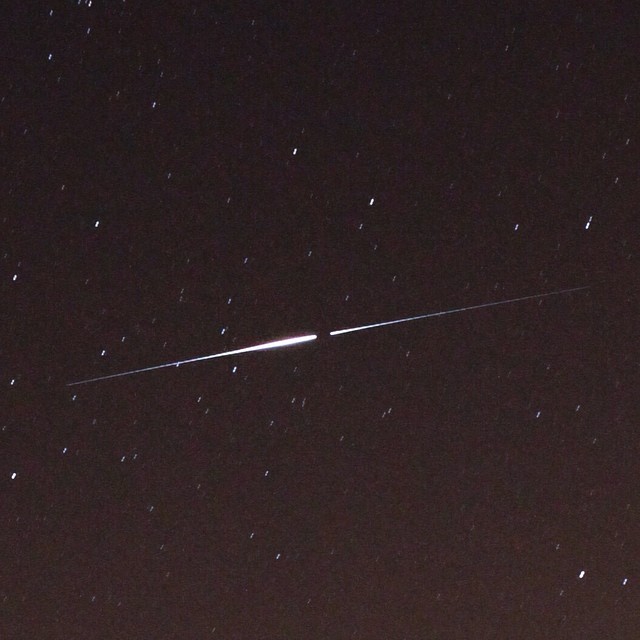
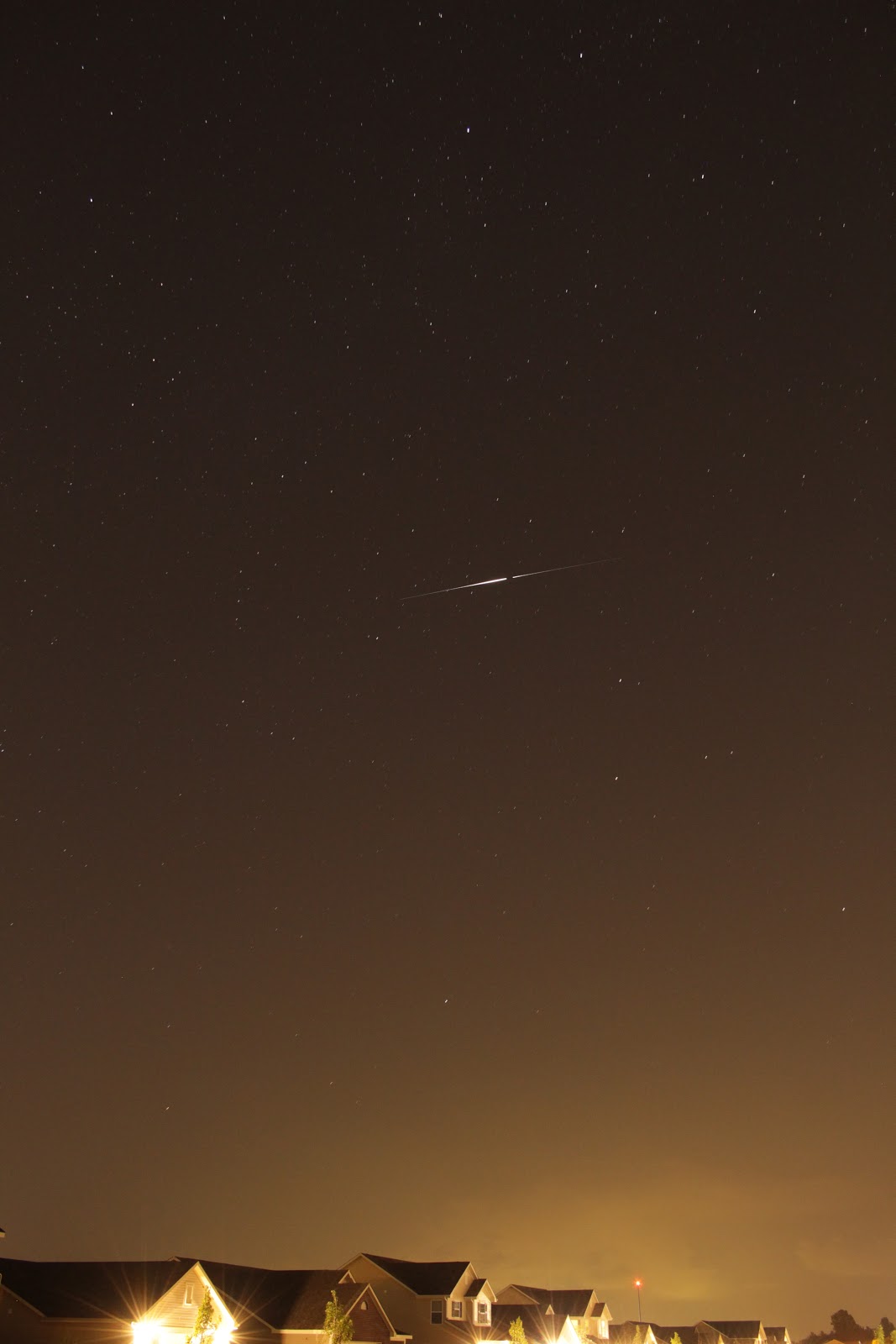
I used Heavens Above to predict a -7.6 iridium flare about 3 days in advance. The flare was set for 11:05pm to the NE at 37° above the horizon. The NE is my darkest sky because Indianapolis lies to the SW of my location.

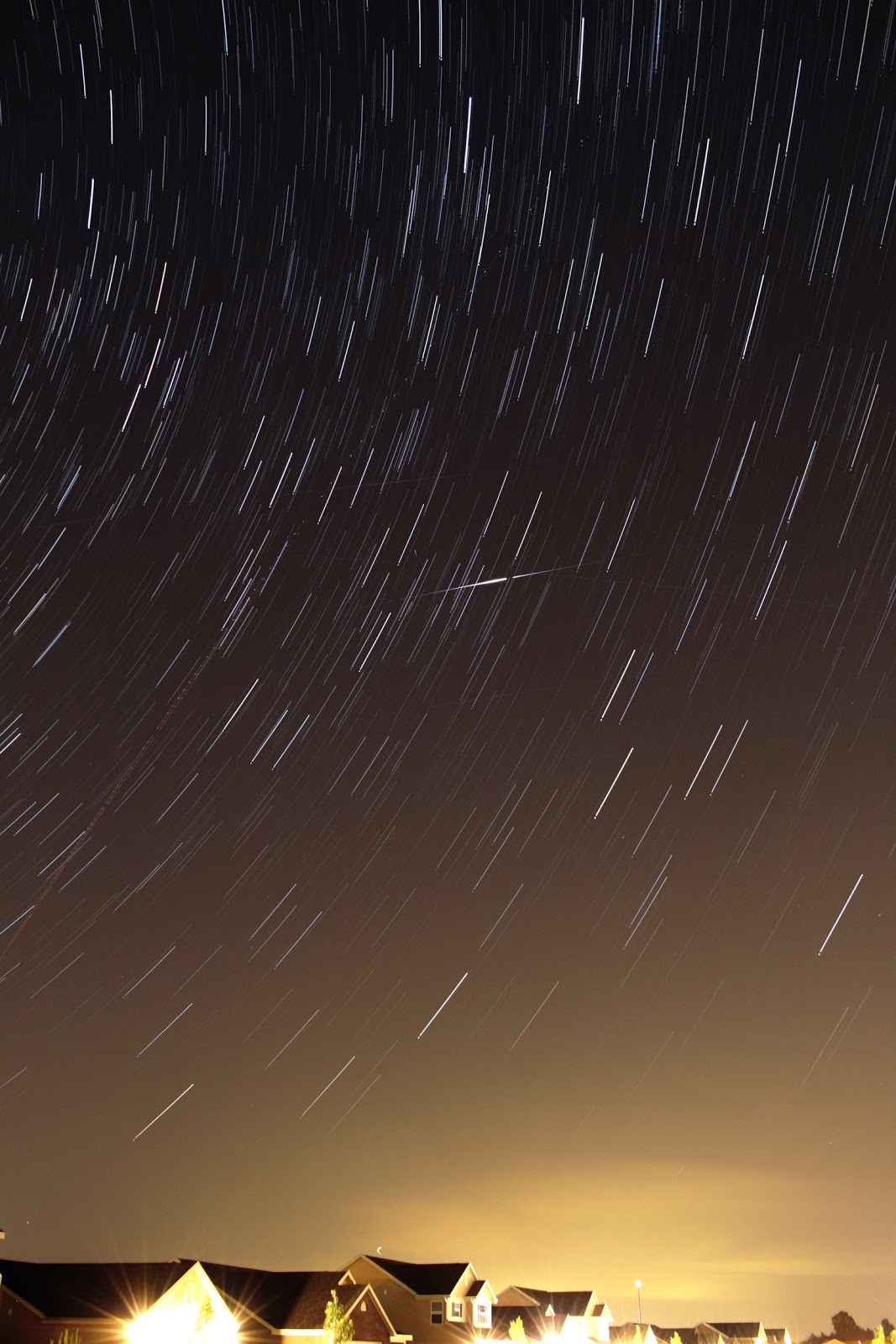
I saw several satellites in the sky before the flare, and a few planes but not enough to ruin my shot. I started my camera on back to back shots at f/5.6, 18mm, 15 sec, 1600 ISO. I ended up with the typical yellow light dome over the horizon, but when I ran the photos through Snapseed on my phone, the "automatic" filter did a super quick and actually very decent job highlighting the stars against a natural looking sky. I guess that's why they call it SNAPseed, it's a snap!

It blows my mind that it's possible to calculate that the right antenna of a satellite 1192 km away will catch the sun just right to shine a beam of light onto Noblesville, and to predict it to the exact second. 

iridium flare 39
2 frames stacked to show full duration of the flare, close crop

iridium flare 39
2 frames stacked, no other edits - the flare was about 30 seconds long so each of my 15 second frames caught part of it

iridium flare with star trails
StarStaX stacked star trails with Iridium 39 flare - "automatic" filter in Snapseed

iridium flare 39
2 frames with the flare by itself, also edited in Snapseed "automatic" mode

Friday, September 7, 2012

Iridium flare photo on iPhone

I haven't done an exhaustive search, but I can't recall ever seeing another iridium flare photo taken with an iPhone. I've seen quite a few long exposures of ISS passes, but this might be the first iridium flare photo captured directly on an iPhone camera.

I used Slow Shutter Cam () in Light Trail mode with light sensitivity to 1 and exposure time on 'bulb.' This -8 magnitude flare from Iridium 68 was visible at 5:58 am over Bowling Green, OH. I woke up at 5:50am, threw on some flip flops, and ran outside in time to see it. I propped my iPhone up against the rear window of my car to try to stabilize it.

I hadn't anticipated the bright moon would be so close to the satellite in the sky. I must say, for a -8 magnitude flare, I was a little underwhelmed. The waning gibbous was only about 3 fists at arm's length away from the flare (ballpark 30 deg or so) - so I guess I'm lucky to have seen it at all.

There is another -8 magnitude flare predicted for Saturday night over Bowling Green at 8:15pm, 47 deg altitude to the North.

iridium flare photo taken with iphone
100% crop from original photo. Iridium 68 on 9-7-12
In this zoomed in crop of the original photo, you can see the bright middle of the flare as it starts to fade out moving from top to bottom. Normally, iridium flares fade in and fade out over a period of about 30 seconds, producing long streaks on time exposed frames. However, because of the proximity to the moon, and the low light sensitivity on the iPhone camera, it's all over in a flash (har har).

iridium flare photo taken with iphone
Original photo on iPhone
Iridium 68 passing over Bowling Green Ohio
Satellite Tracker app shows proximity to the moon
mantis on a window
Bonus! I also saw this guy on the window on my way inside
This was also my first time seeing an iridium flare in person! Definitely worth waking up a little early for. Alright, it's Friday, back to bed!

Tuesday, June 19, 2012

Manipulating the Heavens Above URL to track satellites further back in time

In my previous post, I noticed something in my star circle photo that wasn't a plane like the rest of the non-star objects. Based on the appearance of the streak, I concluded that it was an Iridium flare cut in half by my camera's processing time between two consecutive 15 second exposures.

Iridium 80 above Indiana on June 15, 2012
Iridium 80 above Indiana on June 15, 2012 at 11:30pm

How could I prove that it was an Iridium flare? How would I know which individual satellite is in my image? I tried looking up the object on Heavens Above, but the Iridium flare data only went back to the past 48 hours. I noticed that the Heavens Above URL basically includes the information used to calculate the numbers in the table, so I started to mess around with the values.


Here is the URL for the "previous 48 hrs" Iridium flare list (on the day I wrote this):
http://www.heavens-above.com/iridium.asp?Dur=2&Date=41077.7391100926&lat=39.95502&lng=-86.00647&loc=Fishers%2c+IN&alt=0&tz=EST


Notice that the URL itself includes the information displayed in the table. We have the coordinates, the time zone, and values of Dur=2 and Date=41077. Dur=2 stands for duration of 2, or two days displayed on the table. The date threw me off at first, because we are definitely not in the year 41077 yet! I changed the date to Date=1 and the table jumped to January 1, 1900.

So the date=## in the URL is the number of days since January 1, 1900. I was able to find my Iridium flare from last weekend by turning the date back by a couple of days: From 41077 to 41075.


Now my Iridium flare from Friday night shows up in the table! Sure enough, a flare of magnitude -4 at 30° elevation in the NE sky fits the image I captured perfectly! It looks like Iridium 80 was the culprit.

Star trails and possible Iridium flare over Indiana

long exposure star trails over indiana

These two images were my longest star trail stacks to date, the first with 107 and the second with 109 stacked images (15 sec exposure each). My plan was to tape the shutter down and let the battery die, but I came out to find my first exposure had stopped because the tape lost its grip after an hour and a half or so.

long exposure star trails over indiana

My second image began at around 2:00am and went until the battery died. I taped the shutter down while the camera was on a table instead of pressing down on the camera while mounted on the tripod, this let me press down with more force to secure the shutter with my mechanical pencil eraser.

possible iridium flare
Possible Iridium flare cut off by my camera between exposures

Here is a close-up of an object in the first photo that does not appear to be a plane like the rest of the lights. My guess would be that this is a satellite coming into view that is cut off by the 15 sec exposure. This seems to fit the description of an Iridium flare coming into view and fading out again without traveling very far across the sky. The Iridium flare on Wikipedia shows a 30 second exposure that matches the beginning and end of my flare, which was cut in half by the camera's processing time.

Update: Tracking backwards on the Heavens Above website, I concluded this was, in fact, Iridium 80 at 11:30pm at 30 deg elevation.

I don't usually let to take photos until the battery dies, because I'm nervous about leaving my camera out in front of my apartment complex. That's why it was such a treat to visit my brother at his house in Fishers, because I could let my camera go and go!

Here's a picture of my brother learning how to do star trail photography with his Nikon D3000. His trails didn't turn out as good as mine, but he's just beginning!

night photography
Brian getting into astrophotography for the first time

He was so excited, we even got up on the roof to check out the view - deciding later that the roof was too steep for a tripod observatory.

sunset rooftop view photo with iphone
Rooftop view of Fishers, IN taken with iPhone at 9:53pm

Finally, here is a video showing the creation of the star trails. I saved each composite image in StarStaX so the trails appear to grow over time.