Phil Dimpelfeld from the Indiana Astronomical Society creates a Novice/Urban Observing List each month for newbies like myself with not-so-dark skies and not-so-powerful equipment. Phil recently announced the addition of a Level 1 list for true beginners to get familiar with important and recognizable objects. I'll continue pursuing the Level 2 list with slightly more challenging objects.
Last month I squeaked by with 7 objects (6 required to "complete" the challenge). I got 6 objects in the same night in a little mini Messier Marathon with my T5i on a fixed tripod. I ended up with 1700 frames to stack and process, and didn't post the images until well into April (which is also why this post is late).
To save time, I've also started linking results to the original observing list post - which also cuts down on redundancy. Now as I image the objects I'll return to the original post and check them off with links to the respective observations.
April looks like another time-saving month, with several objects in close proximity. This list includes two sets of triplets that should easily fit into my field of view at 300mm.
“Algieba” (Gamma Leonis), Double Star in Leo, 10h 20.0m, +19° 51', mag = 2.2, 3.5, sep = 4.4"
“The Ghost of Jupiter” (NGC 3242), Planetary Nebula in Hydra, 10h 24.8m, -18° 38', mag = 7.8, size = 45" x 36"
✔ M95, galaxy in Leo, 10h 43.9m, +11° 42’, mag = 11.0, size = 4.4' X 3.3'
✔ M96, galaxy in Leo, 10h 46.7m, +11° 49’, mag = 10.5, size = 6' X 4'
✔ M105, galaxy in Leo, 10h 47.8m, +12° 35’, mag = 11.0, size = 2.0'
✔ NGC 3384, galaxy in Leo, 10h 48m, +12° 37′, mag = 10.9, size = 5′.5 × 2′.5
✔ M65, galaxy in Leo, 11h 18.9m, +13° 6’, mag = 10.5, size = 8' X 1.5'. (Part of the Leo Triplet, with M66 and NGC 3628.)
✔ M66, galaxy in Leo, 11h 20.2m, +13° 0’, mag = 10.0, size = 8' X 2.5'
Langrenus, crater, first quarter Moon
Mare Frigoris, last quarter Moon
Challenge Object:
Xi Ursae Majoris, double star in Ursa Major, 11h 18m, +31° 32’, mag = 4.3, 4.8, sep = 1.7”. First double star confirmed to be a true binary star (orbital period = 60 years).
Notes:
M65, M66, and NGC 3628 form the “Leo Triplet”, a nice trio of galaxies in Leo that are often photographed together. NGC 3628 is significantly fainter than M65 and M66, so is often more difficult to see.
The galaxy NGC 3384 is very close to M105, and (to my eye) is very similar. How did Messier miss this one? M95, M96, M105, and NGC 3384 are members of the “M96 Group” (or the “Leo I Group”).
My learn-by-doing astronomy and astrophotography blog and observing journal
Thursday, April 10, 2014
Sunday, April 6, 2014
Star Hop to Open Clusters M48 and M67
I've been getting a lot better at locating Messier objects, particularly when they have a good anchor star or set of pointer stars to help guide me. I'm using a ball and socket tripod head, so I'm manually slewing my camera to locate the objects with no indication of location or angle.
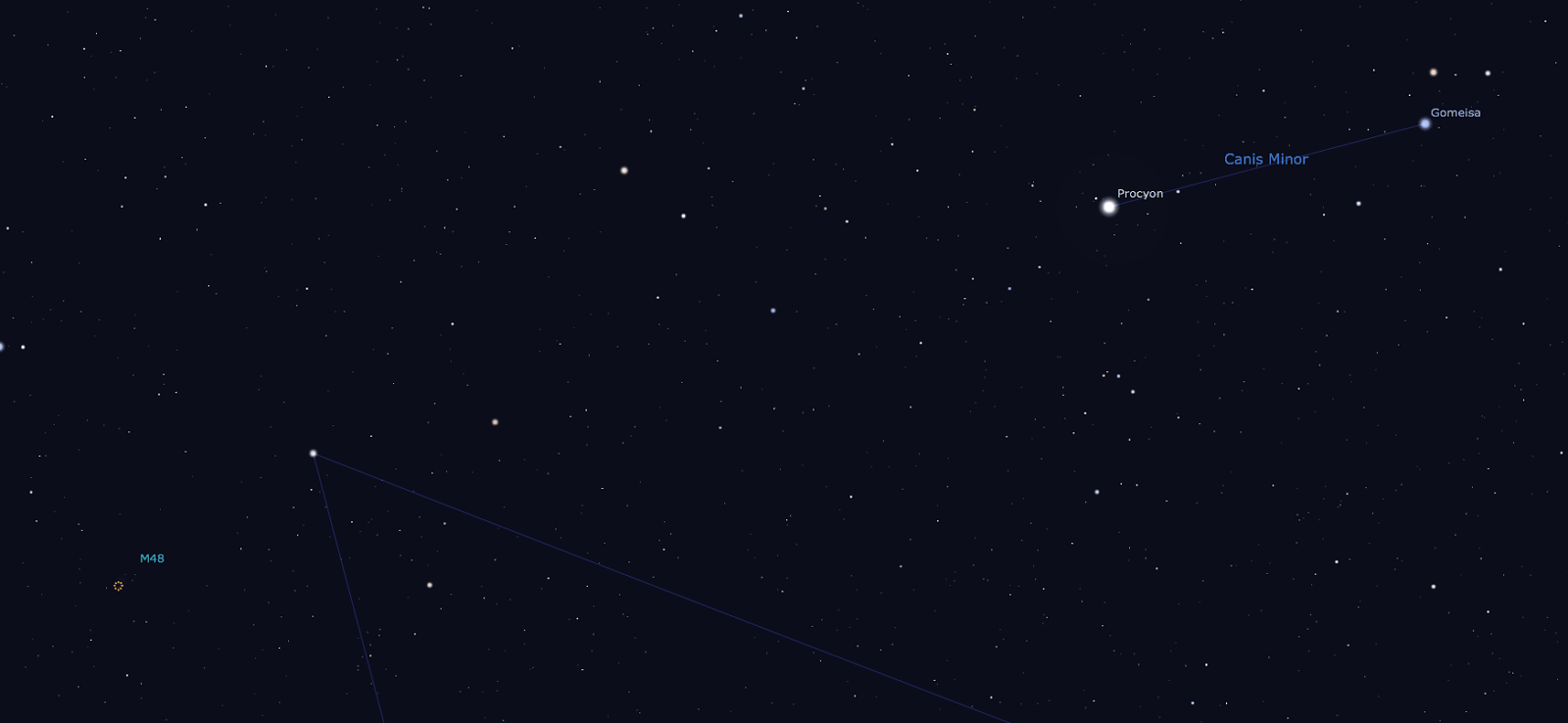
First up, M48 an open cluster in Hydra (although it's really much closer to Monoceros). To locate this cluster, I used the constellation Canis Minor as pointer stars, with M48 sitting on the Procyon side (left).
Woohoo! These two objects not only complete my March observing list, but they bring my Messier Object grand total to 49 out of 110. Keep chipping away!
First up, M48 an open cluster in Hydra (although it's really much closer to Monoceros). To locate this cluster, I used the constellation Canis Minor as pointer stars, with M48 sitting on the Procyon side (left).
![]() |
| Stack of 121 subs, 85 darks, 78 bias at ISO 3200, 300mm, f/5.6, 1.3 sec |
![]() |
| Screenshot from Stellarium showing Canis Minor as pointer stars for M48 |
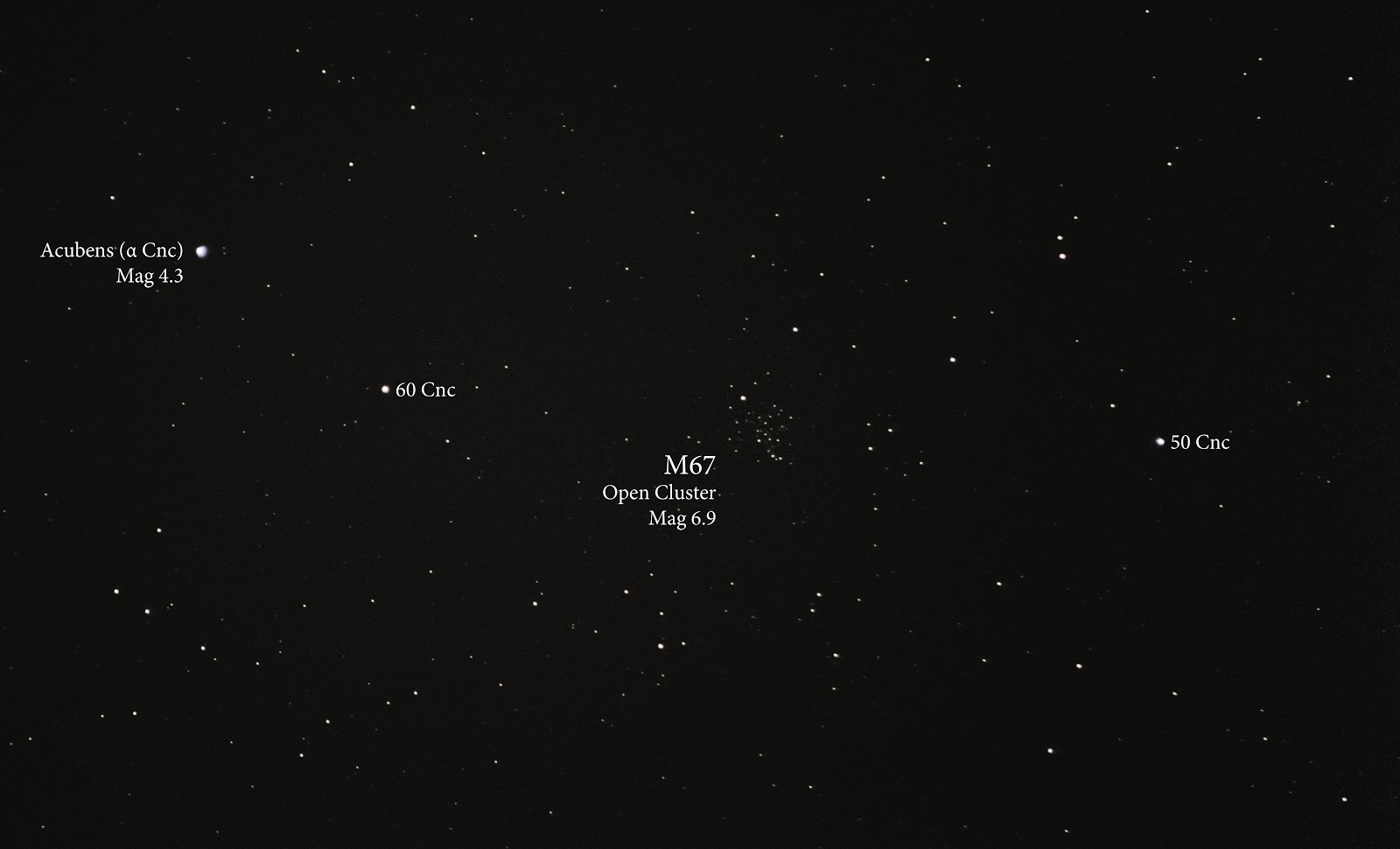
Next up, M67 is an open cluster in the bottom of Cancer. This one is a piece of cake to find because it was within the same frame as Alpha Cancri at 300mm zoom. All I had to do was use Alpha Cancri as an anchor star and M67 was right there.
![]() |
| Stack of 101 subs, 85 darks, 78 bias at ISO 3200, 300mm, f/5.6, 1.3 sec |
Revisiting the Beehive Cluster (M44) with Canon T5i
The last time I photographed M44 was in February 2013 in Bowling Green, Ohio. Now, more than a year later, with more experience under my belt, and a new camera, I was interested to see what I could come up with.
Delta Cancri (δ Cnc) makes an easy anchor to target when locating M44. Fun fact from Wikipedia, Delta Cancri also goes by the traditional name Asellus Australis which in Latin means "southern donkey colt" (can't say I see the resemblance).
Compared to the measly 24 light frames at ISO 1600 last time, there are definitely more stars visible in my latest attempt! Still using the fixed tripod technique, however, so I'll be interested to see how this cluster really shines with an EQ mount.
Delta Cancri (δ Cnc) makes an easy anchor to target when locating M44. Fun fact from Wikipedia, Delta Cancri also goes by the traditional name Asellus Australis which in Latin means "southern donkey colt" (can't say I see the resemblance).
![]() |
| Stack of 92 subs, 85 darks, 78 bias at ISO 3200, 300mm, f/5.6, 1.3 sec |
Compared to the measly 24 light frames at ISO 1600 last time, there are definitely more stars visible in my latest attempt! Still using the fixed tripod technique, however, so I'll be interested to see how this cluster really shines with an EQ mount.
Double Star Iota Cancri with 300mm DSLR Lens
You don't always need a telescope to split double stars. Zooming in with a 300mm telephoto lens is enough for me to resolve separations of about 28" (arcseconds), so with a separation of about 30" Iota Cancri was within range.
The double star is in the upper left arm of Cancer, and although Cancer is itself a fairly dim constellation, this makes it an easy target to spot. The two stars are supposed to appear yellow and blue/white in a scope, but in my camera they came out more red and blue.
I used the same stacked-background single frame insert technique that I used on 8 Lacertae and I'm pleased with the results again!
The double star is in the upper left arm of Cancer, and although Cancer is itself a fairly dim constellation, this makes it an easy target to spot. The two stars are supposed to appear yellow and blue/white in a scope, but in my camera they came out more red and blue.
![]() |
| Composite image: Background stack of 29 subs, 85 dark, 78 bias at ISO 3200, 300mm, 1.3 sec, f/5.6 Insert single frame at ISO 3200, 300mm, 1.3 sec, f/5.6 |
I used the same stacked-background single frame insert technique that I used on 8 Lacertae and I'm pleased with the results again!
Saturday, April 5, 2014
M81 (Bode's Galaxy) and M82 (Cigar Galaxy) with DSLR on Fixed Tripod
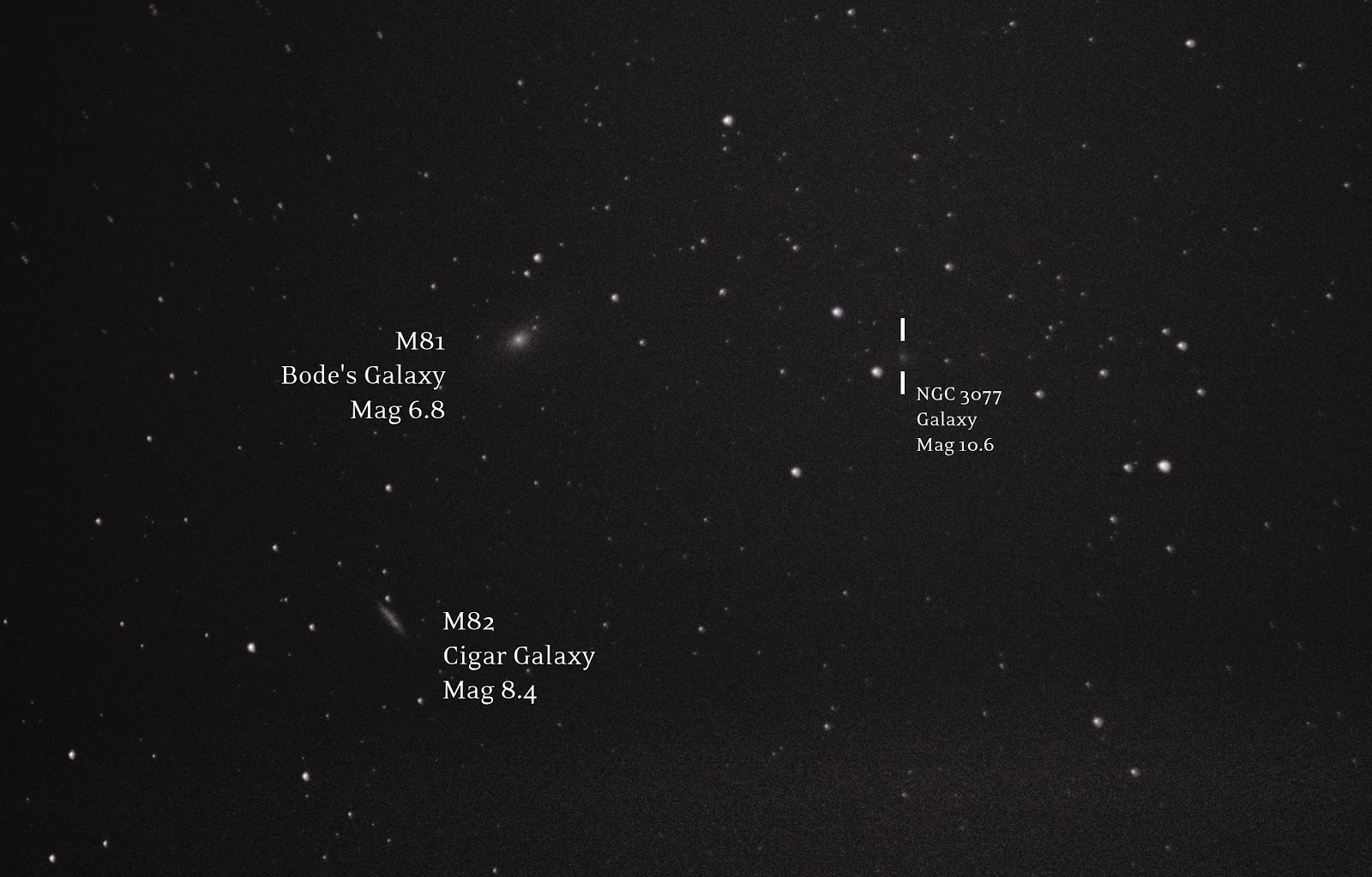
Using my tried and true DSLR on fixed tripod technique to stack hundreds of light, dark, and bias frames in Deep Sky Stacker produced an image I never thought I'd see without a telescope and tracking mount: 3 galaxies in one shot. Very cool! I'm still amazed what a simple DSLR on a fixed tripod can do.
Because these galaxies are so close to the celestial pole, they didn't appear to move as fast as objects near the celestial equator. I definitely took advantage of this and increase my exposure time to 1.6 seconds instead of my usual 1.3 seconds.
![]() |
| Stack of 303 subs, 76 darks, 71 bias frames at ISO 3200, 300mm, f/5.6, 1.6 sec Total exposure time after stacking approx 5 min |
![]() |
| Same image as above with labels |
Labels:
Bode's Galaxy,
Cigar Galaxy,
deep sky,
M81,
M82,
NGC 3077
Subscribe to:
Posts (Atom)