Wednesday, February 27, 2013

Having some fun with the Alien Sky app for iPhone

Here are a couple examples of the fun effects you can add with Alien Sky () for iPhone. I've found that a little goes a long way! The filters, I think, are underrated and usually take a back seat to the planet and galaxy images you can add into the scene. However, the filters themselves are quite nice and create interesting moods with a variety of colors.

I hate astro-fake-tography, but as long as there is full disclosure apps like these can be fun to play with (and day dream about being able to capture images like these out in the field). So, again, these images have simulated star fields!

alien sky app example
Added stars and a color filter

alien sky app example
Added stars, the Milky Way, and a cropped image on the camera LCD

example image alien sky app
Added a Sun lens flare and high contrast filter

example image alien sky app
Added stars and a color filter

Monday, February 25, 2013

It's the Great Pumpkin! A big orange moon rises February 25, 2013

A clear sky overhead and distant hazy clouds on the horizon made perfect conditions for a spectacular orange moonrise just after sunset this evening. I tried stacking my fuzzy orange moon in Registax, but there's no helping the amount of distortion from the hazy horizon. Better to enjoy the beautiful color and not worry about the noisy details.

camera at sunset

big orange moonrise
I was waiting for the moon to rise next to the giant red light until I realized THAT was the moon!

big orange moonrise
Watching the moon rise in real time, it only took a few minutes to clear the treeline

big orange full moon
A wonderful orange jewel. The cell tower provides a bit of scale.

big orange full moon
Better than I had hoped for!

big orange full moon
A mysterious line in the sky, well above the trees. At first I thought it was a piece of grass until a power-walking couple mentioned it as well. Very small jet contrail? Hmmm.

big orange full moon
1/80 sec, ISO 200, 300mm, f/5.6

First time using Registax, tinkering with the 99% full Snow Moon

It never occurred to me to stack images of the moon, I guess because it's already so bright I figured what's the point. However, stacking isn't about making objects brighter, it's about reducing noise. In most cases, this is useful for when you want to brighten an image without losing detail to noise. The stacking = brighter fallacy is difficult to shake, but I'm glad I can now see the benefits of stacking bright objects!

20 subs each at ISO 200, 1/1600s, f/5.6, 300mm


Here are the results of my first time using Registax (free software) to clean up my moon. Using a Canon Rebel XT (only 8 megapixels) I figured my moons would be destined to have a little grit on them even with a 300mm lens. Boy was I wrong! I am still blown away by how clear my image turned out with very little tinkering.

It's a little sad, however, knowing that all my previous moon photos COULD have been so much better had I learned this technique sooner.

Wednesday, February 20, 2013

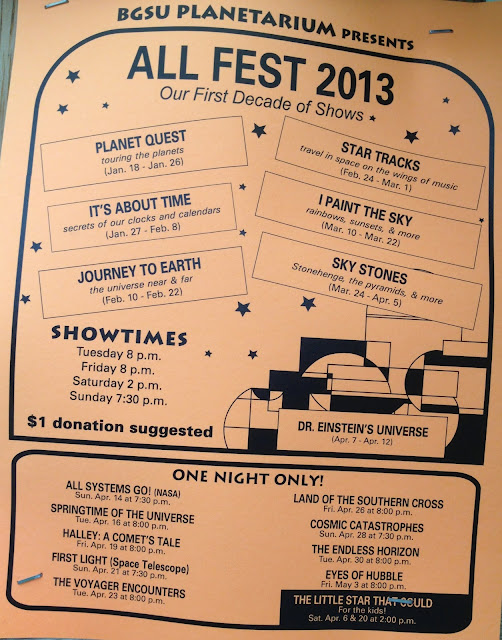
BGSU Planetarium schedule for Spring 2013

BGSU planetarium flyer Spring 2013 schedule
Click to enlarge
The Bowling Green State University planetarium program for Spring 2013 includes a handful of one-night engagements and a full program of throw-backs to the 80's. The planetarium is a little retro in a cool way, definitely never crowded but never completely empty. Some of these shows are older than the college students who attend!

Show descriptions from the BGSU Planetarium Teachers Guide:

PLANET QUEST (Grades 5 and up): The appearance of the planets in our sky, how the ancient Greeks thought all planets revolved around the earth, and an imaginary journey to each planet using space art and photography. (public show, 1986) (43 minutes, 358 slides, BG).

IT’S ABOUT TIME (Grades 5 and up): The tale of astronomy's greatest effect on our everyday lives: keeping time. Our clocks and calendars record all the cycles of the sk y, such as the rising and setting of the sun and stars, the phases of the moon, the passage of the seasons, and more. The program shows all of these celestial cycles and tells the story of how many early cultures based their calendars on them, thereby cre ating hours, days, weeks, months, years, and all the other ways we keep time today. Suitable for use with history or geography as well as astronomy or general science units. (public show, 1987) (47 minutes, 488 slides, BG).

JOURNEY TO EARTH (Grades 5 and up): A unique journey from the Milky Way to the universe at large and back to the earth to discover the place of the earth and humans in the universe. The hierarchy of structure (planets, stars, gala xies, clusters of galaxies) and vast distance scales of the universe are built up, and the creation in other stars of the elements comprising humans is revealed. One of our best programs. (public show, 1988) (38 minutes, 345 slides, BG).

STAR TRACKS (Grades 3 and up): A guided tour of the winter sky and a just - for - fun "space journey" combining space music and motions of the starfield. (public show, 1985) (48 minutes, 28 slides, BG).

I PAINT THE SKY (Grades 3 and up): A guide to the beautiful colors in the sky: blue daytimes, red sunsets, vibrant rainbows, shimmering auroras, icy halos, and more. (public show, 1989) (34 minutes, 476 slides, BG).

SKY STONES (Grades 4 and up): An interpretive trip to Stonehenge, the pyramids of Egypt, the temples of the Maya, and several native American sites, all part of the legacy of ancient skywatchers who recorded the movement of the sun, moon, planets, and stars in their great stone monuments. (public show, 1991) (45 minutes, 462 slides, BG).

THE UNIVERSE OF DR. EINSTEIN (Grades 5 and up): A biography of Albert Einstein and a conversational approach to explain his revolutionary concepts of the Universe. (public show, 1986) (41 minutes, 258 slides).

Tuesday, February 19, 2013

From Procyon to Pleiades: 100º of sky with 18mm lens

orion and surrounding night sky objects with labels
15 sec, f/4.5, ISO 1600, 18mm, adjusted for contrast

I like to label my photos as a way to teach myself what to look for in the night sky. This particular chunk of sky contains plenty to keep me busy! From Procyon (Alpha Canis Minoris) to the Pleiades (M45), this wide field photo covers about 100º of sky - which is about 10 horizontal fists, or 5 wide open hands held at arm's length.

Not all of the objects are visible in this photo, but I added their positions to help me learn them. The dim ones, like the Flame Nebula, will require stacked exposures or a telescope.