Showing posts with label sunspots. Show all posts

Monday, September 4, 2017

Eerie Red Sun Through Clouds with Visible Sunspots

I know you're not supposed to look directly at the sun even through clouds, but it's so tempting when you step outside and see this eerie red sun glowing to the West through a layer of uniform clouds - especially when you've been seeing tweets all day about the huge active region (sun spots) on the face of the sun right now. What an easy opportunity to try to capture some sunspots and this weird red sun in a flat background of gray. I tried looking at it first with a pair of eclipse glasses, and couldn't see anything at all, so then I took a few sideways glances and set up my camera.

sunspots visible through clouds active region 2674 and 2673
Single frame Canon T5i 300mm, ISO 100, f/8, 1/500 sec very minor contrast tweak in iPhoto otherwise straight from the camera. Active regions visible in the middle (sunspots). 

Chris and Zack said they could see the sunspots with the naked eye. Eeeeeeh! I wasn't going to stare at it long enough to try to see them, but I could clearly see them through my eyepiece on the camera.

compare canon 300mm sunspots to nasa soho image of active regions
My photo vs. NASA SOHO to show the labeled active regions. I played with curves and sharpness to try to bring them out a little bit more. Had to remind myself it's through clouds so it's not going to be super sharp, but WOW look at the size of those things!

I tried to get some context photos, and I've found that the DirectTV dish on the roof makes a convenient foreground target, and it's vaguely space-ey so I guess it works haha.

red sun through gray clouds with direct tv dish in foreground
If you look closely you can see the sunspots even in this wider shot. Single frame with Canon T5i at 75mm, ISO 100, f/8, 1/500 sec

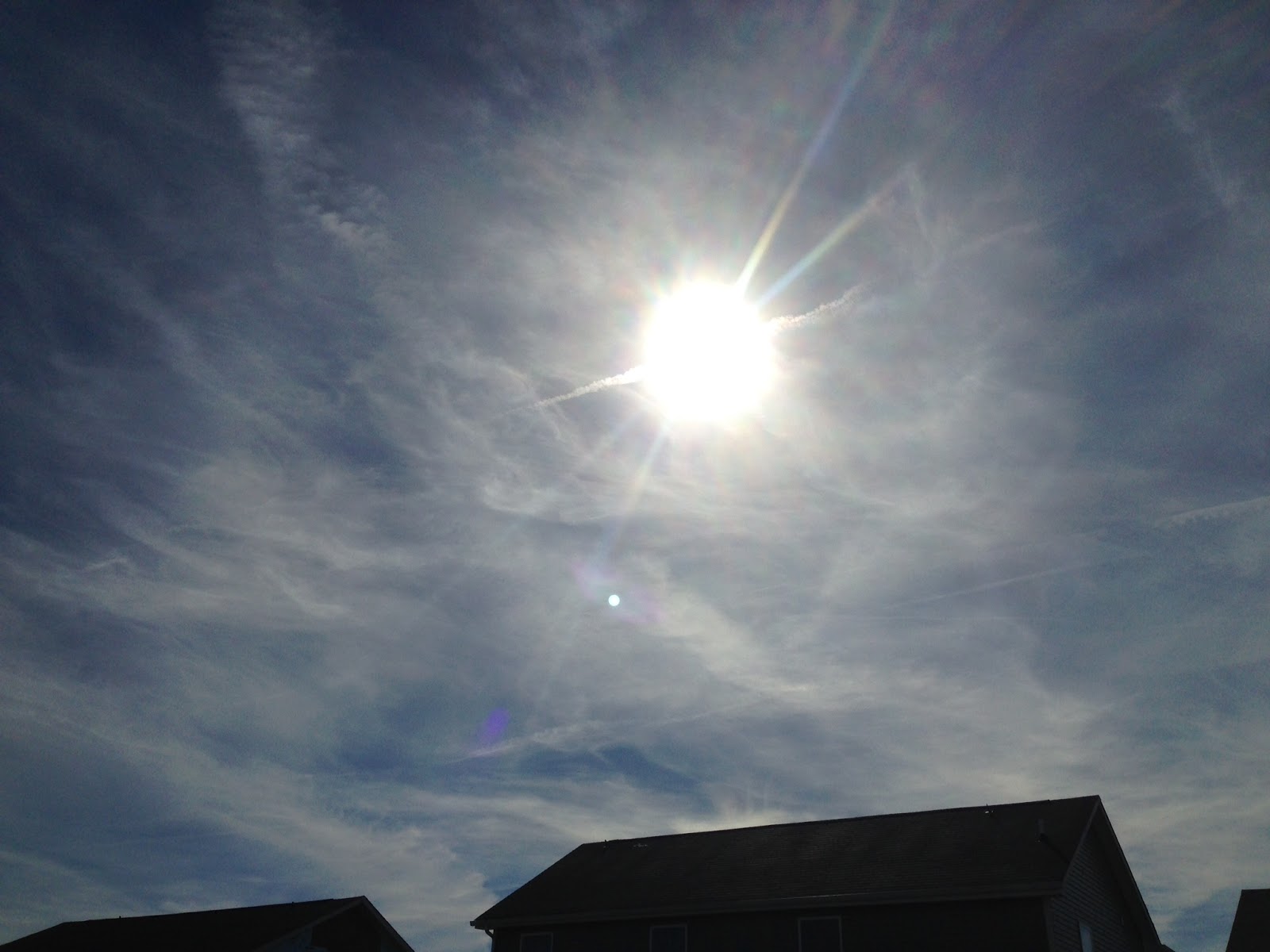
And yet another context shot, with my iPhone before I ran inside to get my tripod. I think this weird red sun through clouds beats out my eerie yellow sun from a few years ago. What do you think?

iphone photo sun through gray clouds
iPhone photo wide angle showing the sun in the sky with the solid gray clouds

I guess I had HDR turned on because the roofline has a glow around it, but this wasn't meant to be a cool iPhone photo of the sun just an example of the setting with the weird gray sky and red sun high in the sky. It's like the color of a sunset but much higher away from the horizon. The iPhone photo makes it look a little darker than it really was because I was trying to properly expose the sun.

Sunday, July 9, 2017

Huge Sunspot, Active Region 2665 on July 9, 2017

I don't have amazing solar imaging gear - just a DSLR and a home made solar filter - but when there is a sunspot or active region large enough, it's always worth taking a look to see if I can 'spot' it! 😂 But seriously, when I started seeing photos of active region ("AR") 2665 show up on my social media feeds, I had to grab my camera. 

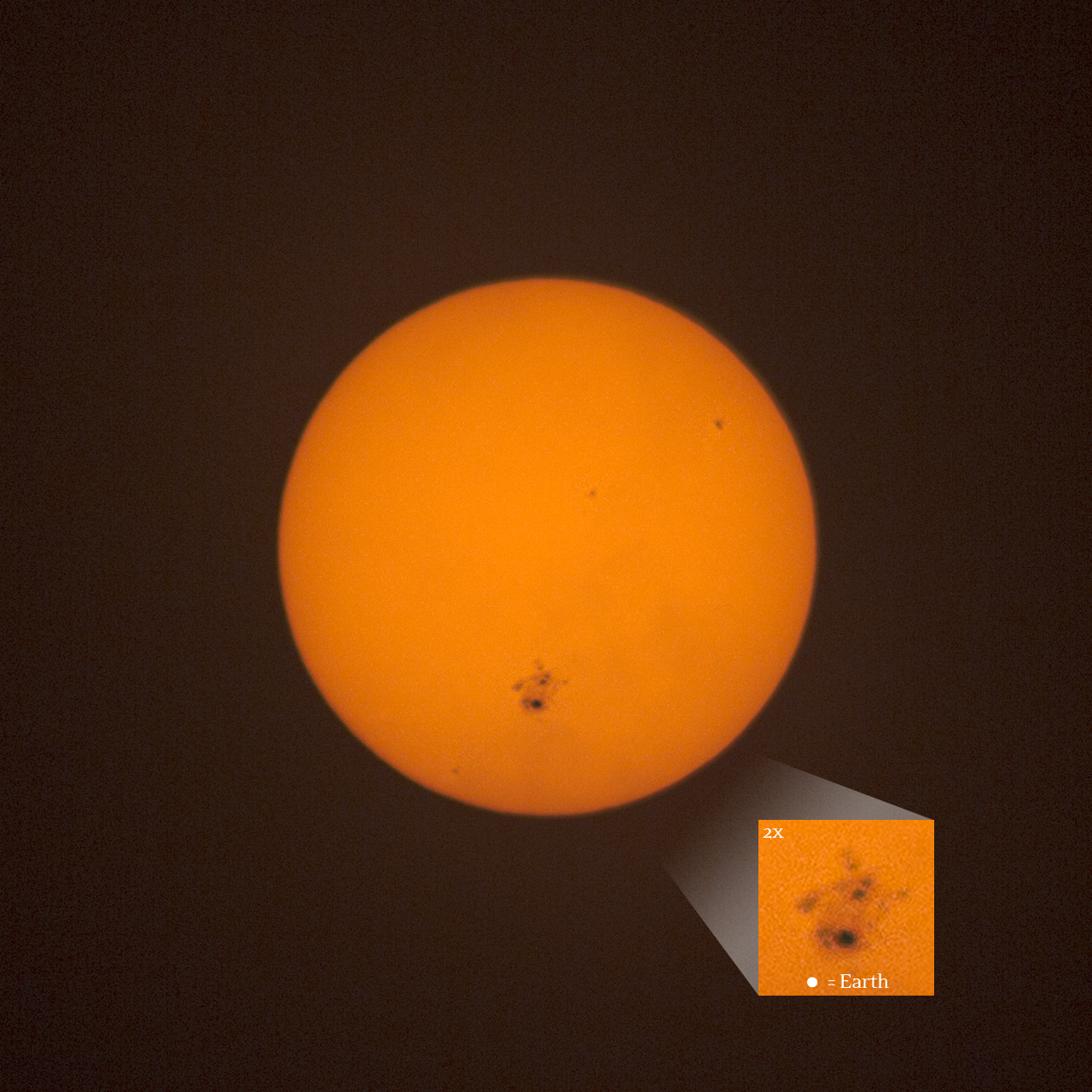
Active Region 2665
Single frame with Canon T5i, black polymer solar filter, 300mm, f/7.1, 1/60 sec, ISO 100

My lens isn't quite sharp enough to really pull out all the detail, and who can compete with the Solar Dynamics Observatory with crystal clear live images of the sun. 
Active Region 2665
Image above compared to the SDO HMI Intensitygram

Nevertheless, I've found over the years that my best chances are to focus the camera while it's tethered to my laptop, rather than relying on the auto-focus or trying to focus by hand looking through the viewfinder. 

taking photos of the sun
If you stop and think for a second, it's pretty darn cool to be able to see a sunspot like this with very little equipment. Controlling my camera from my laptop makes me feel super cool, as if I have my own observatory at my disposal. 

tether control DSLR with laptop
Love being able to control my camera using the EOS Utility app

tether control DSLR with laptop
My laptop perched on a chair near the sliding door so the USB cable can reach the camera.

DSLR with solar filter
My camera slowly following the sun so I don't have to keep re-adjusting it.

DSLR with solar filter
DIY solar filter on DSLR on motorized mount

I don't think it's my best sunspot photo, but it definitely was an honest attempt. If you take a look at the weather conditions, they were just okay I guess. I've tried stacking solar photos before and it just doesn't boost the clarity as nicely as moon photos. I'll quit moaning and just enjoy this sunspot the size of Earth, captured on my DSLR in my backyard. 

summer sky
Weather conditions, Noblesville, IN July 9, 2017

Sunday, October 9, 2016

Following Observe the Moon Night with (Carefully) Observe the SUNday

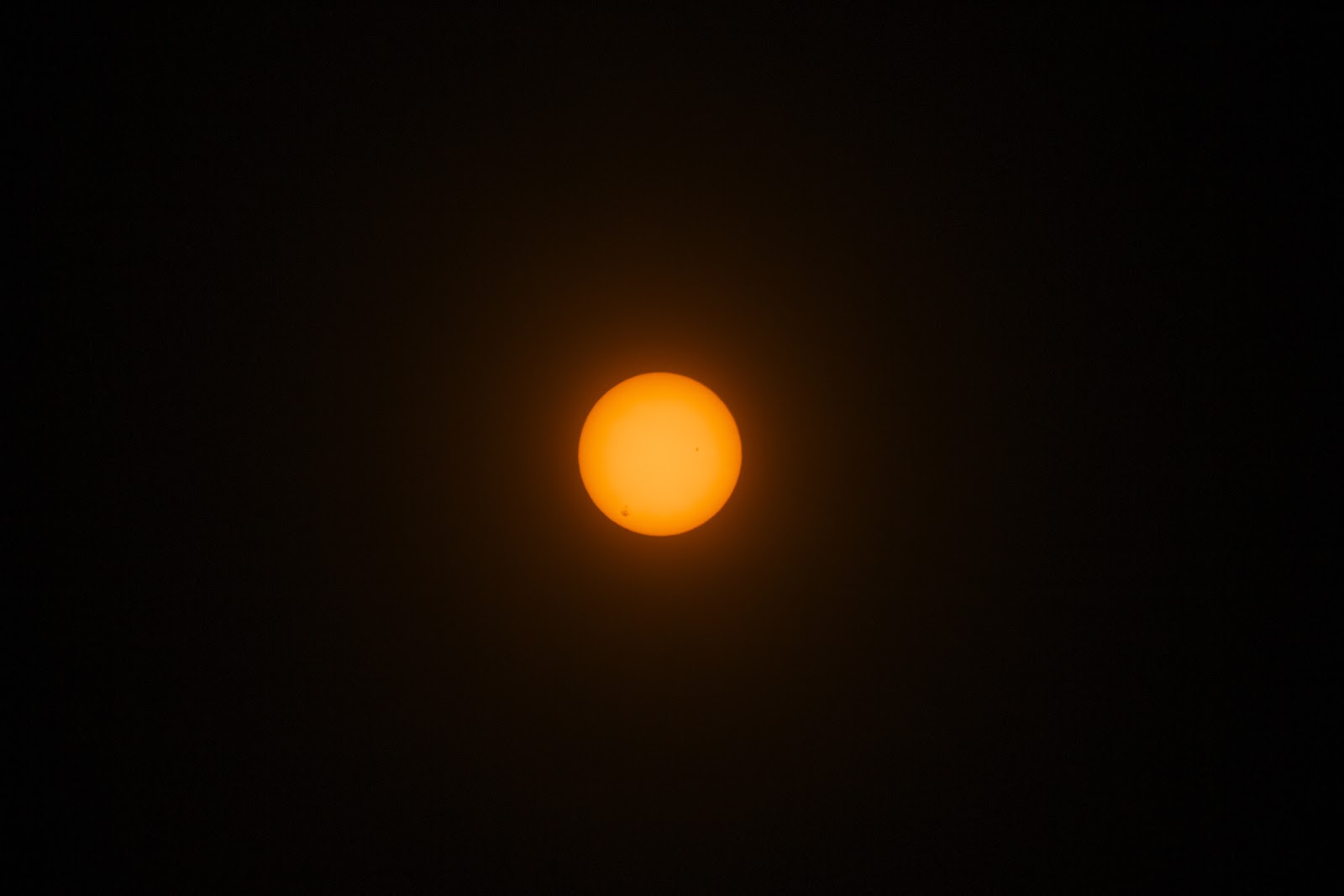
Can the Sunday after International Observe the Moon Night be known as Carefully Observe the Sun Day? Maybe we shouldn't encourage the general public to observe the sun, that could turn bad. But anyway, I had gorgeous clear skies today and had a busy and fun morning working on solar projects! I don't observe the sun all that often. Check it out, each of the active regions (sunspots) are the size of the Earth!
sunspots october 9 2016
Canon T5i single frame prime focus on Meade 285, ISO 800, 1/60 sec, 900mm

I find it much more challenging than observing the moon for a few reasons: You can't look at the sun to line up your telescope - I ended up slewing around hoping to stumble upon it in my eyepiece. Viewing your camera's LCD screen in the daytime is terrible - and if you rely on it to focus like I do, this becomes extremely challenging.

Today's sun from sohowww.nascom.nasa.gov showing active regions

I modified my homemade DSLR solar filter to fit over my telescope. This is my first solar image at prime focus, and it was my first time observing the sun through my telescope eyepiece. Here are some more photos from today:

meade 285 refractor solar observing
My solar observing setup with Canon T5i at prime focus on Meade 285 with homemade solar filter

I noticed the finder scope was producing a scary looking magnified dot of light, and I imagined a magnifying glass burning a hole in my shirt while I looked through the telescope. No thanks! While it didn't look like the dot was too hot, I covered the finder scope with an eyepiece cap just to be safe.

finder scope and sunlightcover finder scope


Here is my homemade solar filter attached to the telescope. The tube is a good fit, but I added some tape just to make sure it wouldn't blow off while I had my camera attached to it. I'll go into more detail about the modification to my filter in a separate post.

meade 285 refractor solar observing
DIY solar filter anchored with tape so it doesn't blow off and ruin my camera or blind me in one eye. 
There's a trade off between the resolution of the sun at prime focus, and the ability to carefully control focus with the Canon T5i focus controlled by my laptop. So what's more important? A larger disk size but clunky manual focus out in the sunlight where it's hard to see anyway? Or careful laptop focus controls but smaller disk of the sun?

camera hooked up to computer
Canon T5i with 300mm lens and solar filter connected to my laptop with EOS Utility
sun 300mm
Canon T5i 3 frames stacked in Registax, ISO 400, 300mm, f/9, 1/250 sec
I think the resolution wins and the prime focus is a little nicer even though it's not as sharp, it looks more natural even in one frame without stacking. What do you think?

compare prime vs 300mm sun photo
Compare prime focus sun (left) vs DSLR at 300mm stacked (right) 

Wednesday, November 4, 2015

Active Sunspot Region 2443

Had thin clouds on Sunday but I wanted to try to get a photo of active sunspot region 2443 that I've been hearing so much about. I haven't taken many sun photos with my DIY solar filter for my DSLR, but when there is an especially large active region they are fun to catch.

I had a little haze - well, more than haze, I had thin clouds I was trying to shoot through. The sunspot active region was large enough to see even though the clouds without a telescope. I just used a 300mm lens with the DIY solar filter over the top.

The hardest part is focusing with the additional filter over the lens and the glare of trying to look at the camera display screen in the daylight. Auto focus doesn't quite do it with the additional layer over it, of course the clouds don't help either.

November is looking good for some stargazing, but I don't think I'll be taking many more solar images during the week. By the time I get home it's already getting dark!

sunspot through clouds
Active sunspot region 2443 on Sunday, November 1, 2015 - Single shot with Canon T5i edited in Instagram
Instagram actually does a good job bringing out the contrast in sunspot images. I didn't list the acquisition details under the image above because I cheated it too much. Below is the original image out of the camera, which in this case is my trusty Canon T5i.

300mm sun image
Canon T5i single frame at f/7.1, 1/30 sec, ISO 100, 300mm

For comparison, here is a look at what the face of the sun looked like at the same time, but through much better gear from the Solar and Heliospheric Observatory (SOHO).

soho image

And if you were wondering, this is what my setup looked like. Identical to my setup last year, but with worse atmospheric conditions. In both cases, stacking actually didn't do much good and I ended up using single images.

canon solar filter
Canon T5i and home made solar filter attachment

Friday, October 24, 2014

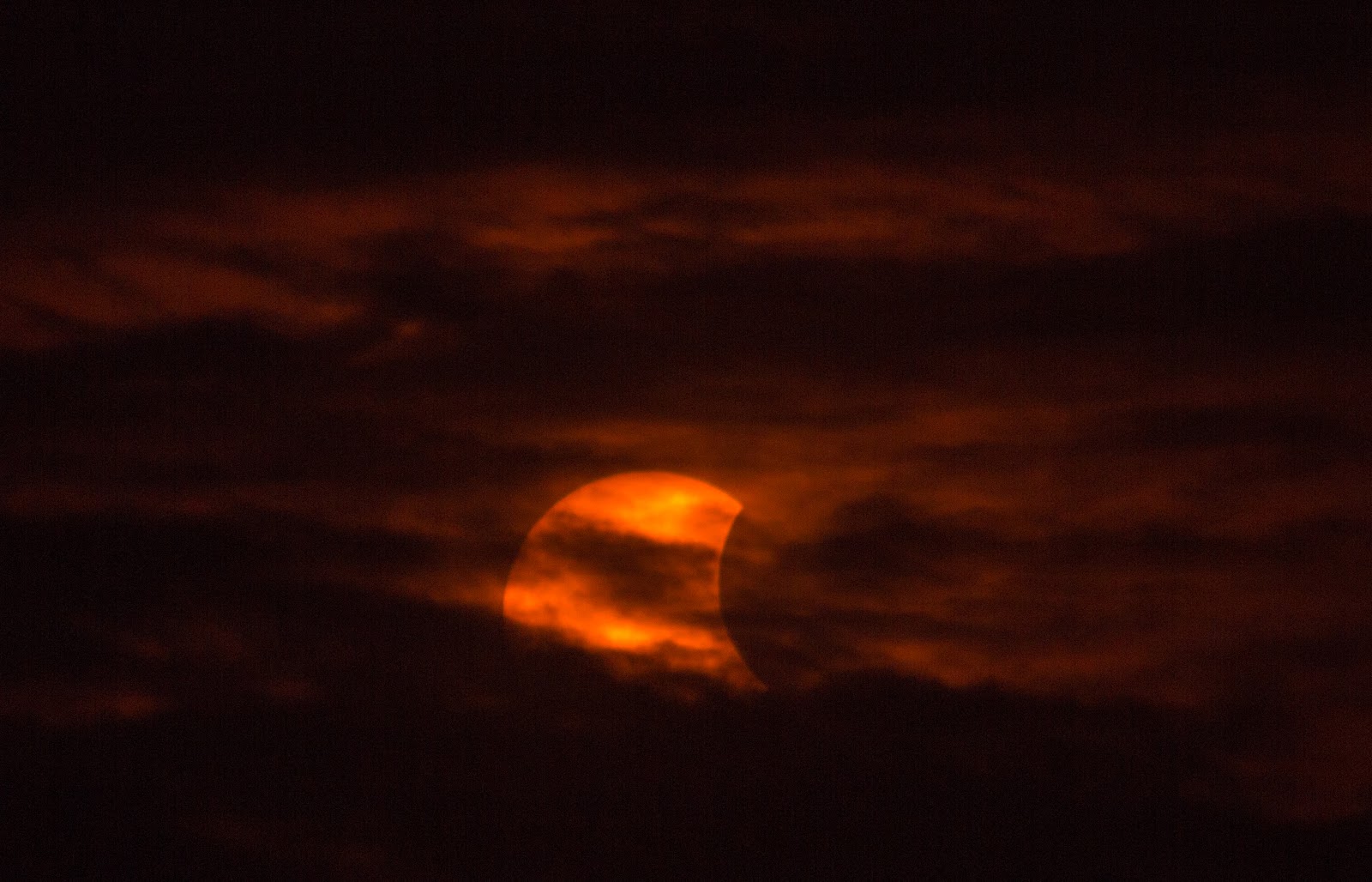
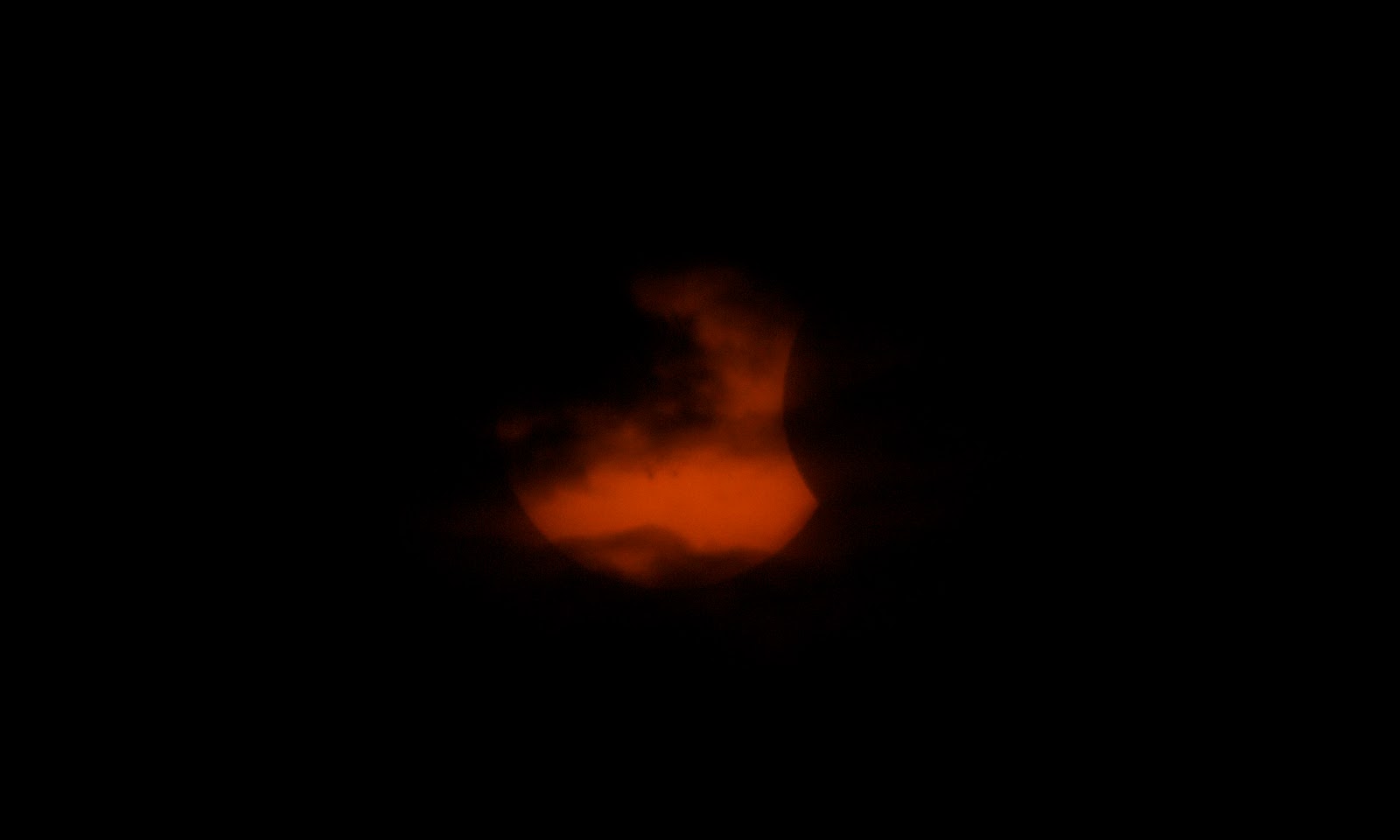
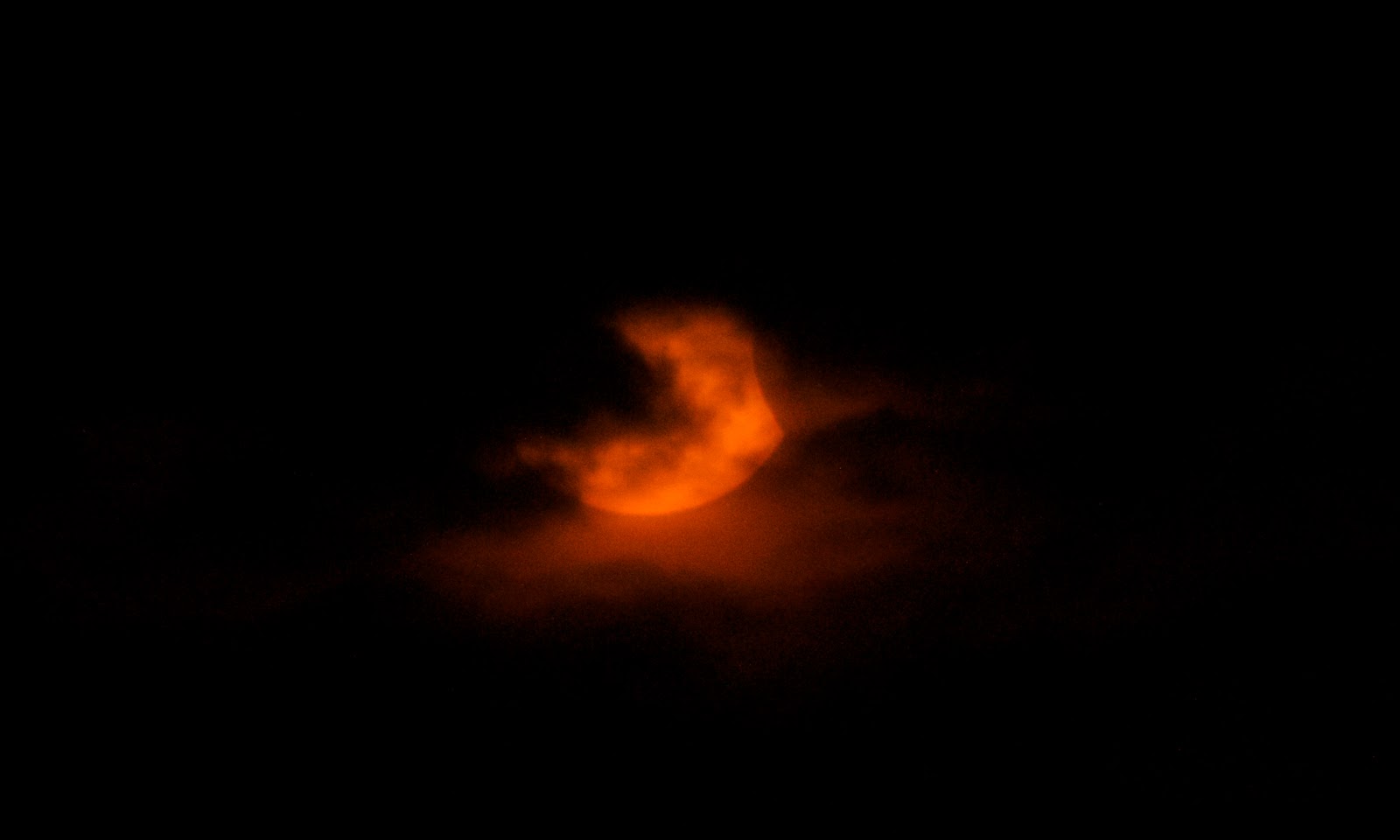
October 23 Partial Solar Eclipse from Indiana and AR12192

We had clear skies all day and then got clouded out right before sunset. I had my camera set up in my office with a west-facing window, and planned to snap some pics before a 7:00pm meeting. I got a few through the clouds, and a chance to spot the huge sunspot (active region) AR12192, which is now the biggest since November 1990.

October 23 Partial Solar Eclipse
Single frame with Canon T5i, 6:06pm, ISO 100, 300mm, f/7.1, 1 sec, exposure adjust in Lightroom

October 23 Partial Solar Eclipse
Single frame with Canon T5i, 5:58pm, ISO 200, 300mm, f/7.1, 1/20 sec

October 23 Partial Solar Eclipse
Single frame with Canon T5i, 6:06pm, ISO 100, 300mm, f/7.1, 1 sec

October 23 Partial Solar Eclipse
Single frame with Canon T5i, 5:58pm, ISO 1600, 300mm, f/7.1, 1/25 sec

October 23 Partial Solar Eclipse
Single frame with Canon T5i, 5:59pm, ISO 200, 300mm, f/7.1, 1/15 sec
 
sunspot AR12192 october 23
Single frame with Canon T5i, 5:08pm, ISO 100, 300mm, f/7.1, 1/25 sec

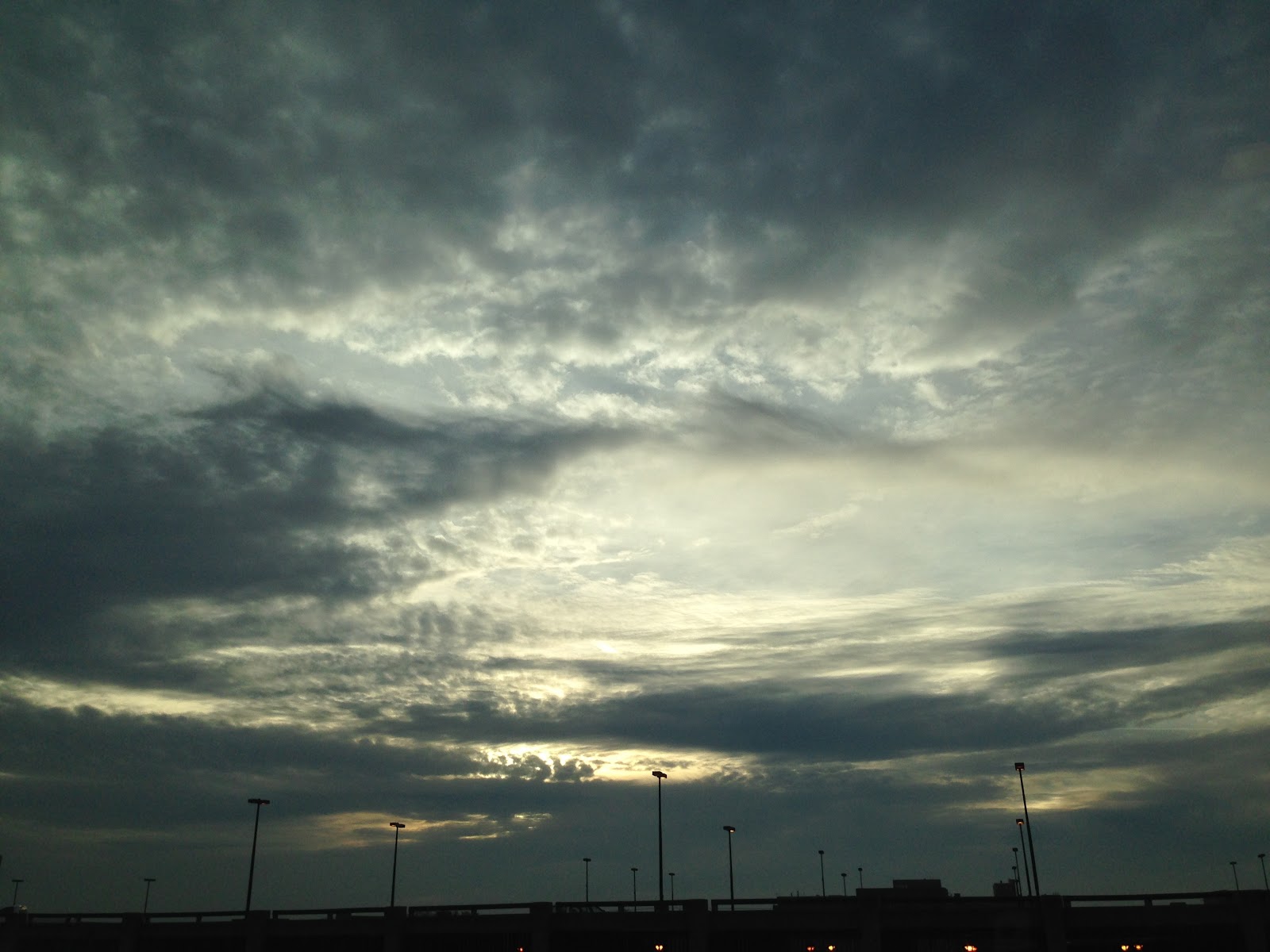
indiana sky october 23
Sky conditions during the solar eclipse... what the heck!

sun photo canon t5i
Shooting the sun from my office

Tuesday, October 21, 2014

Huge Sunspot October 21, 2014

sunspot 300mm canon
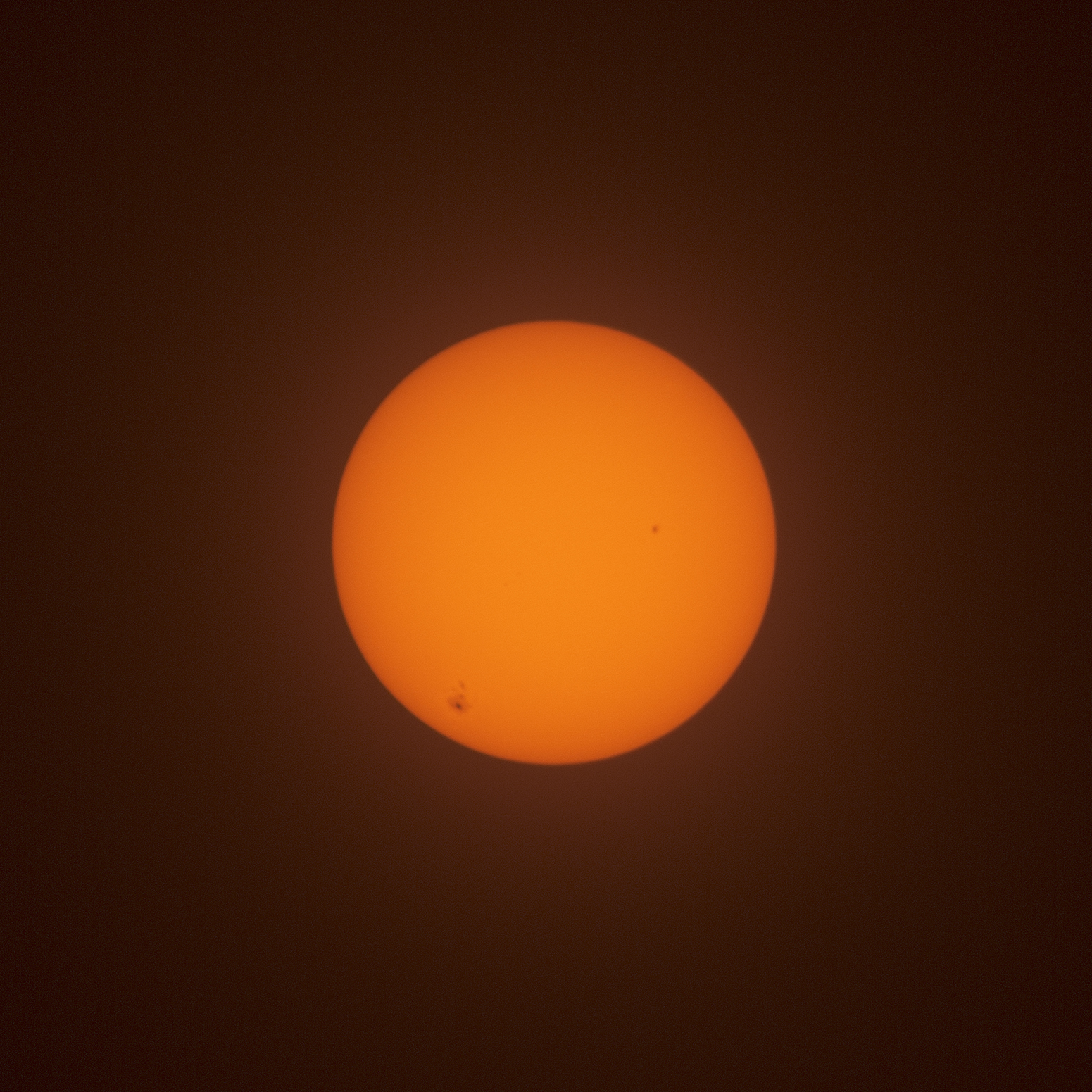
Single frame with Canon T5i, 300mm, ISO 100, f/7.1, 1/30 sec
I tried stacking my sunspots again and I was actually more pleased with the clarity of single frames rather than the stacking result. I did some developing in Lightroom, which included turning down the contrast (brings out the lighter area around the sunspot) and turning down the shadow (similar to decreasing contrast) and turning up the clarity (just a bit). Next I brought the brightness down a little bit and was pretty pleased.

This is a gigantic sunspot! I can't wait to see if it is still in view during the partial solar eclipse on Thursday. I'm bringing my camera with solar filter to work with me on Thursday, and I'm also hoping to get a shot with some foreground - which I'm learning uses much different settings compared to the shots through the filter. Check out my home made DSLR solar filter shoutout on Universe Today!

sunspot october 21
Single frame with Canon T5i, 300mm, ISO 100, f/7.1, 1/30 sec

Sunday, October 19, 2014

DSLR Solar Observing Test and Sunspots October 19, 2014

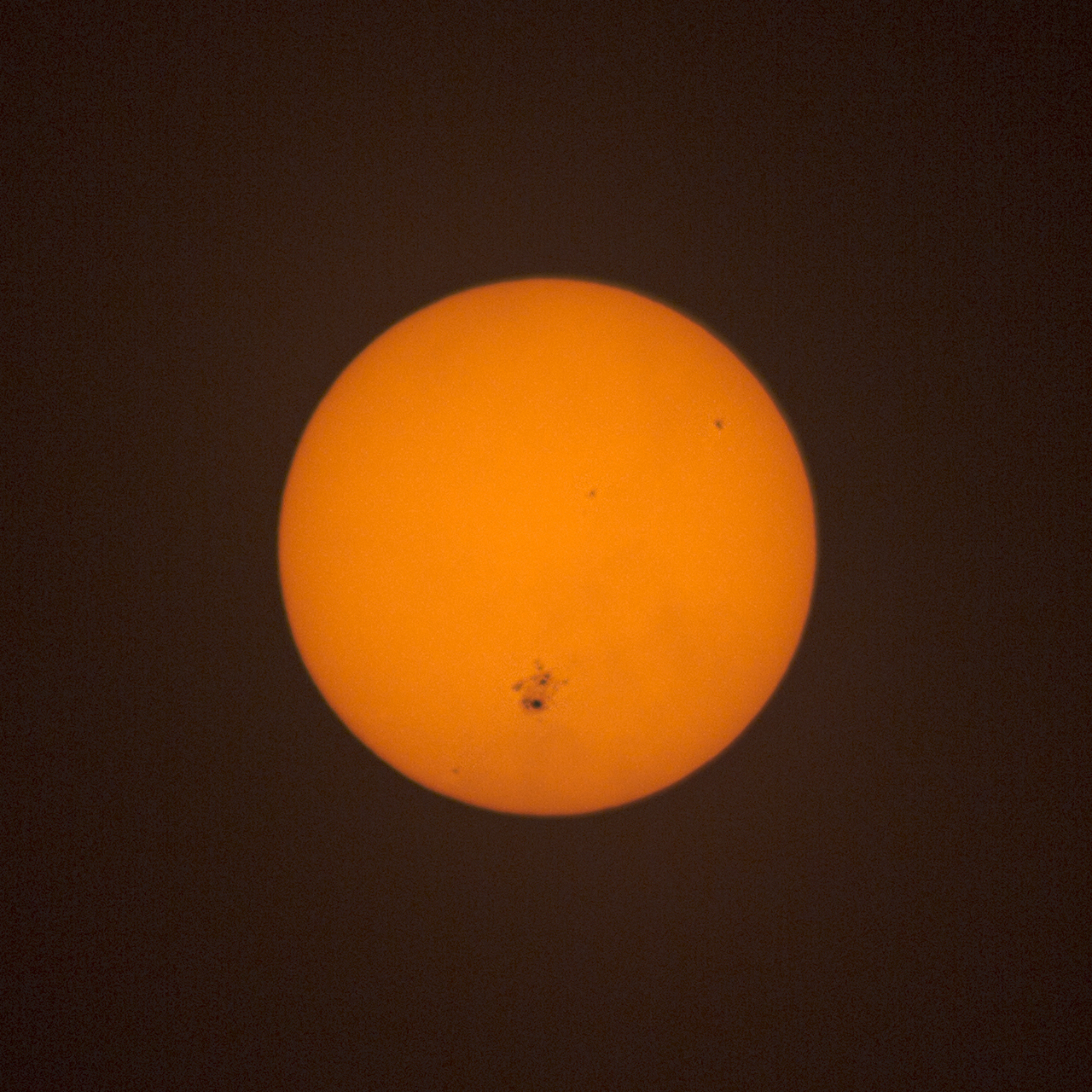
Using my home made solar filter attachment for my DSLR, I did my first solar observing test today. I couldn't have asked for anything more for a first try! How exciting! Not only do I have a ballpark set of numbers camera settings to use on the partial eclipse, but I was able to observe and identify sunspots for the first time ever!

canon T5i sun photo
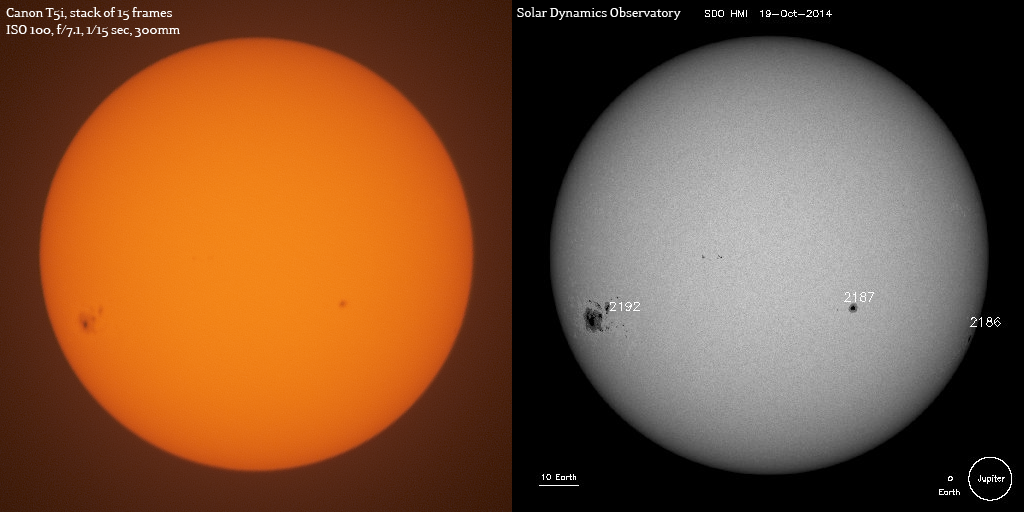
Canon T5i, stack of 15 frames each at ISO 100, 300mm, f/7.1, 1/15 sec

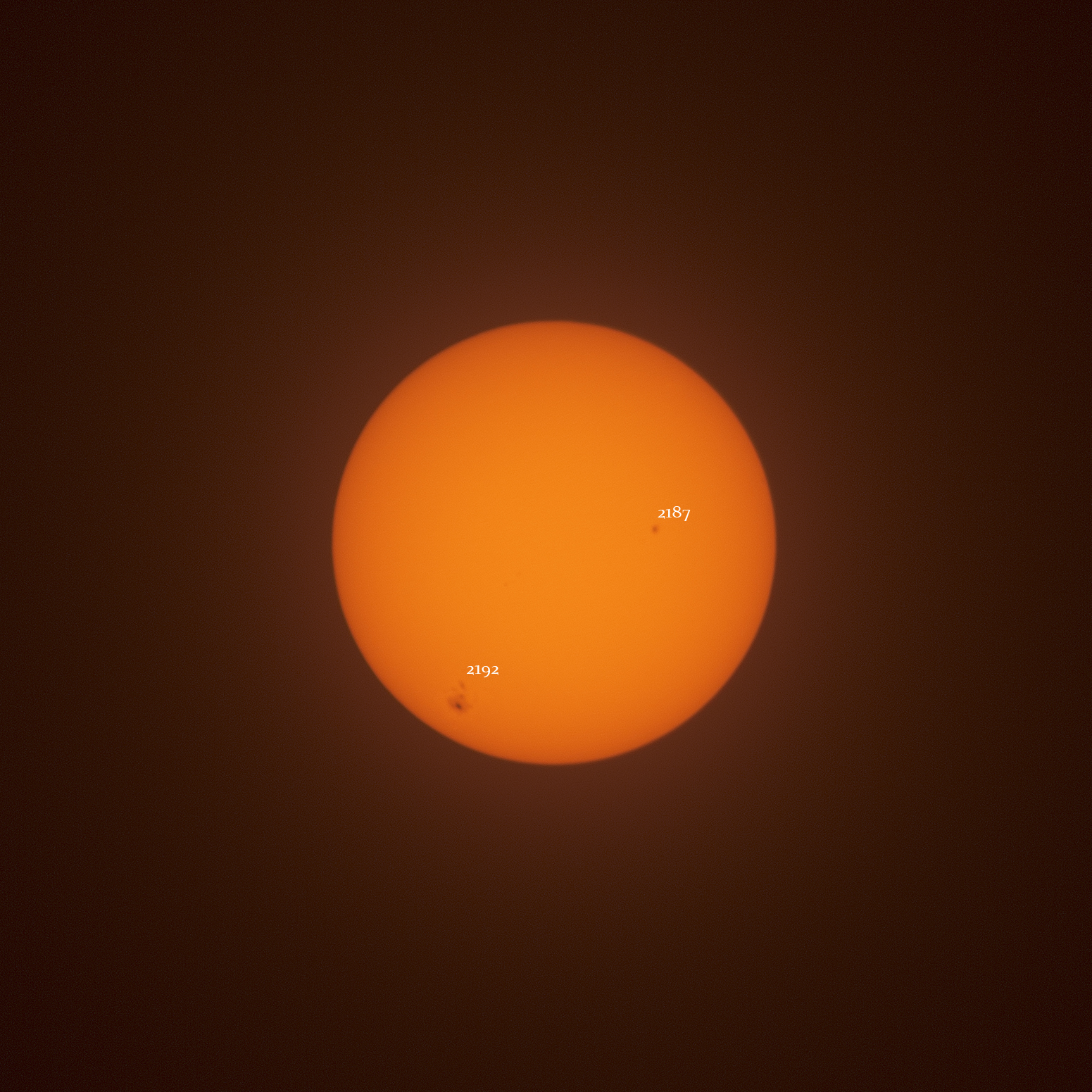
sunspots DSLR 300mm
Same as above with sunspot active regions labeled. 2192 recently produced a large solar flare (link).
So this solar observing test also prompted me to learn a little more about sunspot naming or labeling. It turns out, "There is no naming or numbering system for sunspots. There is a system for numbering active regions, however. An active region can contain one or more spots. The National Oceanic and Atmospheric Administration (NOAA) numbers active regions consecutively as they are observed on the Sun" (source).

During this test, the sky wasn't totally clear - but I was still able to observe sunspots. Can't wait to try it again when the sky is perfectly blue.

observing conditions
Sky conditions during my solar observing test
I looked up the sunspot active regions on the SOHO website and easily compared it to my photos. Here is a side by side version. I had to rotate my sun to match the orientation of the SDO image.

sunspots and active regions
Comparing my photo to the SDO image at the same time, you can clearly see the two large active regions, and faintly make out the two tiny ones in between. They are more apparent if I crank the contrast but it ruins the look of the image. 

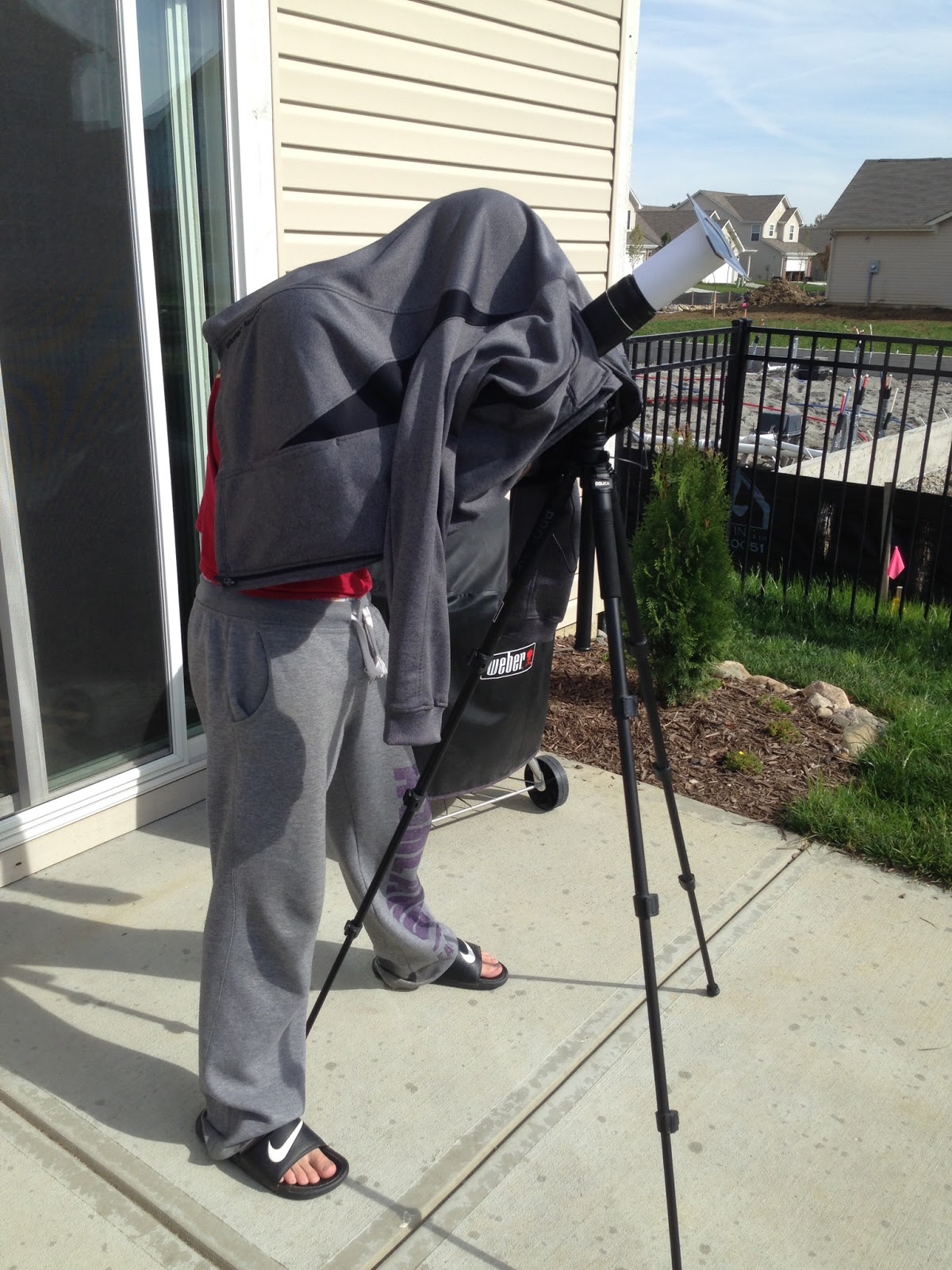
I learned a lot about taking photos in the daytime. It was really difficult trying to focus on the sun, but I used the live view method of zooming in and manually adjusting while looking at the large LCD screen. The reflection on the screen was so bad, I had to cover myself and the back of the camera with a jacket in order to see it clearly. I felt like one of those old-timey photographers with the hood over the back of the camera.

taking photos of the sun
Whatever gets the job done!

Also, in case you were wondering what the photos look like straight out of the camera, here is an untouched shot prior to stacking and cropping. It still has a pleasing orange color because I'm using black polymer instead of Mylar. To compare, I think the telescopes had Mylar filters for the transit of Venus event that I photographed with my iPhone through the eyepiece.

sunspots DSLR at 300mm
Single frame straight from Canon T5i, ISO 100, 300mm, f/7.1, 1/15 sec

home made solar filter or DSLR
Here's another look at my home made solar filter, it looks pretty good in the daylight