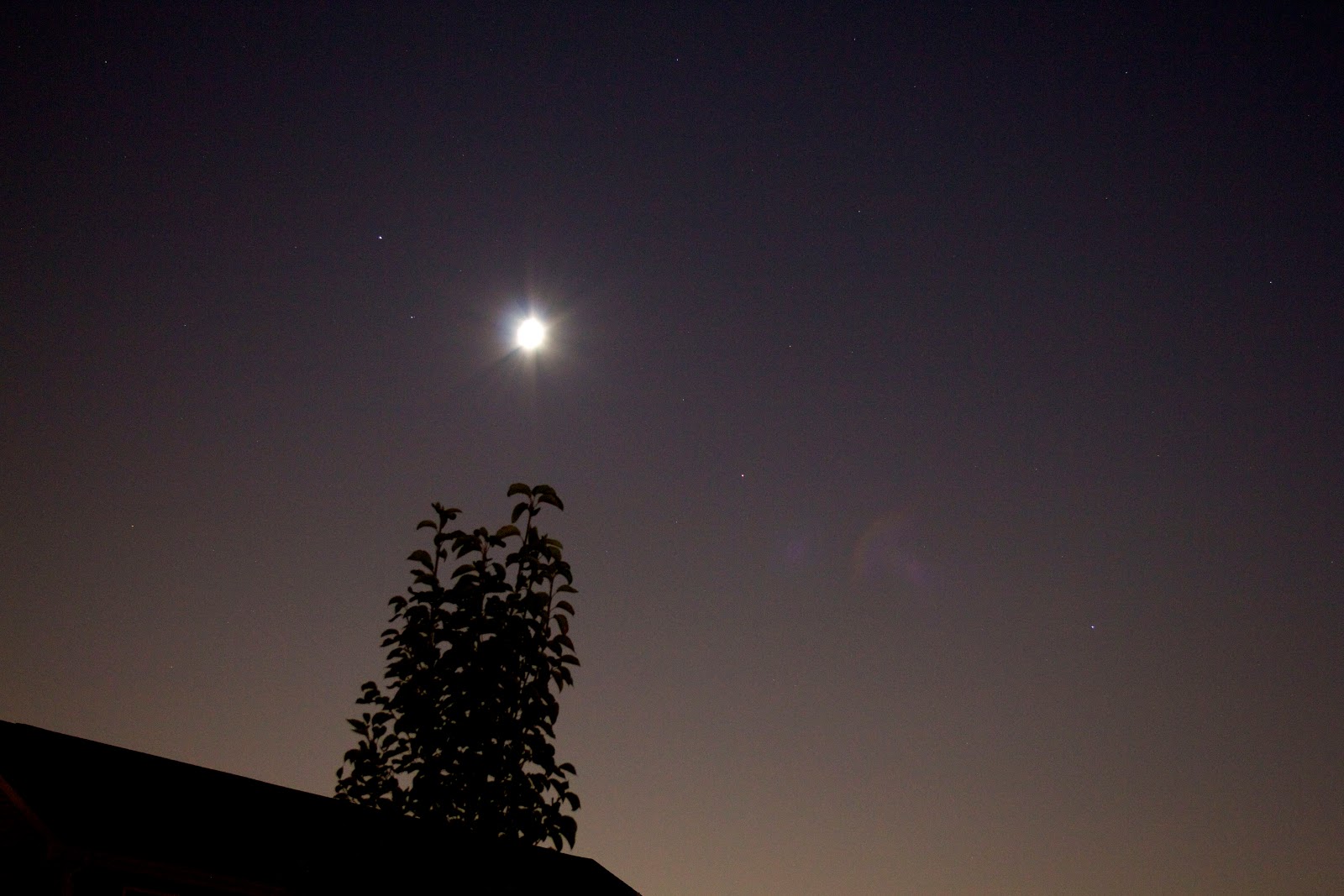
These cool nights are nice but not quite clear enough for some deep sky photography. Since I'm limited by gear, I'm very picky about my nights - if it's going to be the one time I go out all winter it better be good! So in the meantime, I have been doing some quick captures. Here I made the most of the alignment of Venus, Mars, and the crescent moon.
The thin clouds and contrails made Venus look larger than normal, and by increasing the f-number I was able to add an interesting lens flare around the moon. It looks like an eerie sun in a dark sky. The same principle works for taking photos of Christmas lights, you can really make them pop by adding tiny lens flares around each one. You just have to increase the exposure time to let in more light, and keep the ISO low to reduce noise.
Single frame Canon T5i ISO 800, 33mm, f/7.1, 6 sec lightened in Photoshop
Here's a closer look with Mars sneaking behind the branches of my favorite river birch trees in the backyard. Venus looks huge in the haze.
Single frame Canon T5i ISO 800, 38mm, f/7.1, 6 sec lightened in Photoshop
Contrails over the moon for a hazy look, pulled back to get a little more foreground. Not much you can do with the foreground composition here in the backyard.
Single frame Canon T5i, ISO 800, 22mm, f/8, 20 sec lightened in Photoshop
Single frame Canon T5i, ISO 800, 22mm, f/9, 20 sec with porch light on
Stack of about 88 frames each at ISO 800, 22mm, f/9, 20 sec
I guess this is one of my only star trail photos with the moon in it. It's kinda neat, I normally exclude it and just focus on the stars. Just for overkill here is a timelapse of the stack:
Plenty of planets in the night sky right now. I missed the Jupiter/Mercury sunrise the other day, but I did catch an extremely bright Venus setting over the roof of my neighbors' house at -3.8 magnitude. By far the brightest planet in the night sky, Venus is often mistaken for airplanes or other flying objects. It's rare that I go outside just to get a photo of a planet by itself, without something more interesting or rare to capture - like a conjunction or interesting alignment. But on October 11, Venus was shining along the rooftop and I think the interesting foreground made it really stand out.
Foreground composition is something I've been working on in my photos overall, so this was a good chance to practice. The roofline isn't very interesting, but there's more going on than just a planet by itself in an empty sky. In hindsight I should have increased the f-number to get the chimney in focus. I always think back to this depth of field test I did when I first got my Canon T5i camera.
Venus setting, single frame with Canon T5i, ISO 400, 110mm, f/4.5, 1.6 sec
Following my 'trying to get things in the foreground' theme, this photo of Mars in Sagittarius didn't turn out as interesting as I hoped with a few leaves floating between Mars and Nunki mag +2.1. I'll need to work on it, maybe when there aren't any leaves on the trees I can get some interesting foreground compositions.
Mars in Sagittarius single frame with Canon T5i, ISO 400, 110mm, f/4.5, 1.6 sec
The red planet Mars is hiding in Scorpio this morning, just 10 arc minutes from the 2.6 magnitude star Acrab (β1 Sco). The red light gives it away. It was a windy morning but the clouds and the dark blue sky background made a cool effect.
The high ISO kinda ruins the color of Mars, so there is one at ISO 800 also, but then you can't see as many background stars.
Single shot Canon T5i, ISO 3200, 300mm, f/5.6, 1.3 sec
Single shot Canon T5i, ISO 800, 300mm, f/5.6, 1 sec
Single shot Canon T5i, ISO 3200, 300mm, f/5.6, 1.3 sec
Chris texted me to go outside and look at the moon and a bunch of stars. When I got out there I noticed a conjunction between the crescent moon, Venus and Jupiter, and I didn't notice until I looked it up in my StarWalk app that Mars was in the mix as well!
The 3 planets show up well in photos, and the white/blue star Regulus is a nice addition as well. I had some thin clouds obstructing my view, but that made for an interesting glowing orb effect in the longer exposures. Venus looks like a smaller second moon glowing in the morning sky!
Cropped single shot from Canon T5i - f/5.6, 6 sec, ISO 800, 34mm
Single shot Canon T5i, f/5.6, 6 sec, ISO 800, 34mm
Single shot Canon T5i, f/5.6, ISO 400, 55mm, 1.3 sec
I got clouded out for the great triple conjunction of Venus, Mars, and the Moon on February 20 - but a few days later, our neighbor planets were still fairly close together in the sky. I caught them setting to the west over my neighbor's house.
I tried some different exposure settings, including high f-stop number to create a spiked lens flare around bright Venus. Chris wasn't too happy that I stepped outside to take photos right when dinner was ready, so after a few shots I came back inside for Taco Night. :)
Single frame, Canon T5i, ISO 1600, 105mm, f/5.6, 1.3 sec
Single frame, Canon T5i, ISO 1600, 135mm, f/5.6, 1.3 sec
Single frame, Canon T5i, ISO 1600, 135mm, f/5.6, 1.3 sec
Single frame, Canon T5i, ISO 1600, 300mm, f/7.1, 1.3 sec, this one has my favorite lens flare around Venus
Single frame, Canon T5i, ISO 1600, 300mm, f/11, 1.3 sec
I've heard that men are from Mars and women are from Venus, so it seemed fitting that the two planets seemed to chase each other into the sunset on Valentine's Day. The bright evening star Venus shone bright high above the horizon, but it wasn't until I got the photos onto my computer that I noticed fainter Mars to the upper left.
Single frame, Canon T5i, f/8, 0.8 sec, ISO 400, 50mm
Single frame, Canon T5i, f/8, 1.3 sec, ISO 400, 30mm
Keep an eye on the two over the next few days, as the couple will get closer together. I guess you could say the pair got together on Valentine's Day, got closer over time - finally, on February 20, the planets will have a kinky 3-way with the slim crescent moon after sunset. I doubt the 50 Shades of Grey movie includes planetary conjunctions haha!
Mars, Venus and the Moon within 2° on February 20th, screenshot from Stellarium
Chris and I were taking an evening walk around the neighborhood when we saw this alignment of 4 bright objects, starting with Saturn in the top left connecting through the moon to Mars and Spica further to the bottom right.
Canon T5i, ISO 400, 33mm, f/5.6, 5 sec, edited in iPhoto
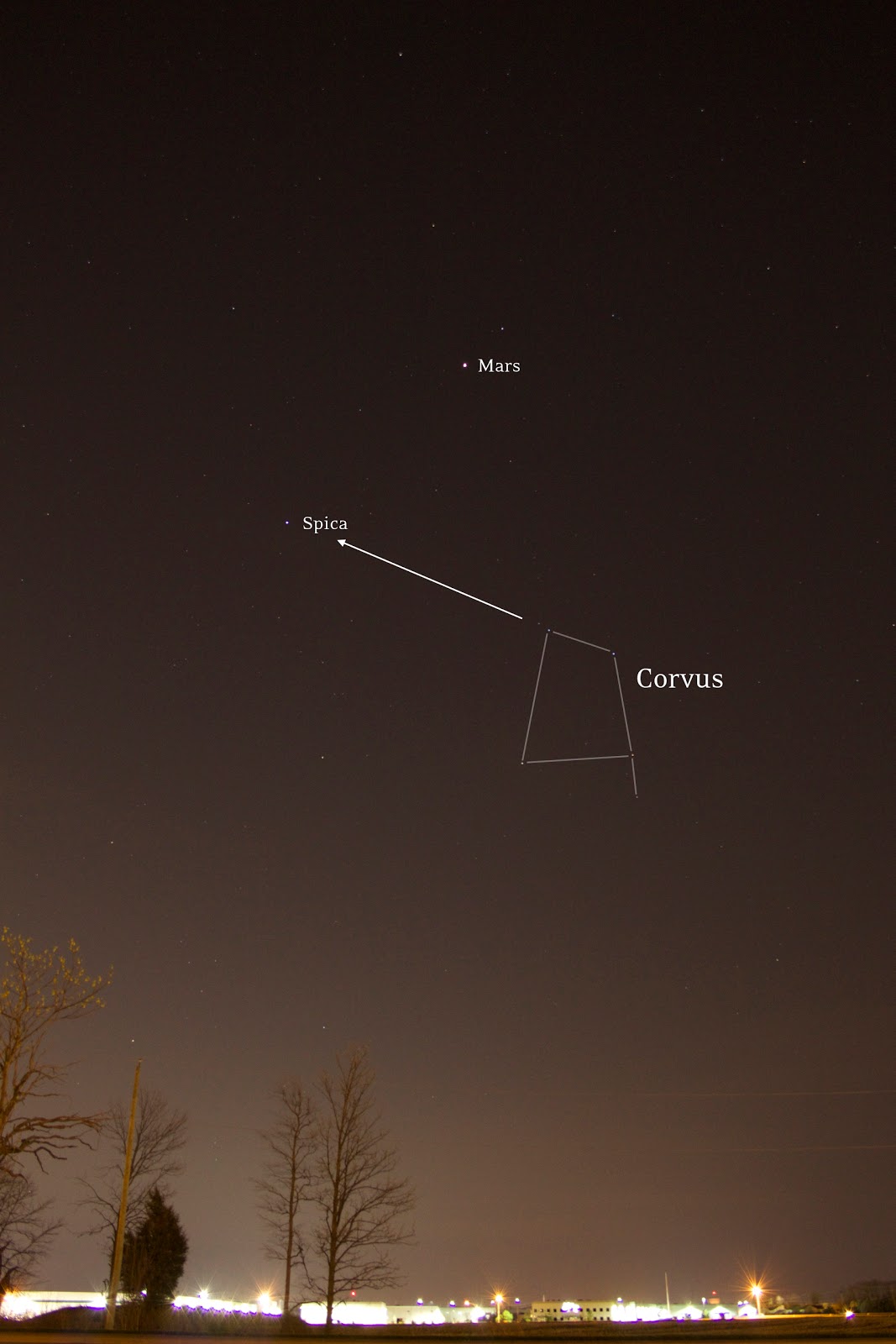
There are some great views to the southern sky this month, with Mars blazing near Spica, and Saturn hanging out in Libra. I also got a chance to see one of my favorite smaller constellations, Corvus the crow - also known as Spica's Spanker because it resembles a type of sail called a spanker, and because two of its stars form excellent pointers for Spica.
Single frame at f/4.5, 10 sec, ISO 800, 18mm
Same image as above without labels
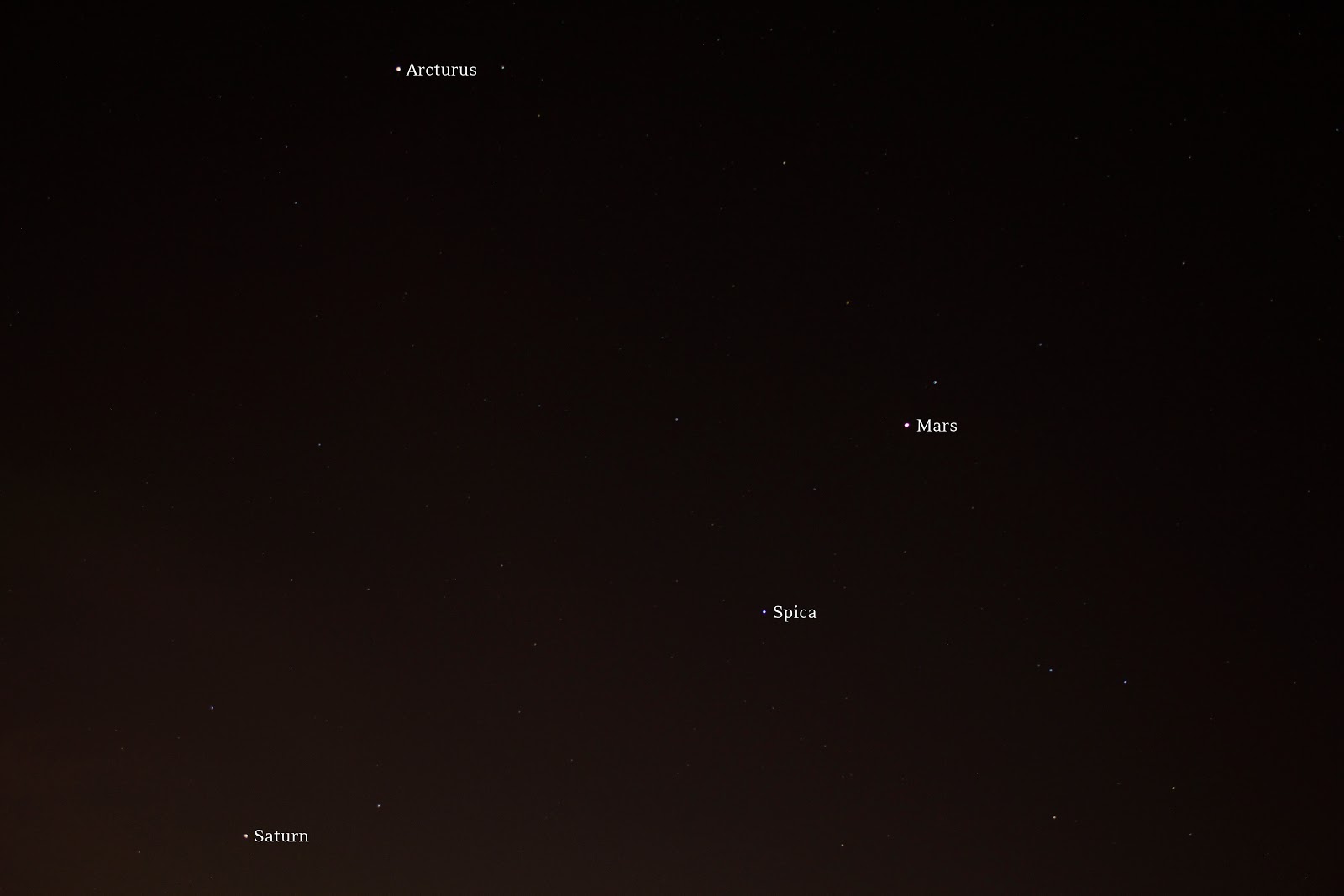
Next, I wanted to see if I could fit Saturn, Mars, Corvus, and Arcturus all in the same frame. At 18mm, my calculated field of view is about 64° horizontal and 45° vertical. Currently, Arcturus is about 38° from Saturn, Saturn is about 41° from Corvus, and Corvus is about 48° from Arcturus in a big triangle. It looks like it should fit, and it does!
Single frame at f/4, 13 sec, ISO 400, 18mm - Gaussian blur light pollution layer subtracted in Photoshop
On July 5, 2014, the night of my sister's birthday, and my friend Ryan's wedding, the Moon will be within half a degree of the planet Mars, and the pair will both be about 3 degrees from the 15th brightest star Spica. It should be a bright and interesting summer night conjunction!
The position you see here is based on my location in Indiana. In South America the moon will actually move in front of Mars. This is known as an occultation, e.g. the moon will "occult" Mars.
Every time I poke around in Stellarium I find new and interesting events. I suppose I could have just looked at the 101 Astronomical Events for 2014, but stumbling upon conjunctions is fun too.
In the past year and a half, I've photographed every planet in the solar system and then some. I've always wanted to put them all together and see my collection all at once - so here it is! Hopefully as I learn to take photos with my scope, I will be able to improve upon this collection. But for now, this is what I've got.
I couldn't sleep last night, I think it had something to do with our dog hogging all the pillow space. Either way, it was an excellent excuse to go outside and look at the stars. There was a very thin veil of clouds - not clear enough to try for deep sky objects, but fun to observe the summer constellations.
I also saw some familiar wintery constellations rising low to the East at about 3:56am. The crescent moon was to the top left of Orion, and Jupiter was rising into its next observing season. I also got some photos of Cassiopeia and Perseus that I'll post later.
Single frame, ISO 200, 5 sec, f/4.5, 35mm
Mars was still below the horizon. Looking ahead a few days, the crescent Moon will join Jupiter and Mars in conjunction during the early morning hours on August 31 and September 1, 2013. Next to Mars, Comet ISON is still too faint for my camera (around Mag 12.8). Check out Comet ISON Daily Pictures for recent photos. The comet will make it's closest approach to Mars on October 1.
Screenshot from StarWalk, conjunction early morning September 1, 2013
I went outside to check to see if the conjunction was visible, and I was able to spot all 3 planets rising above the apartment complex. I went back inside to get my camera, and when I came out the light was a little less optimal (too bright), but I was able to capture all 3 planets in the frame. I adjusted the contrast a bit in Photoshop to compensate for the brighter sky.
I've been planning ahead for this conjunction of Mars and Mercury for a few days now, and I'm super excited that the clouds dispersed just in time for me to stop the pair hovering over a radio tower. I think this is my first time observing the planet Mercury, which is an added bonus!
The conjunction just after sunset in Bowling Green, Ohio
Mercury is the brighter of the two (magnitude -0.89) and slightly above Mars (magnitude 1.38). Mercury was visible when the sky was still very blue/yellow, and Mars wasn't visible with the naked eye until the sky became a little more rusty red.
The clouds and radio tower add a dramatic setting
It's been cloudy all day, but the tail end of winter storm Nemo began to clear up just as the sun was setting. I grabbed my tripod and camera and began to scan the skies looking for a dot of light to poke through the clouds. I found the pair hovering above a radio tower and took as many photos as I could before they got too low in the sky. Not a big window of opportunity, but it looks like luck was on my side. The dispersing clouds and towers in the foreground add a dramatic industrial feel to the setting.
Moon, Mercury, Mars conjunction just after sunset (Image: Stellarium)
A very thin (3.4% illuminated) crescent moon joins Mercury and Mars just after sunset on the evening of February 11, 2013. If the weather cooperates, make sure you have a clear view to the West as close to the horizon as possible. At sunset (6:02pm in Toledo), the moon will only be 20º above the horizon, and only about 14º altitude when the pair of planets becomes visible.
Mercury and Mars will actually be much closer together (< 1º apart) on the evening of February 8, 2013, but will not be joined by the moon. On this night, Mercury will also be a brighter -0.89 magnitude compared to -0.72 on February 11.
Mercury and Mars <1º apart after sunset (Image: Stellarium)
If the sky cooperates, I'm planning to set up a camera at the Slippery Elm Trail in Bowling Green. The open fields should give me clear views to the West, and the trail is open an hour after sunset (that's all I'll need).
This is what my desktop looked like during the Mars Science Laboratory 'Curiosity' rover landing. I had NASA live on Ustream, a live simulated visualization from NASA's Eyes on the Solar System, a live G+ hangout hosted by UniverseToday.com, and of course Twitter.
"Pale blue dot" image looking over MSL's shoulder
The Eyes on the Solar System simulation was amazing, and I was impressed that everything in the visualization was to scale - the relative speeds, sizes, and distances between objects were all accurate. This visualization really reminded me that the solar system is mostly empty space, and that objects that we consider pretty significant (like entire planets) are just little specks orbiting a larger speck.
"NASA mohawk guy" was also an interesting addition to the live coverage. Not only is Bobak Ferdowsi young, edgy, and super smart - he's also mildly famous after becoming an internet sensation during the live feed.
In the end, the successful landing was obviously the highlight of the night. The first image back was a 64x64 pixel thumbnail from a rear ground camera - something that could be transmitted quickly and could prove that the rover was working and on solid ground. The next images were larger but still low res until the 'real' cameras can be fired up.
One of my favorite parts of the night (I loled) was the very first tweet sent out by @MarsCuriosity after landing. It was retweeted nearly 50,000 times in under an hour! Not exactly 'one small step' but equally memorable and also hilarious:
Tonight, just after sunset, Mars was visible in the west forming a triangle with Saturn and Spica. This picture came out blurry, which actually makes it easier to see the color difference between the objects.
Mars is reddish, Saturn is yellow, and Spica is blue.
Mars 300mm zoom
Saturn 300mm zoom
These are my first close-up shots of planets with the 300mm zoom lens. I think they came out a little blurry, meh. No, those aren't moons circling the planets, those are other stars in the background.
And right now, screaming toward Mars at thousands of miles per hour, the Mars Science Laboratory mission with the Curiosity rover is on approach. I'll be tuning in tonight at 11:30pm for live coverage on Ustream up until the landing at 1:31am ET. Unfortunately, I've heard that 2:30am ET is the earliest anyone will expect to hear news from Curiosity on the ground.