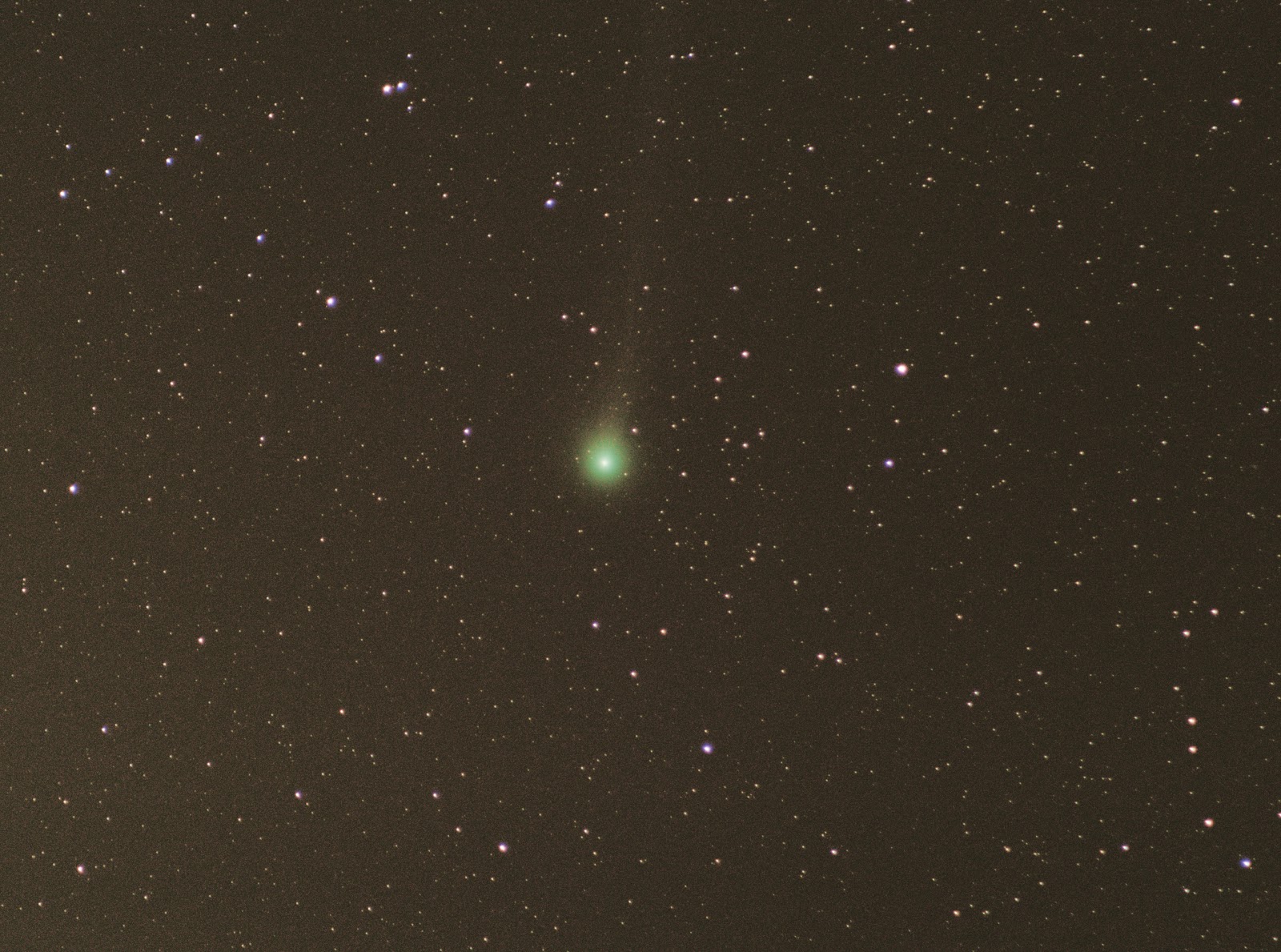
Visible to the naked eye this morning. Comet c/2020 F3 NEOWISE at 5:01 a.m. facing NE in Noblesville, Indiana. Shot with DSLR on tripod.
Canon T5i, ISO 3200, 75mm, f/4, 4s
I set an alarm for 4:30 a.m. but I was up at 4:15 because I was too excited. I made some coffee and doused myself in bug spray, ready to head out to a spot I scouted the evening before with Chris. I used an app called Theodolite to scout my location because it accurately measures through my iPhone the direction and elevation of the crosshairs in my camera viewfinder so I can tell if I have a clear view of the NE sky at 10 degrees above the horizon.
I didn't even have time to drink my coffee. I figured I'd be waiting around for the comet to rise above the building across the street, but I guess I under estimated how high it would be by 5am. When I got to the sidewalk, I quickly got my bearings spotting Venus and Aldebaran in close conjunction and looked to the left.
Dawn was quickly approaching, and I just used the spray and pray method, using all different combinations of duration and ISO so that I wouldn't come home with a bunch of streaky blurry or extremely noisy shots. I didn't do anything fancy, these are just single exposures and I turned the yellow tint down ever so slightly because I was surrounded by street lights.
After a quick single frame of comet Catalina C/2013 US10 with my Canon T5i DSLR a couple weeks ago, I was hoping for clear skies to do a more thorough treatment. I woke up at 5:00am on January 2, 2016 and took my motor driven Orion EQ-1 mount out to the back patio. It was cold but not bone-chilling cold like some mornings, and we've had a mild winter so far this year.
I did a rushed setup and got some pretty poor alignment, meaning I could only take up to 6 second exposures without star trails. I was feeling lazy so I figured 6 seconds was good enough and I didn't want to re-align everything. I was also battling the pre-dawn twilight, which would ruin my session in a couple hours.
This YouTube video shows a timelapse of my setup, getting the Canon T5i on the Orion EQ mount. The Orion EQ-1 mount has an optional motorized attachment that will turn the camera/telescope to compensate for the rotation of the Earth. The motor does not track or lock on to anything, it just tries to turn at a constant rate. While this might be good for keeping your target in the field of view longer, it's not very smooth or precise. It's much better than a fixed tripod, however.
Notice the amount of drift in the timelapse video at the end. My alignment was not great, but that should result in a constant drift in a single direction - not the shaking up and down motion we see. It looks like small variations in the motor speed are causing the mount to lag or speed up.
The sequence at the end is 239 frames, each 6 second exposures at ISO 3200, f/5.6, 300mm with Canon T5i on January 2, 2016. If you look closely you can see the small fuzzy comet move slowly to the left relative to the star below it.
Comet photos with DSLR are tricky, especially with a very basic mount like this or even on a fixed tripod. Sometimes I get good results with stacking, and sometimes I like single frames better. I was really hoping to get some of this comet's tail, like I did with comet Lovejoy last year, but 6 seconds was just not enough.
While taking over 230 individual photos, each at 6 seconds long, the comet moved a noticeable amount. This thing is moving quick! It becomes more obvious when you look at the first and last frame I took that morning. Here is an animated GIF showing the earliest and latest frame from my stack to show the change in position.
Animation of 2 single frames taken with Canon T5i each at 6 sec, ISO 3200, f/5.6, 300mm
Single frame from the GIF animation above in large .png format to show detail
This was also my first time stacking a comet photo in Deep Sky Stacker with comet mode, attempting to register the position of the comet to hold it constant and let the stars trail in the background. Because the comet moved quite a few pixels across the field of view relative to the background stars, I was hoping this painstaking process would pay off with a nice comet tail.
In Deep Sky Stacker, you literally have to go in and click on the comet in every single light frame to teach the program where the comet is. This maybe isn't so bad if you have 6x 5 minutes exposures or something, but I had over 200x 6 second exposures. Ugh! I gave it the ol' college try to see what it would do, and I was underwhelmed. After about 2 hours of pin-pointing the comet in sub frames and another 2 hours of stacking, the image below is what I got out of it.
Stack of 213 light frames, 38 dark, 25 bias, ISO 3200, f/5.6, 300mm, 6 sec (no flat frames)
You can see comet Catalina to the left and bright Arcturus to the right. All of the stars are trailing and the comet is supposed to appear stationary in this kind of stacking. I forgot flat frames and I have a massive gradient hot spot in the middle of the image. I'm going to try re-stacking with my ISO 1600 flat frames and see if they're close enough to do the job. I've been using the same flats for just about every stacked photo, I'm so bad!
Tagging the comet frame by frame in Deep Sky Stacker
Here is another process with flat frames - do I see a hint of a blobby tail coming off to the right or is that my imagination? Honestly, I like the look of the single frames better. The stars are around and the comet has color. I just should have spent more time on the set up and gotten longer exposures!!
Same process as above but with flat frames to remove the hot spot in the middle
12/10/2015 Single frame Canon T5i, ISO 6400, 5 sec, f/5.6, 300mm - tweaked in Instagram
I missed the comet-moon-Venus conjunction the other day, so I've had my eye out for a clear morning to try to find Comet Catalina (C/2013 US10) rising in the Eastern morning sky. It was sort of a spontaneous morning so I ran out without looking up a sky map first. I swiveled around for a while with no luck, so I got my phone out and went to Heavens-Above.com.
Screen grab from Heavens-Above.com - see how the field of view is slightly tilted so Venus and Spica look like they're at the same elevation. Totally didn't realize that at first!
They had a pretty good star chart posted (below), but it was a little misleading. Maybe I'm just out of practice. At first glance it looked like the comet should be directly above Venus and directly to the left of Mars. This led to me looking way too high. The Heavens-Above chart is slightly tilted but accurate. I found Stellarium to be much more intuitive.
See how in Stellarium Spica is clearly higher than Venus, Stellarium feels more intuitive to me.
Of course I had to add Comet Catalina to Stellarium first - and it had been so long I forgot how. So then I found this helpful How To article left over from Comet ISON. It was really simple, but I was still annoyed because I was racing the rising sun!
Photo at the top straight out of the camera; ISO 6400, 5 sec, f/5.6, 300mm
I'm used to finding things with Stellarium, so once I knew to look to the top left of Venus, it was a pretty quick find. I got that familiar rush of excitement when I first saw that little green fuzzy blob. I think I'll wait to see if it gets brighter before trying to do a tracking stack of images - but blobs count! This is another confirmed comet photo!
I'm getting better at polar-aligning my motor driven EQ-1 mount, and increasing the total exposure length I can achieve without star trails. However, now I'm running up against another barrier - I'm getting to the point where my sky conditions have too much light pollution to even merit longer exposures.
My longest single frame without star trails (left) straight from the camera. I love the aqua color of the comet without any processing! Stacking always seems to make it a dull green. ISO 1600, 300mm, f/5.6, 20 seconds, Canon T5i on motor driven EQ-1.
With the sky beginning to wash out even after 20 seconds, you can tell that my techniques are advancing up against another ceiling, the sky conditions themselves. Even if I did have a super fancy tracking mount, would it even be worth it if I can only get exposures of 20 seconds?
Comet Lovejoy C/2014 Q2 with Canon T5i on EQ-1 mount Stack of 31 light (ISO 1600, 300mm, f/5.6, 13 sec), 21 dark, 23 bias, and 15 flat frames Processed in DSS
Comet Lovejoy C/2014 Q2 with Canon T5i on EQ-1 mount Stack of 31 light (ISO 1600, 300mm, f/5.6, 13 sec), 21 dark, 23 bias, and 15 flat frames Processed with layers from both DSS and Photoshop
And yes, I'm using flat frames like a good boy! Every time I learn something new it seems to make my imaging procedures longer not shorter! Flats make a big difference though, it's like the "eating your vegetables" of astrophotography. I used the same technique I talked about in this previous post.
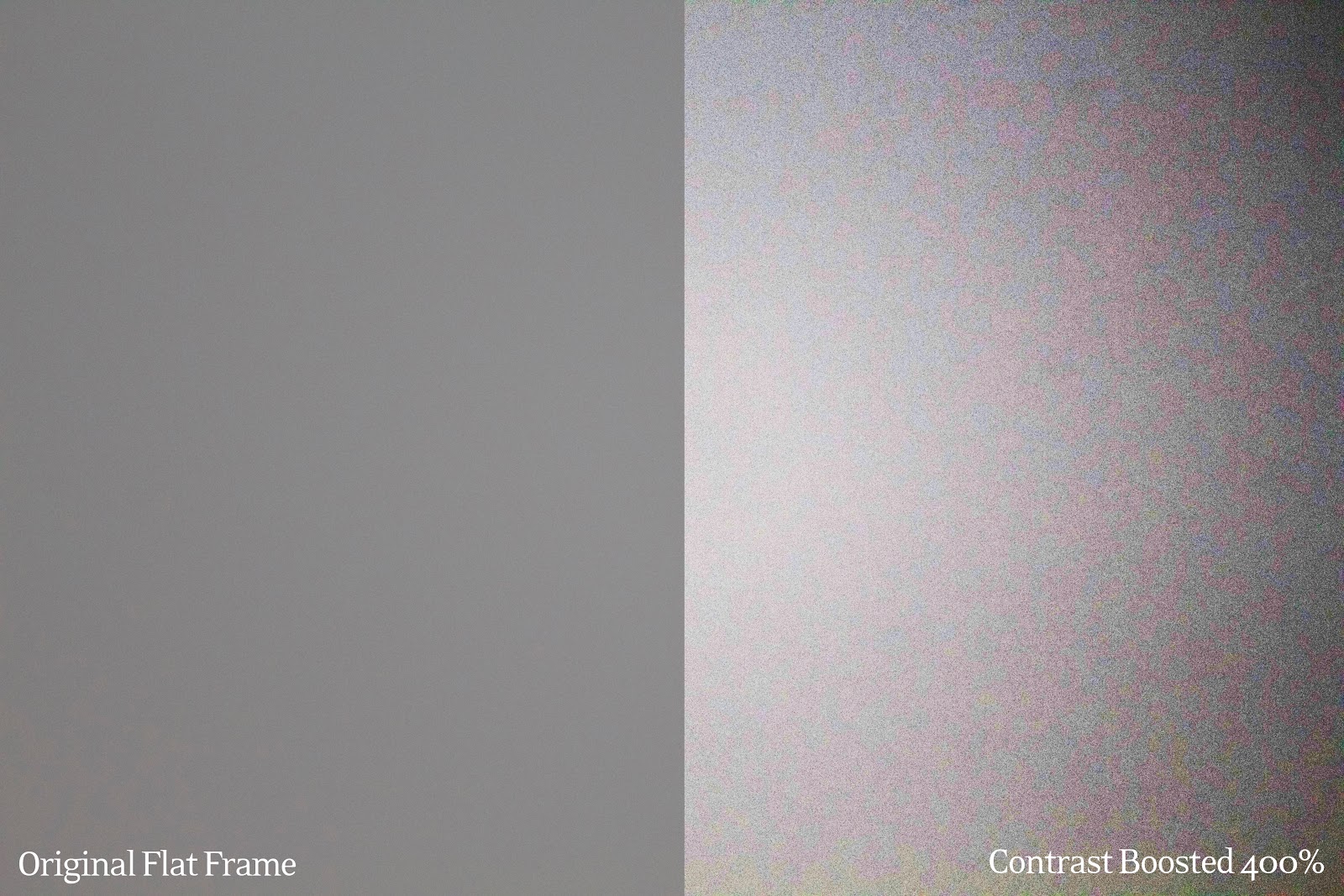
Flats should be gray, not white. Below is a sample of one of the flat frames (left) and that same frame with the contrast turned WAY up (right) to show that there really is some gradient and vignette information there even though to the naked eye it just looks like an even gray wash. The purpose being that the image processor, such as Deep Sky Stacker, will remove the hot spot gradients and corner vignettes.
One of my flat frames with contrast boosted on one side to show gradient information hidden within. Adjust exposure time until you get a good histogram just to the left of center. This one happens to be ISO 1600, 300mm, f/5.6, 1/640 seconds.
Taking flat frames with DSLR - I actually took them hand-held as close to the screen as possible while moving the camera around to make sure I didn't get a dust spot in the same place each time.
One last post in 2014 ya'll! Here is Comet Lovejoy C/2014 Q2 at 10pm ET tonight, taken with my DSLR on a fixed tripod and stacked in Deep Sky Stacker. In spite of the bright moon, the skies were completely clear and the green color showed up without cheating the saturation up at all!
In Photoshop, I stretched the histogram in levels by sliding the gray slider to the left, then used the eye dropper in Curves to identify the grays and turn them up. Next, I created a Gaussian blur layer and subtracted it to get rid of the slightly red hot zone that I had from not taking flat frames.
Canon T5i on fixed tripod, stack of 46 light, 21 dark, 12 bias, 205mm, f/5, ISO 3200, 1.6 sec
Comet Lovejoy C/2014 Q2 is currently in the constellation Lepus, and the celestial rabbit's bunny ears made excellent pointer stars to help locate the comet last night! The comet was visible with binoculars and with my DSLR even through thin clouds. Tonight is supposed to be crystal clear, so I might make another attempt to photograph it since I don't really have any NYE plans.
Brightness, contrast, and saturation adjusted in Photoshop
Original image, single frame with Canon T5i, ISO 3200, 75mm, f/4, 6 sec
I set an alarm this morning to get up at 6:25am ET and head out to look for C/2012 S1 (ISON). There were some thin clouds along the horizon which didn't help my search at all. I scanned back and forth looking through my viewfinder, and snapped dozens of photos hoping to catch ISON poking through the clouds. All I came away with was one questionable smudge, and no confirmation of ISON in its predicted position. I guess it's just too low to the horizon, meaning more atmosphere in the way and too close to the light of the rising sun to show up.
Latest updates on Comet ISON. Looks like it's predicted to be visible again by December 1 and up above the treeline by December 5. I thought it was going to go to the other side of the sun and be visible after sunset, but it looks like it will stay a morning comet. So much for my West-facing balcony :(
f/5.6, 2 sec, ISO 400, 120mm, small smudge in circle maybe?? Height of cell tower is about 4°
I heard Comet Lovejoy was showing up better than Comet ISON, and boy is it! Because Lovejoy is higher in the sky, there's a lot less atmosphere between this dirty snowball and my camera. I took these photos at 6:00am ET on the morning of November 14, 2013.
My stack of 107 light frames shows a bright coma but not much color due to the short exposure time (1.3 sec for each frame). In a longer exposure, the comet and stars form streaks across the sky, but the cool emerald color of Lovejoy's coma is very nice.
Comet Lovejoy: Single frame 8 sec, ISO 1600, f/5.6, 300mm
Looking at the individual frames, I noticed the comet is very close to a 9 magnitude star which creates the appearance of a dense point of light in the center of the coma. Sadly, the comet is all green fuzz from my perspective, but the adjacent star makes it look like it has a visible head.
I've been reading a lot about Comet ISON (C/2012 S1) already visible to amateur astronomers in the early morning sky over the Eastern horizon. At magnitude 7.50 on the morning of November 7, 2013 I figured I could try to pick it up with the DSLR and 300mm lens. After all, I've picked up magnitude 9 or 10 stars through stacking in DeepSkyStacker (DSS), and since a comet is more compact than a galaxy (whose visual magnitude is spread out over a greater area) I knew I could grab it.
11/7/2013 at 6:00am ET Stack of 62 subs, 32 darks, 0 bias, ISO 1600, 300mm, f/5.6, 1.3 sec
It was very easy to find Comet ISON in the sky, below Mars and right on top of Beta Virginis (β Vir), one of the brighter stars in Virgo. They were actually about 24 arcminutes apart (less than 1°), and both easily fit into my field of view - which was good because I couldn't even see ISON in my view finder. ISON was relatively high in the sky, about 28° alt, which was different for me because the only two comets I've photographed previously have been about 10° above the horizon at twilight.
Stack of 62 subs, 32 darks, 0 bias, ISO 1600, 300mm, f/5.6, 1.3 sec
While I was stacking these, I had something happen that's never happened before. I got an error in DSS that said "only one frame (out of 62) will be stacked. You should check/change the star detection threshold to detect more stars and help DeepSkyStacker find a transformation between the reference frame and the others."
I had the star detection threshold on the lowest setting (2%) which tells DSS to treat anything that looks like a star as a tracking/alignment option. In photos of the Milky Way, having DSS on 2% would produce tens of thousands of traceable stars (and take forever to stack). However, in my light frames, DSS was only picking up 6-9 stars.
To solve this problem, I went back to my RAW files in Adobe Camera RAW, and lightened the frames up so the stars that were in the frame would be brighter and easier for DSS to pick up. I saved them as TIF files and loaded them into DSS. Then I got an error saying my light and dark frames were different file types, so I had to go back and save my dark RAW files as TIF files just to make them match.
In the end it worked, and I'm pleased I was able to troubleshoot this little issue on my own while still producing an image of Comet ISON.
In late November, Saturn and Mercury will make a very close conjunction, coming within 1 degree of each other from our perspective. The pair will be low in the SE sky an hour before sunrise.
November 23, 2013 Mercury is about 6° above the horizon to the SE about an hour before sunrise. Screenshot from Stellarium.
Comet ISON (C/2012 S1) is predicted to pass Spica on November 18 as it dives toward the horizon, passing the Mercury Saturn conjunction around November 22-23.
November 25, 2013 Mercury and Saturn will be within 1 degree separation low in the SE to the left of the double star Alpha Librae (α Lib). Mercury will only be about 5 degrees above the horizon an hour before sunrise. Screenshot from Stellarium.
November 26, 2013 Mercury and Saturn switch places, with Saturn now on top and still within 1 degree separation. Saturn will only be about 5 degrees above the horizon an hour before sunrise. Screenshot from Stellarium.
Saturn joins the party on December 1, 2013 - this screenshot from Stellarium shows 7:00am ET from Indiana
Last month I posted my plan to photograph C/2011 L4 (PanSTARRS) as it approached the Andromeda Galaxy (M31). I was successful, but never got around to blogging about it, so here goes! On April 2, 2013 I went to Slippery Elm Trail at dusk to wait until the comet and galaxy were visible low in the NW sky.
I had all but given up on Andromeda for the season, because the view to the west from my apartment is blocked below 40º or so. This far into Spring, Andromeda is well behind the building by sunset, and so low in the sky by the time it gets dark that taking detailed deep sky images with my camera probably wouldn't yield anything beyond a fuzzy blob. However, paired with a comet, a fuzzy blob would be a welcome target!
180 subs, 30 dark, 30 bias; subs at 1.6 sec, ISO 1600, f/5.0, 190mm
I used bright stars in Cassiopeia and Andromeda to star hop to the approximate location. Once I knew I was in the area, I used the same technique from the last time I spotted Andromeda or PanSTARRS - and that is to take 10 second exposures and see what blobs appear. Then, once you have the images framed well, take exposures more appropriate for stacking (in my case, 1.6 sec at 190mm).
One of my "finder frames" to help me zero in on my targets, 10 sec, ISO 1600, 190mm
Here is a wide field shot to show just how low M31 ended up at the end of my night. With all the atmospheric distortion and light pollution, it's a wonder I was able to see the darn thing!
Background image is a single exposure at ISO 1600, 13 sec, 18mm
You gotta take advantage of every clear night you get! Even though I had just gotten some much cooler shots of PanSTARRS with the moon the night before, I saw the weather clearing up and headed to the hill on Forrest Creason Golf Course in time to see the comet setting over the BGSU campus.
I was hoping for a cooler image of the Bowling Green skyline, but the commet was setting a little north of 270º (due West) and ended up over the roof of the Perry Field House.
4 images stacked, each 5 sec, ISO 400, 300mm, f/5.6
Over the next few weeks the comet will fade, while at the same time staying visible in the sky longer after sunset - so it's sort of a trade off. Hopefully I'll get a couple more chances to photograph it higher in the sky with a brighter tail.
How do you quickly and easily straighten the horizon in Photoshop? I can't believe I didn't know this until just this week! Using the Measurement tool (under the eye-dropper) draw a line along where the horizon SHOULD be, then click Straighten.
I'm a big fan of less reading. This should about do it!
That's all! Photoshop automatically rotates and crops your image so you don't have blank space along the edges. I seriously had no idea this tool even existed until now, and it's my new favorite thing!
I tested it out on this image of comet C/2011 L4 (PANSTARRS) from March 13, 2013. The comet was only about 10º from the crescent moon. In this photo, a plane happened to fly right over the moon during my 5 second exposure, making it a little more interesting. It's a neat picture, but the horizon wasn't quite straight. This new trick solves it instantly!
Plane over a crescent moon with comet Pan-STARRS below
It's been rainy, snowy, and overcast since early last week - so I knew when the forecast called for "partially cloudy" skies I would take the chance to try to spot comet Pan-STARRS through the clouds.
My view looking West after sunset, crescent moon barely visible
My setup, Canon Rebel XT with 300mm f/5.6 lens
Bored and freezing, waiting for the comet to appear
Zoom/crop, a close up of the comet through the haze just above the horizon
300mm, f/5.6, ISO 1600, 3.2 sec, 8:49pm ET
I've been following the story for weeks; jealously looking at photos from the Southern Hemisphere and the southern United States, waiting for my turn. Earlier today, the skies were a blank gray. It even started snowing around lunch time. When I saw a patch of blue sky, I started obsessing over the hourly forecast hoping to get a chance to photograph the comet for myself.
Had to go vertical to get the moon and comet both in frame, super cool!
95mm, f/4.5, ISO 800, 5 sec, 8:46pm ET
I got to Slippery Elm Trail around 7:30pm (sunset was 7:39pm ET). I got to see a cool sunset, and started setting up my camera. I ended up waiting around for 20 min or so before I could even see the crescent moon clearly. 30 minutes later I knew I should be getting close, but I didn't see any comet.
Watching the comet dip behind clouds in the fairly bright twilight sky
300mm, f/5.6, ISO 400, 4 sec, 8:32pm ET
I started clicking around looking for the comet with 1.5s exposures. I finally caught a glimpse of it in my LCD screen and I knew I had it! I followed it over the next 30 min or so until I could get a shot of the comet and horizon in the same frame. I stayed out for about an hour and a half total. It was freezing being out in the middle of a field with no protection from the wind, but it was worth it!
Target practice on the crescent moon, also useful as a focus aid
Earthshine with some clouds. I never get tired of earthshine!
75mm, ISO 200, f/4.5, 0.4 sec, 8:13pm ET
The photo I've been waiting for! Pan-STARRS low with the horizon in frame
300mm, f/5.6, ISO 1600, 3.2 sec, 8:49pm ET
After 90 minutes in the cold, I made a mad dash for my car. If I didn't have hand warmers in my gloves and shoes, I don't know what I would have done. Next winter I'll have to invest in some thicker gloves and some boots - this photography stuff is rough!