Showing posts with label Perseus. Show all posts

Saturday, August 16, 2014

Nice Perseid Meteor Capture and Perseid Candidate Analysis

I knew the Perseid meteor shower was coming up, but frankly because of the recent Supermoon I wasn't giving it much thought. On August 12 I was taking Katie out in the middle of the night and inspecting my recently planted linden tree to see if it was improving. While I was looking up I noticed a quick meteor flash high in the sky to the north.

The next night, the night of August 13, I looked at my Scope Nights app to see if it would be clear - but the icon was red so I mentally planned on not going out that night. It wasn't until I took Katie out again that night that I noticed the sky was perfectly clear with a bright moon high to the south. I looked at the app again and noticed that the forecast was for clear skies but that the icon was red because of the moonlight.

In any case, I decided that a clear sky to the north (which happened to be the best direction for observing the Perseids) was worth a shot setting my camera out to try to capture something. I set my camera up on the back patio so it hopefully wouldn't get stolen (we're building a fence soon).

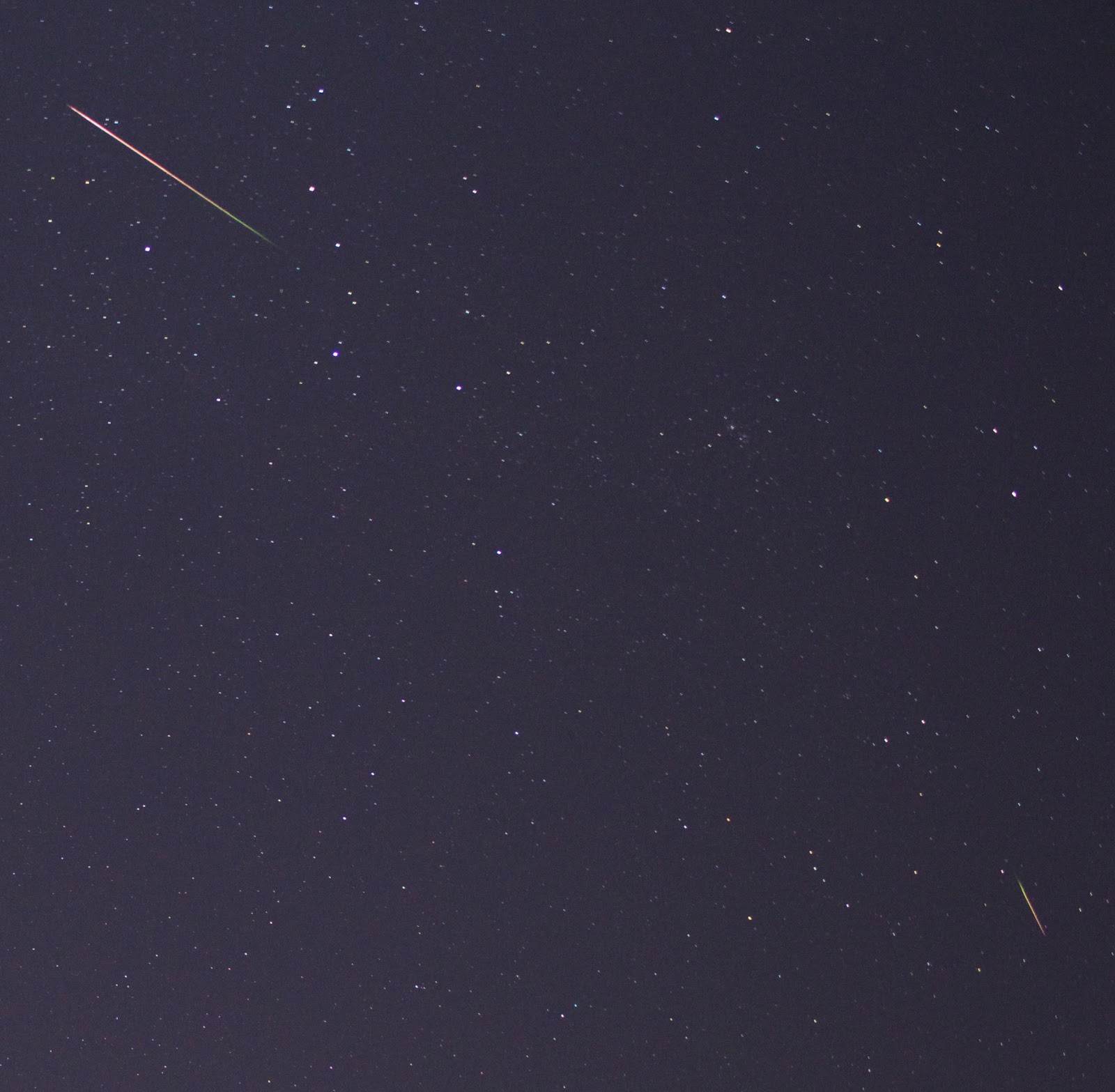
I woke up in a hurry for work, but eagerly put my memory card into my computer and began sifting through the 555 photos. I found a handful of meteor candidates, and two very clear very bright meteor streaks!

bright perseid meteor
Close crop from larger image, T5i, ISO 800, 18mm, f/4, 15 sec, contrast in Photoshop

bright perseid meteors
2 frames aligned, T5i, ISO 800, 18mm, f/4, 15 sec, contrast in Photoshop

These two bright meteors have a javelin shape and irregular colors, they did not have trails on the frames before or after (ruling out many satellites), and the best evidence is that they are pointing to the anticipated radiant point. These are the real thing! Because they happened in two consecutive frames, we know they lit up within 30 seconds of each other - this makes them great tools for backtracking to the radiant point.
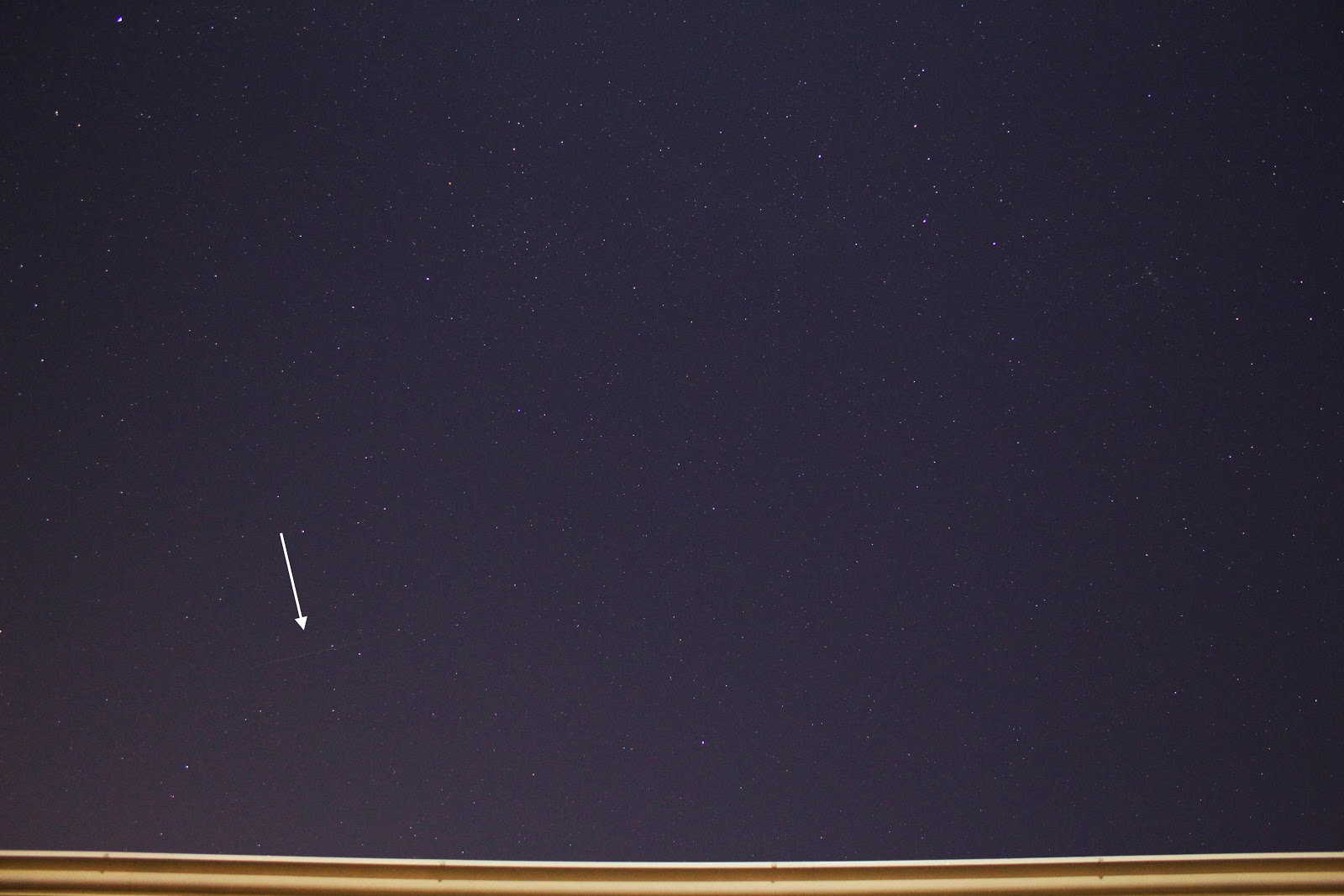
identify perseid meteor candidate
Single frame with T5i, ISO 800, 18mm, f/4, 15 sec, contrast in Photoshop

Now let's look at a candidate Perseid meteor - a faint streak of light that we're not so sure about. It could be a satellite, or another meteor unrelated to the Perseids. How can we find out? First, I look to see if there are any lines in the frames before or after. If this 15 second exposure is of a satellite, there should be a continuation of the path in the adjacent frames - but there isn't. Ok, it might be a meteor, but is it a Perseid? Let's look at the paths.
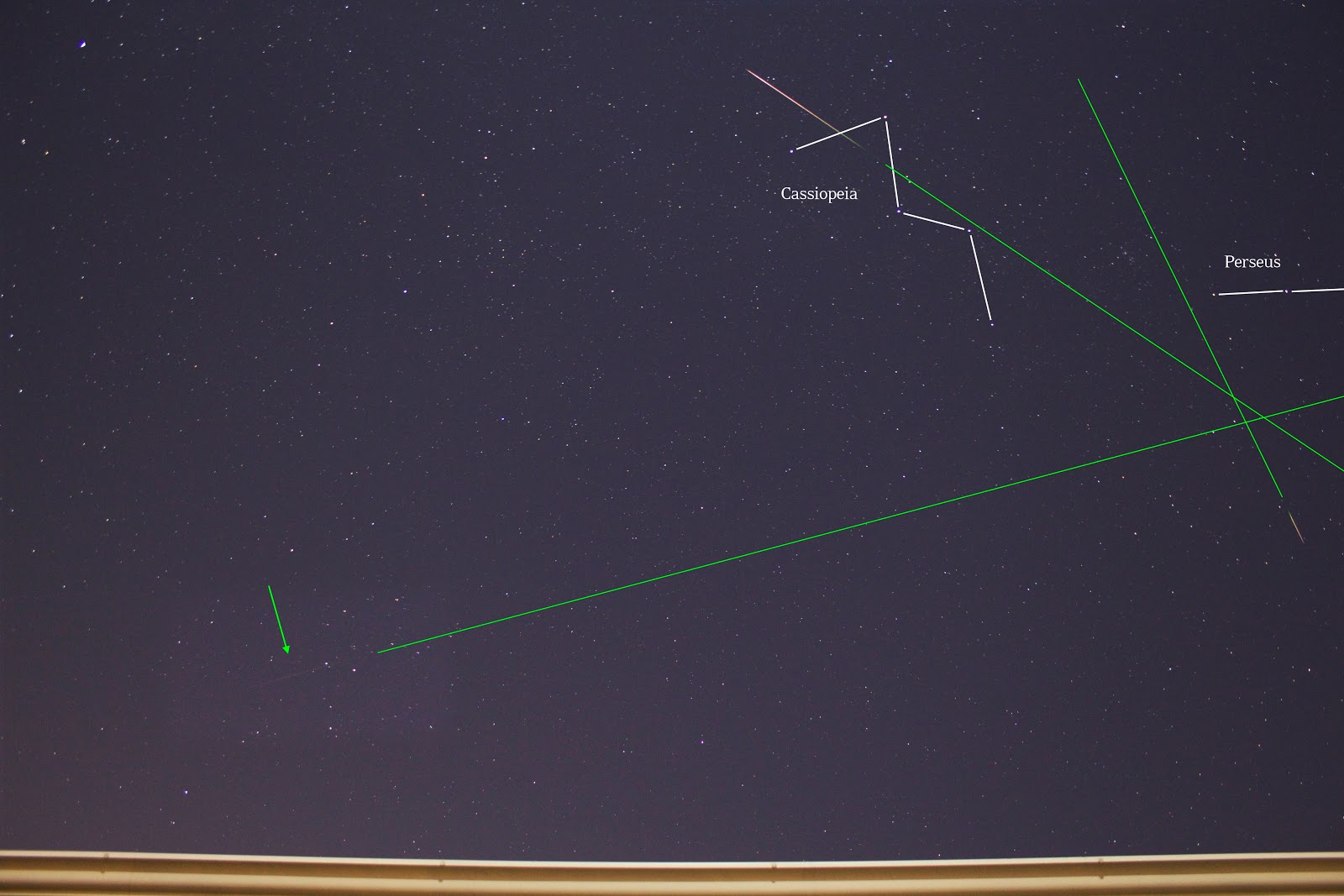
identify perseid meteor candidate
3 frames aligned, T5i, ISO 800, 18mm, f/4, 15 sec, contrast in Photoshop

Here's the candidate overlayed onto the confirmed meteor photo. Notice how the paths of the two bright meteors meet right where we expected the radiant to be. This candidate appears to be originating from the same point - so it's very possible that this is also a faint Perseid.
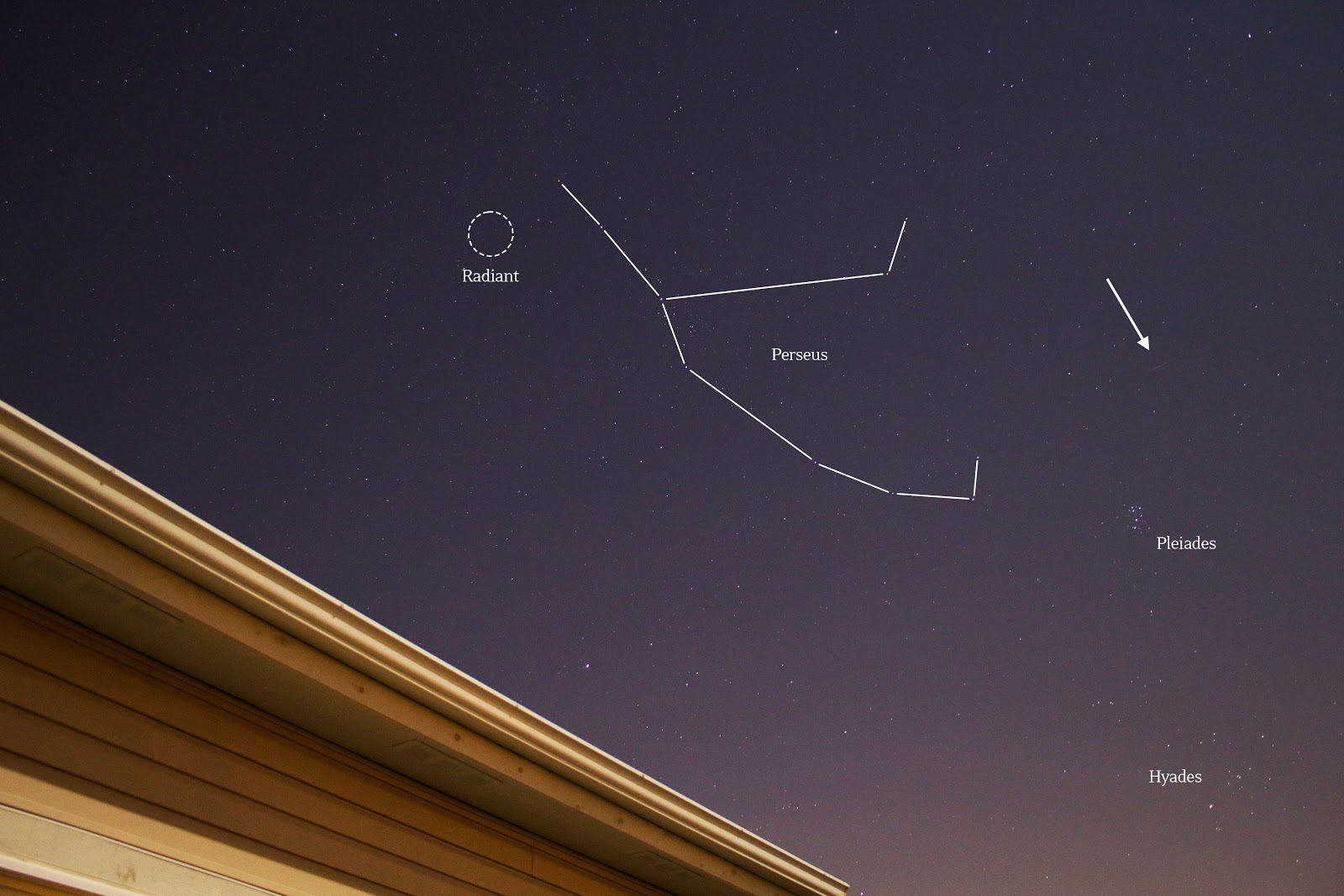
identify perseid meteor candidate
Single frame with T5i, ISO 800, 18mm, f/4, 15 sec, contrast in Photoshop

Now what about this little guy? A faint streak in the sky with no trails in the frames before or after. Sounds like a meteor - but is it a Perseid? It is certainly in Perseus, but the angle of the origin is a little off. It should look like it's flying out of the radiant point, but instead it looks more like it's cutting across Perseus. I'm not sure sure about this one - It's in the right general orientation but not quite.

Monday, September 2, 2013

Homemade Star Charts: Andromeda, Perseus, and Cassiopeia

I really enjoy making star charts from my own photos. It helps me learn the constellations, their position relative to each other, and a little about their features. As I look up each constellation (usually in Wikipedia or Stellarium), I find which stars are the brightest, which have names, and a little about interesting deep sky objects or double stars nearby.

Andromeda constellation
Single frame at 18mm, f/4.5, ISO 1600, 15 sec

First up, the constellation Andromeda, which was directly overhead late last week. I've seen the constellation drawn with as few as 4 stars and as many as 16. The version I chose to draw was the most complex, and is the one depicted in the IAU/Sky&Telescope chart on the Wikipedia page. The constellation contains Messier object 31, also known as the Great Andromeda Nebula or simply the Andromeda Galaxy. I photographed the Andromeda Galaxy last winter, and I hope to improve on my effort in the near future.

Perseus with labels
Single frame at 18mm, f/4.5, ISO 800, 15 sec

When I see Perseus, I see what looks like a dove or some kind of bird flying to the left. I guess it is supposed to be Perseus carrying the head of Medusa. Algol, the second brightest star in Perseus, is also known as The Demon's Head (how wicked is that!) and represents the eye of Medusa. This is becoming one of my favorite constellations, it's relatively easy to spot as a sweeping arch pointing to Pleiades.

Cassiopeia with labels
8 subs, 5 darks, 10 bias, each at ISO 800, f/5.6, 15 sec, 45mm

Cassiopeia is a very interesting piece of sky. Situated along the Milky Way, it's full of star clusters. Because of this, I gave Cassiopeia the special treatment with a stack of images rather than just a single frame. I'm definitely going to be back at a higher power to check out some detail in a few of these objects. I'm also realizing that there are a bunch of NGC objects available to me through my little camera that I've been counting out. I've been focusing on Messier objects, but these NGC's (especially the double cluster) deserve some more attention.

Sunday, April 14, 2013

Comet PanSTARRS buzzes the Andromeda Galaxy

Last month I posted my plan to photograph C/2011 L4 (PanSTARRS) as it approached the Andromeda Galaxy (M31). I was successful, but never got around to blogging about it, so here goes! On April 2, 2013 I went to Slippery Elm Trail at dusk to wait until the comet and galaxy were visible low in the NW sky.

I had all but given up on Andromeda for the season, because the view to the west from my apartment is blocked below 40ยบ or so. This far into Spring, Andromeda is well behind the building by sunset, and so low in the sky by the time it gets dark that taking detailed deep sky images with my camera probably wouldn't yield anything beyond a fuzzy blob. However, paired with a comet, a fuzzy blob would be a welcome target!

andromeda and panstarrs
180 subs, 30 dark, 30 bias; subs at 1.6 sec, ISO 1600, f/5.0, 190mm

I used bright stars in Cassiopeia and Andromeda to star hop to the approximate location. Once I knew I was in the area, I used the same technique from the last time I spotted Andromeda or PanSTARRS - and that is to take 10 second exposures and see what blobs appear. Then, once you have the images framed well, take exposures more appropriate for stacking (in my case, 1.6 sec at 190mm).

andromeda and panstarrs
One of my "finder frames" to help me zero in on my targets, 10 sec, ISO 1600, 190mm

Here is a wide field shot to show just how low M31 ended up at the end of my night. With all the atmospheric distortion and light pollution, it's a wonder I was able to see the darn thing!

interesting night sky objects
Background image is a single exposure at ISO 1600, 13 sec, 18mm