Showing posts with label Jupiter. Show all posts

Sunday, December 20, 2020

The Great Conjunction, Saturn and Jupiter with Visible Moons at 300mm

I didn't have high hopes to get a glimpse of the great conjunction of Saturn and Jupiter this month. I've gotten my hopes up too many times and gotten burned by Indiana weather in December. Like my husband says, better to be pessimistic and pleasantly surprised if it works out. When I saw the clouds clearing up a bit this evening around sunset, I dusted off my camera and tripod. 

The conjunction wasn't visible at first, so I used a great iPhone app one-two punch to find what I was looking for. First I opened Star Walk and found Saturn, then clicked for more information to get the exact altitude (degrees above the horizon) and azimuth (horizontal degrees clockwise from true north). So this gave me the numbers for where Saturn should appear.

Next, I use one of my absolute favorite apps called Theodolite that uses the camera with on-screen display that shows altitude, azimuth, lets you take screen shots, and a whole bunch of other things. It feels like a professional grade surveyor app. So knowing Saturn should be about 15° above the horizon and 222° SW it was a snap finding where I should be pointing to make sure I had a clear view over the tree line. 

Once the sky got a little darker it was obvious because Jupiter and Saturn are so bright, but I think the planning helped me decide if I should even bother setting up in the backyard or if my view would be completely blocked. 

I was pleased I could get some trees in the foreground rather than just the conjunction against a wash background. Here's what I got...

jupiter and saturn conjunction 300mm december 20
Jupiter and Saturn taken with DSLR on fixed tripod, 300mm, f/5.6, ISO 800, 0.3 sec

december 20 2020 jupiter saturn 300mm photo
Same photo as above with labels added

jupiter saturn conjunction december 20 2020 with moons label


theodolite app screen shot jupiter saturn conjunction
Screen shot of Theodolite app tagging the Alt/Az of the conjunction and timestamp

I learned from the my comet Neowise photo that if I tweet at Sean Ash he'll sometimes feature astronomical photos on the WHTR Indianapolis channel 13 evening news, and sure enough he asked if he could feature the photo that same night. I'm famous! 

Saturday, October 10, 2015

October 9, 2015 Conjunction: Moon, Mars, Venus, Jupiter

Chris texted me to go outside and look at the moon and a bunch of stars. When I got out there I noticed a conjunction between the crescent moon, Venus and Jupiter, and I didn't notice until I looked it up in my StarWalk app that Mars was in the mix as well!

The 3 planets show up well in photos, and the white/blue star Regulus is a nice addition as well. I had some thin clouds obstructing my view, but that made for an interesting glowing orb effect in the longer exposures. Venus looks like a smaller second moon glowing in the morning sky!

october 9 2015 conjunction
Cropped single shot from Canon T5i - f/5.6, 6 sec, ISO 800, 34mm

moon and planets over houses
Single shot Canon T5i, f/5.6, 6 sec, ISO 800, 34mm

moon mars venus jupiter conjunction
Single shot Canon T5i, f/5.6, ISO 400, 55mm, 1.3 sec

Tuesday, March 10, 2015

Observing in Slightly Warmer Weather

This Saturday, March 7, I set up the telescope and camera for some slightly warmer weather observing, and to show Chris' uncle, mom, and nephew some views of the moon and Jupiter. The moon was low on the horizon, so the detail wasn't all that impressive, and the moons of Jupiter were obviously just little dots. But still!

We were talking about looking through the telescope on the way home from dinner, and I was keeping an eye on the moonrise time. I knew it would be rising any minute, but Chris' uncle told me he saw it peaking up over the horizon on his drive in. He said at first he thought it was a water tower or something before realizing it was a big orange moon.

I looked outside and sure enough it was just rising behind the houses down the row. I ran to get my camera and tried to set up as fast as I could. I was still on Av mode (aperture priority) and not full manual, but I snapped a few anyway and adjusted as I went. The accidental long exposures actually turned out kinda cool with the over exposed moon looking like a rising sun.

moon that looks like sunrise
Moonrise, single frame, Canon T5i, f/10, ISO 800, 10 sec, 300mm
In the above picture, normally at 300mm for 10 sec you'd see a huge trail but since the moon was still behind the house I guess it still looks pretty round if not a little football shaped I guess.

orange moon rising over house
Single frame, Canon T5i, f/6.3, 1/30 sec, ISO 100, 300mm
orange moon 1/15 sec
Single frame, Canon T5i, f/6.3, 1/15 sec, ISO 100, 300mm
moon iso 100
A little later with the moon higher in the sky, single frame, Canon T5i, f/6.3, 1/250 sec, ISO 100, 300mm
jupiter 150x
Jupiter single frame with iPhone 6 through 6mm eyepiece and Meade 285 refractor (150x), f/2.2, 1/15 sec, ISO 32, 4mm

Visually, I could see 2 orange bands on Jupiter through the 6mm eyepiece, but in the photo I just got a fuzzy ball. This was my first time using the Carson Universal adapter on my telescope. It was easier than trying to hold it in place, and easier than using a medicine bottle, but it wasn't a walk in the park completely. The iPhone 6 is large, and while it definitely held it onto the eyepiece, attaching it bumped my telescope (more my telescope's fault than the adapter). I need to tighten up the mount or get a tracking mount or something. Jupiter is very high in the sky lately, so I hope to try again with some appropriately exposed video to see what I can get.

telescope and camera on porch
I can see the porch again!

Thursday, August 21, 2014

Close Conjunction of Venus and Jupiter, August 18, 2014

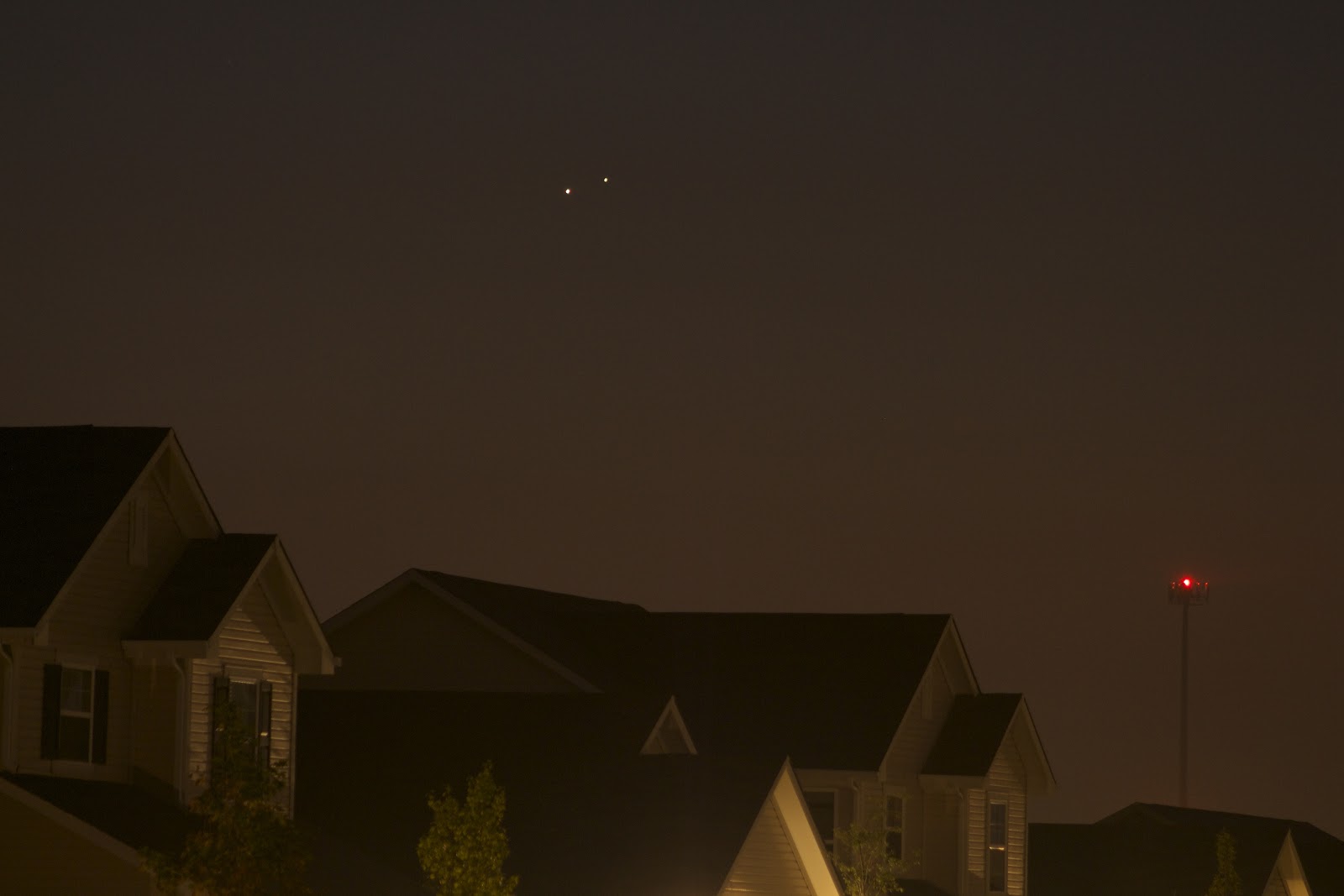
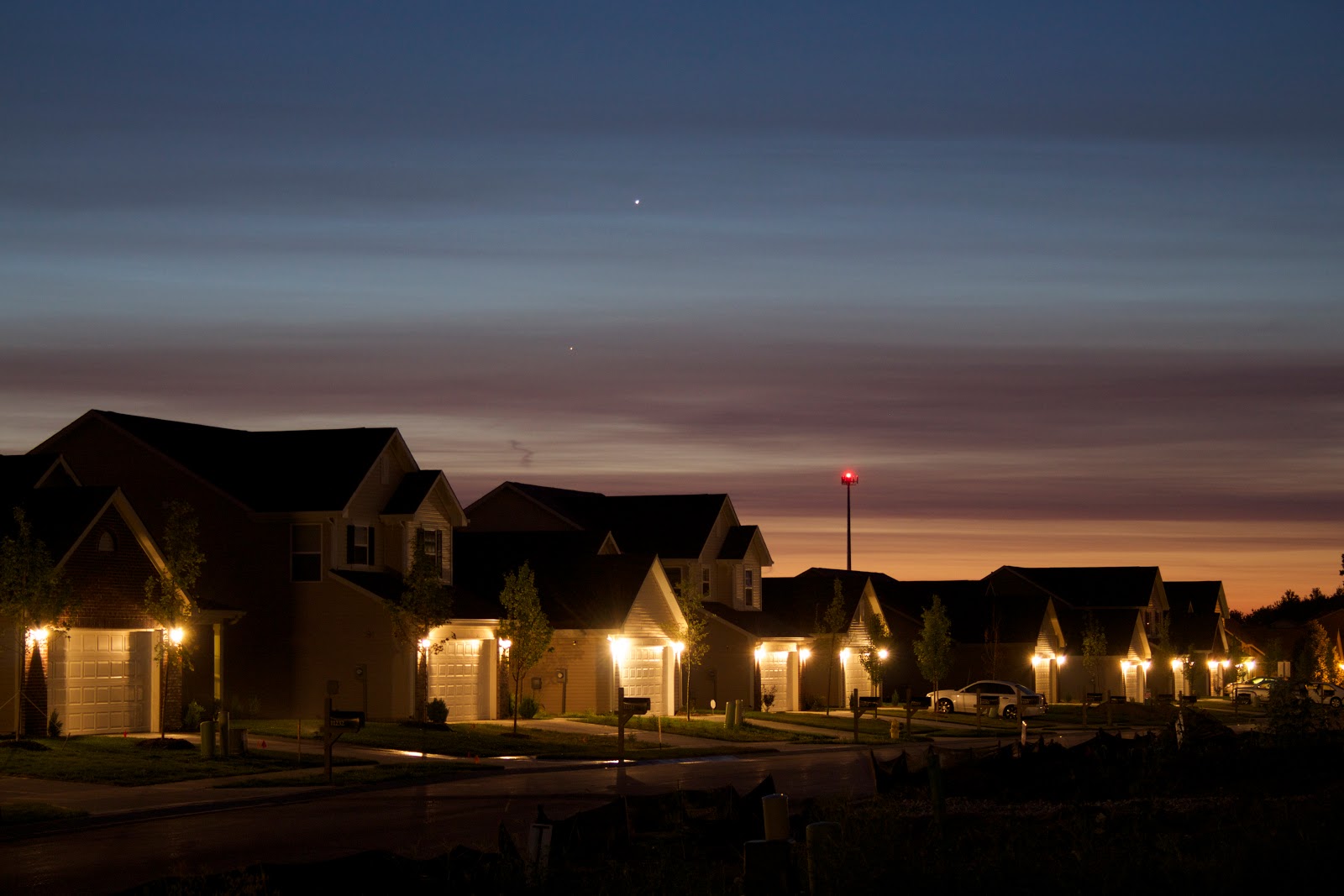
I've been waking up earlier for work with my longer commute from Noblesville, this made it easy to spot the progression of Venus and Jupiter in the sky at 6:08am. On August 16 I saw bright Venus to the upper right of fainter Jupiter, and on August 18 they had switched positions with Jupiter slightly to the right of Venus. It was rather hazy, and I'm glad I saw the pair at all in the yellow pre-dawn glow.

venus and jupiter august 18 conjunction
Single exposure, T5i, f/4.5, 1.6 sec, ISO 400, 135mm

From our perspective, the two were less than 1/2° apart (17 arcminutes according to Stellarium, but at those distances who knows how precise that is). I believe it's the closest conjunction I've seen. Another good one was the Mercury/Mars conjunction in February 2013 that was 22 arcminutes according to Stellarium.

venus and jupiter august 18 conjunction
Single exposure, T5i, f/5.6, 0.8 sec, ISO 1600, 300mm

venus and jupiter august 18 conjunction
Single exposure, T5i, f/4.5, 1.6 sec, ISO 400, 135mm

jupiter venus conjunction august 2014
Single exposure, T5i, f/5.6, 3.2 sec, ISO 400, 55mm

I didn't realize it at the time, but upon closer inspection you can actually make out 3 of Jupiter's moons in my image at 300mm. With the moons to show a little scale, you can tell just how close together the two bodies appear to be! If you read the labels backwards you get a photo of "Jupiter Moons Venus"...

jupiter moons venus

Saturday, August 16, 2014

Venus and Jupiter Morning Conjunction, August 2014

Venus and Jupiter are moving toward each other (from our perspective) and will be very close 45 minutes before sunrise on August 18, 2014 (less than 1/2˚ separation). The pair will rise to the East, so if you want to look for them, find a location with an unobstructed view of the horizon.

We are supposed to have clouds the next few days, but here is Venus (brighter) and Jupiter on August 15 at 6:09am.

venus and jupiter conjunction in the morning
Single exposure, T5i, ISO 400, 55mm, f/5.6, 3.2 sec
Update: I was able to catch the super close conjunction of Venus and Jupiter a few days later on August 18.

Saturday, April 19, 2014

Jupiter at Prime Focus with Canon T5i on Meade 285

I wish I could show you what I saw with my eye (said every photographer ever). I observed Jupiter through my Meade 285 refractor (60mm, 2.4") last night. I was able to visually make out two red stripes on the face of a pale yellow orange dot. At something like 35 arcseconds in diameter, this might not be the ideal time to observe Jupiter - but it's still larger than Mars at only 15 arcseconds in diameter.

Because my camera takes 1080p video, the single frames are actually much higher resolution. I was able to see a faint dark cloud band in a single frame (not as good as with my eye through the eyepiece). My 6mm eyepiece focuses the light further away from the eyepiece, which is great for people who wear glasses so they don't have to press their glasses up against the eyepiece. However, this makes it harder to hold an iPhone over the eyepiece because you have to hover in mid-air rather than resting the phone on the eyepiece.

DSLR attached to refractor telescope
Canon T5i attached to my small telescope with T-ring and .965" to T-thread adapter

DSLR attached to telescope
Looking at Jupiter down the barrel

Jupiter single frame
Single frame (not stacked from video), one dark cloud band visible

astronomy fuzzy blob
Stacked from 1080p video at prime focus (just a blob)

Jupiter and moons from DSLR
Single frame at ISO 6400 compared to Stellarium screenshot

Saturday, January 25, 2014

Hyades Cluster in Taurus with Major Star Labels

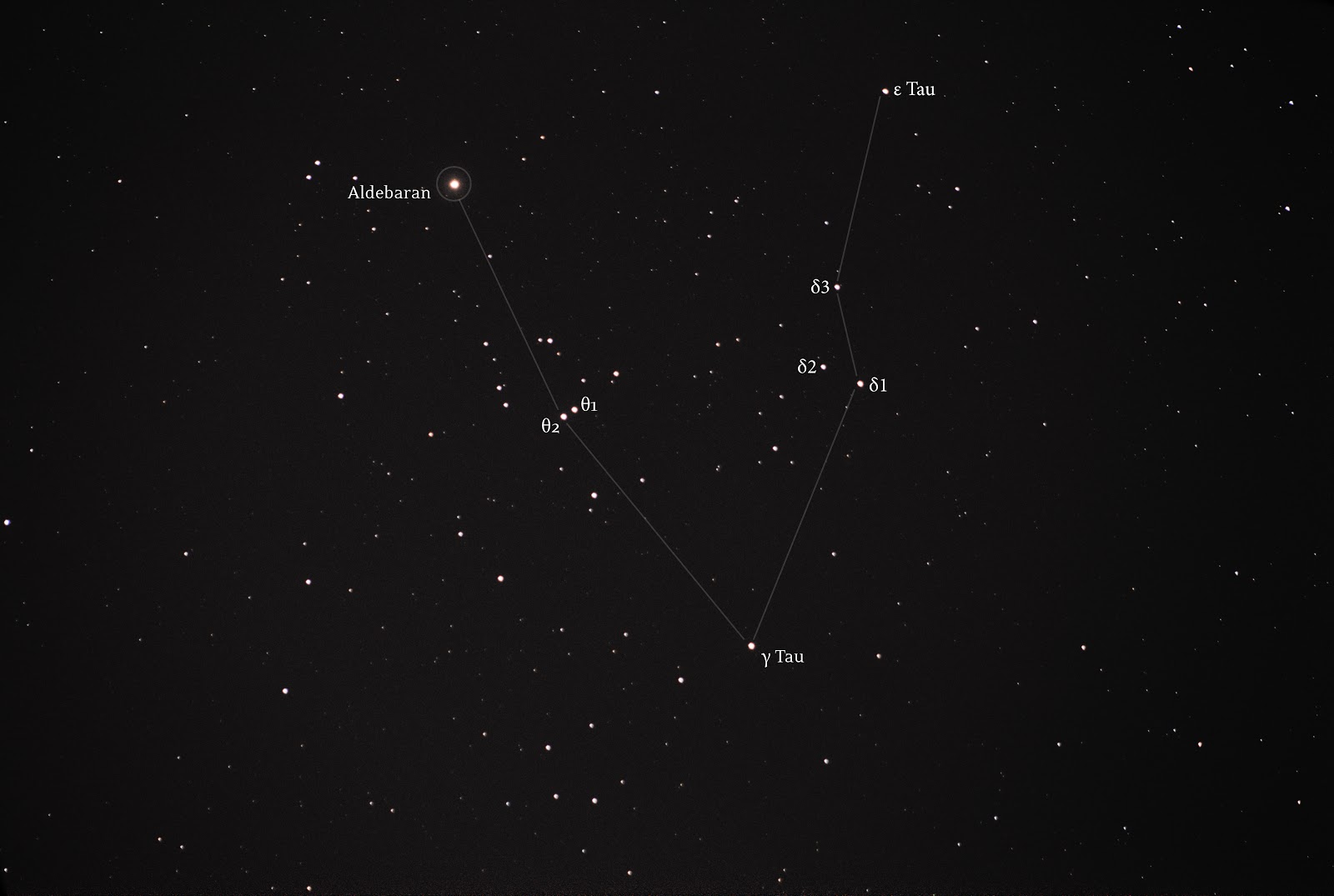
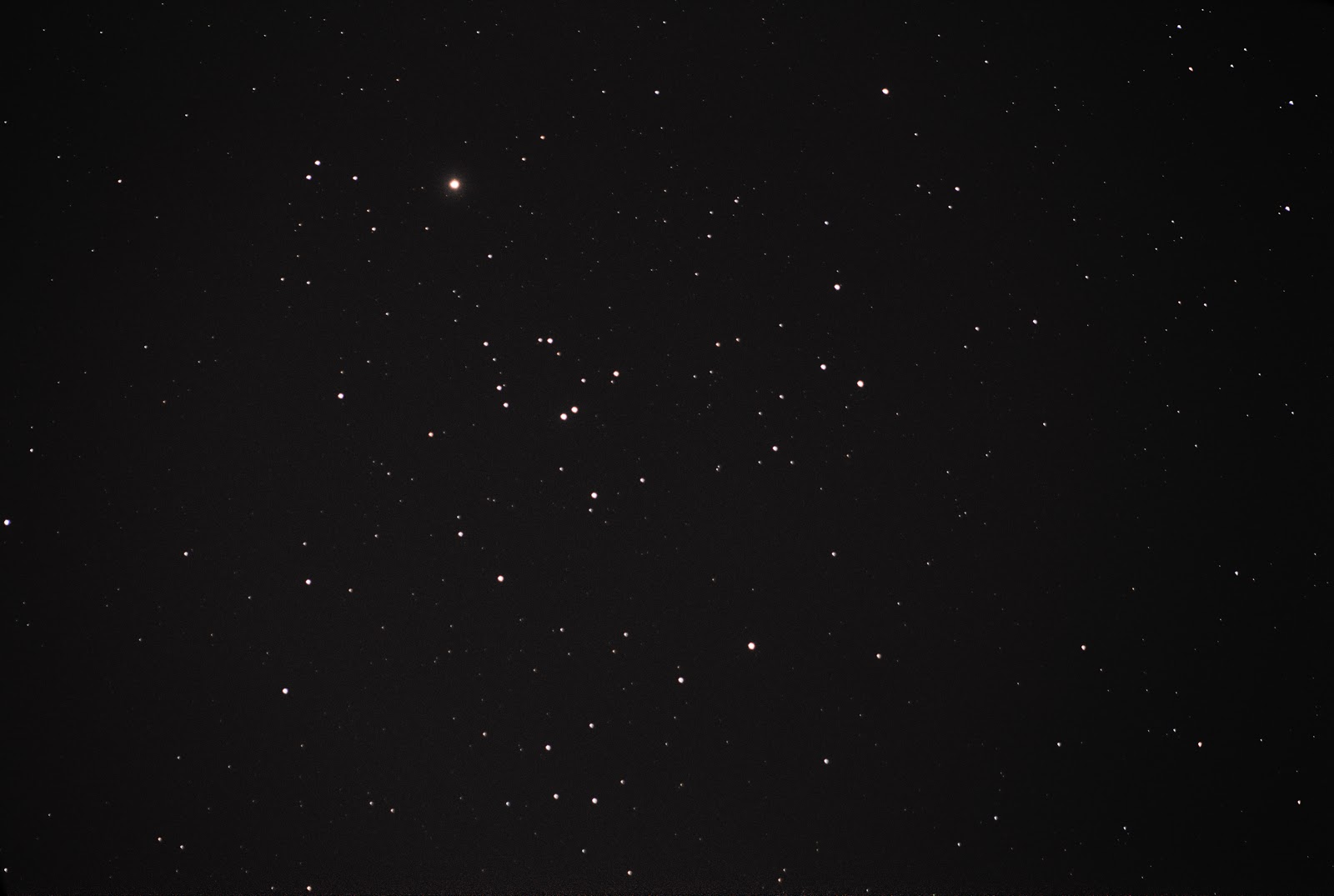
Another recognizable object that I've photographed before is on the IAS observing list for January. I'm happy to revisit the Hyades star cluster with my new camera! I took a series of short exposures and stacked the images in Deep Sky Stacker. Typically this brings out more stars which is great, but makes the original asterism less apparent - so I've included some labels and made a little star chart out of my final image.

hyades star cluster asterism with labels
Stack of 69 subs, 22 darks, 28 bias each at ISO 3200, 135mm, f/4.5, 2 sec

hyades star cluster in taurus
Stack of 69 subs, 22 darks, 28 bias each at ISO 3200, 135mm, f/4.5, 2 sec

jupiter and moons on january 21
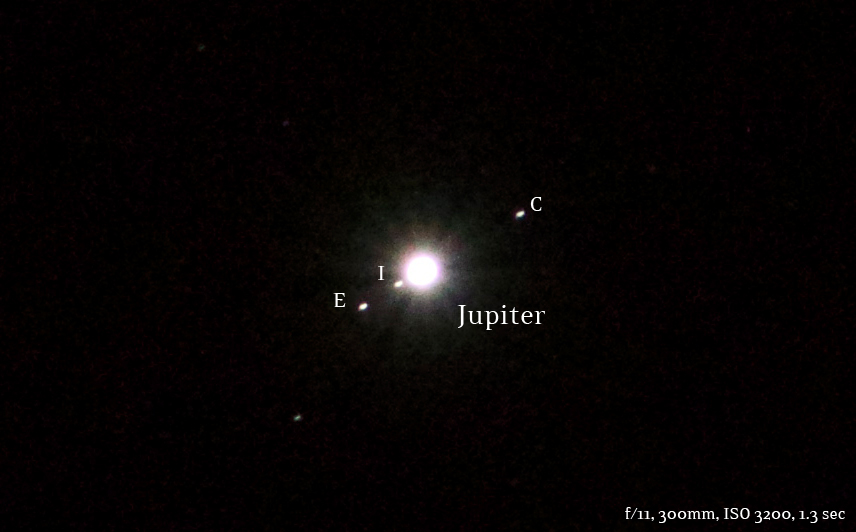
Crop of Jupiter at f/11, 300mm, ISO 3200, 1/3 sec

That same night I also snagged a quick photo of Jupiter with my T5i on a fixed tripod. Still waiting for some warmer weather to take my mount out to play with it. It's going to be a low of -17°F on Monday. This winter is the worst!

Sunday, October 13, 2013

Jupiter at Prime Focus (900mm Meade Refractor)

I pointed my Meade refractor at Jupiter for the first time on Friday night to try to catch a rare triple moon shadow transit. Jupiter was too low to the horizon to see much detail, but I did try observing and imaging it with a combination of eyepieces and my camera at prime focus. It was obviously bigger through my 9mm eyepiece (which is rather dirty), but still nice at prime focus with my DSLR.

Since imaging at prime focus is much easier than trying to hover my iPhone over the eyepiece - and because I have more control over exposure this way - my prime focus images turned out much nicer. I stacked 9 of them with a longer exposure to create this composite of Jupiter with 2 visible moons:

jupiter 900mm
Stack of 9 frames, each at 1/15 sec, ISO 200, at prime focus on Meade 285 (900mm)

I observed some faint brownish red bands on the planet visually, but they didn't come out in the photos even after stacking. Not a bad first attempt - always room for improvement.

Friday, September 27, 2013

Solar System Showcase: My Collection So Far

In the past year and a half, I've photographed every planet in the solar system and then some. I've always wanted to put them all together and see my collection all at once - so here it is! Hopefully as I learn to take photos with my scope, I will be able to improve upon this collection. But for now, this is what I've got.

solar system
Click to enlarge
amateur solar system
Updated 10-8-13 Click to enlarge

Friday, August 30, 2013

Crescent Moon Rises with Jupiter, Weekend Conjunction Coming Soon

I couldn't sleep last night, I think it had something to do with our dog hogging all the pillow space. Either way, it was an excellent excuse to go outside and look at the stars. There was a very thin veil of clouds - not clear enough to try for deep sky objects, but fun to observe the summer constellations.

I also saw some familiar wintery constellations rising low to the East at about 3:56am. The crescent moon was to the top left of Orion, and Jupiter was rising into its next observing season. I also got some photos of Cassiopeia and Perseus that I'll post later.

Crescent Moon Rises with Jupiter
Single frame, ISO 200, 5 sec, f/4.5, 35mm
Mars was still below the horizon. Looking ahead a few days, the crescent Moon will join Jupiter and Mars in conjunction during the early morning hours on August 31 and September 1, 2013. Next to Mars, Comet ISON is still too faint for my camera (around Mag 12.8). Check out Comet ISON Daily Pictures for recent photos. The comet will make it's closest approach to Mars on October 1.

September 1 moon jupiter mars conjunction
Screenshot from StarWalk, conjunction early morning September 1, 2013

Sunday, July 28, 2013

Conjunction of Jupiter, Mars, and Mercury on July 28, 2013

I went outside to check to see if the conjunction was visible, and I was able to spot all 3 planets rising above the apartment complex. I went back inside to get my camera, and when I came out the light was a little less optimal (too bright), but I was able to capture all 3 planets in the frame. I adjusted the contrast a bit in Photoshop to compensate for the brighter sky.

Morning conjunction 30 min before sunrise

Sunday, May 12, 2013

Jupiter and the Crescent Moon over BGSU Rec Center Pond


Play in 1080p 

It's 41º F out right now in Bowling Green, OH. What gives!? I was freezing sitting out by the Rec Center pond for 45 minutes recording a time lapse of the sunset and crescent moon. Here are some photos of my evening...

iphone on tripod over pond
I set my iPhone up on a tripod to record a time lapse of the sunset and crescent moon

jupiter and moon conjunction
Typical Moon-Jupiter conjunction photo
140mm, 1/125 sec, f/5.0, ISO 400

jupiter and moon conjunction
The crescent moon and Jupiter a little closer to the horizon
39mm, 0.5 sec, f/5.0, ISO 100

jupiter and moon conjunction
I like how the water looks in this one!
18mm, 1.6 sec, f/4.5, ISO 100

jupiter and moon conjunction
A nice shot of the Moon-Jupiter conjunction over the pond
30mm, 1.6 sec, f/4.5, ISO 100

Sunday, April 14, 2013

Crescent moon with Jupiter tonight, April 14, 2013

It was cloudy all day here in Bowling Green, Ohio. At dusk, I saw the clouds break a bit, but a thin layer of haze remained into the night. Photographed from my apartment complex courtyard at 10:00pm ET, the crescent moon created a ghostly smile through the clouds. In this single exposure, Jupiter is a small point to the lower right.

moon and jupiter april 14, 2013
Single exposure at ISO 100, 210mm, 1/2 sec, f/5.0

I also made a stack of the crescent moon to round out my stacked lunar phases collection. Before, I only had a single exposure of this phase of the moon. Now I should have enough for a composite picture of the main phases: crescent, quarter, gibbous, full, gibbous, quarter, crescent, new.

I also have to say, I'm super impressed with the Registax software! I took these 38 subs through a haze of thin clouds, and after stacking you would think the sky was completely clear tonight!! Impressive!

20% crescent moon
38 subs at ISO 100, 1/100 sec, 300mm, f/5.6

Monday, March 4, 2013

Asteroid hunting: Ceres and Vesta

If someone had told me a year ago that I'd be able to see asteroids from my apartment building with an 8 megapixel camera, I would have said "you're crazy!" Currently at magnitude 7.54 and 7.25 respectively, Ceres and Vesta were my best chances for bagging some big rocks near the limit of my camera's (and sky conditions') capacity.

The dwarf planet Ceres is the largest asteroid in the asteroid belt. At nearly 600 miles in diameter, it is the would-be planet that never came to exist thanks to a disruptive gravity tug from Jupiter. Ceres alone comprises nearly 1/3 of the mass of the asteroid belt. 

Vesta, the second largest asteroid, is typically the brightest asteroid. Vesta is over 300 miles in diamater and makes up about 9% of the mass of the asteroid belt. Vesta was recently visited by NASA's Dawn spacecraft. 

Stack of 46 subs, each at 75mm, ISO 1600, f/4.5, 4 sec (cropped)
Stack of 43 subs, each at 75mm, ISO 1600, f/4.5, 4 sec (cropped)
The asteroids are barely visible, but after some tedious work lining up charts in Stellarium and Star Walk, I'm confient that these dots are asteroids and not dim stars. This is also my first sighting of open cluster M35, so I can check that one off my list!

Tuesday, January 22, 2013

Conjunction of the Moon and Jupiter, January 21, 2013

These photos were taken around 7:30pm when the Moon was still approaching Jupiter - so they weren't exactly at their closest point, but the weather was already turning sour so I had to go early. Snow flurries were rushing in from the NW, and I had to wait to get shots between the clouds. We're currently under a wind advisory (20 mph with gusts up to 35 mph), so the 10°F temperature feels like -8°F.

The first image shows the moon and Jupiter over-exposed through thin clouds, taken at 300mm, ISO 200, 1 sec, f/5.6. It was quite an eerie sight!

jupiter moon conjunction single exposure


When the clouds parted, I was able to grab two photos for a clean composite image. The moon was shot at 300mm, ISO 1600, 1/4000 sec, f/5.6; and Jupiter was shot in the same position at 1/200 sec.

jupiter moon composite photo


I also got a wide angle shot at 18mm, ISO 400, 25 sec, f/4.5 which includes a radiant lens flare from the bright moonlight.

wide angle jupiter moon conjunctioniphone weather screenshot


I was out for about 20 minutes total and couldn't feel my fingers as I was packing up my gear and rushing back into my apartment. Less than ideal conditions, but at least I got a couple cool shots. I couldn't let this event pass me by - I knew I'd be jealous of everyone's pics on Instagram!

Sunday, January 6, 2013

The Hyades Cluster, Jupiter, and the Pleiades

I took these photos on January 3, 2013 at 12:20am (just now getting around to posting). If the beautiful conjunction of Jupiter with two prominent asterisms (Hyades and the Pleiades) weren't enough, I wanted to look up some more information on the Hyades star cluster for my own benefit.

I'm also working on improving my manual noise-reduction technique by stacking. The image below was made with a simple stack of 2 exposures to reduce some of the random noise at high ISO. I also did some color adjustments in Photoshop - for some reason my high ISO exposures come out with a hazy red tint to them. I'm not sure if there is something up with the camera (it's pretty old) or the lights in the parking lot (they naturally have an orange tint to them).

Hyades Jupiter and Pleiades
Two stacked images at f/4.5, ISO 1600, 10 sec, 75mm focal length
According to Wikipedia, the Hyades Cluster includes the 4 brightest stars in the "V" shaped head of Taurus. These stars, designated Gamma, Delta, Theta, and Epsilon Tauri, are all very close together (only a few light years apart). Aldebaran, however, is much closer to Earth - although it appears to line up with the other stars in the "V" shaped asterism.

The Hyades Cluster
Same image as above, but with labels!

Jupiter has been passing over the Hyades since the summer (although not always visible in the Northern Hemisphere) and will hover in the area before leaving again this early Spring. Looking at the Star Walk app, it looks like Jupiter is in the middle of one of it's backwards loops in the sky (an illusion based on our perspective as we overtake Jupiter in our orbit around the Sun). Jupiter will dip between the Hyades and the Pleiades, and begin turning around by the first part of February - leaving the Hyades in its dust by April.

Tuesday, December 4, 2012

Jupiter and the Moon, super bright conjunction 11-28-2012

According to Astro Bob, Jupiter is at opposition making it the biggest and brightest it will be for the year. I've been watching Jupiter rise in the evening while taking my puppy out to pee, and it's been fun watching Jupiter slowly pull away from the moon each night.

I tried my hand at capturing a close up of the Jupiter-Moon conjunction, but the moon was so darn bright, the best I was able to managed looked like a big white dot next to a little white dot.

To solve this, I did my first bit of astrophotography hocus pocus (e.g. Photoshop) to take back to back exposures of the pair at two different settings so that each could be appropriately exposed. Then in Photoshop I lined them up to the exact position and cropped the best of each into the same photo.

Here is the finished product:

Photoshop composite moon jupiter conjunction
Photoshop composite of multiple exposures

I tried to get Jupiter's moons in the photo as well, but the nearly full moon blew my chances. The bright halo of light makes the photo pretty cool in its own interesting way, but ruined my ability to crop out the black background for a composite. Zoomify the picture to see the tiny moons caught in the bright moonlight.

Single exposure jupiter moon conjunction
Single exposure showing Jupiter's moons